

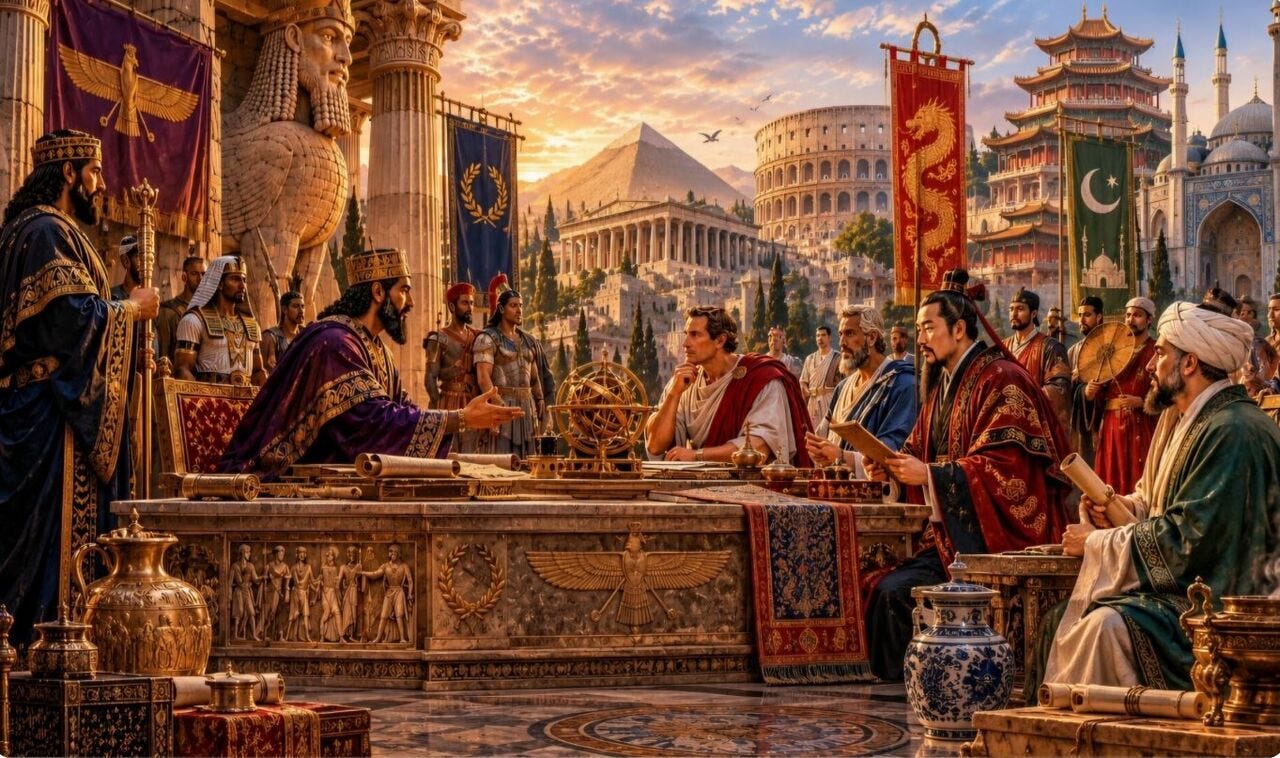
As the wreckage of Gaza and two rounds of aggression against Iran during active diplomacy expose the bankruptcy of the so-called rules-based order, former Iranian Foreign Minister Mohammad Javad Zarif has issued a civilisational challenge to the doctrine of might-makes-right now dominating Western capitals.
In an article co-authored with Ali Nasri, deputy head of the Paiab (Possibilities Architects: Inspiring Ascending Beyond) think tank and published on its website this month, Zarif proposes what he calls the “diplomacy of civilisations”: a demand that every civilisation recover its own deepest teachings on the limits of power — and then submit to them.
The verdict every civilisation reached
The article opens not in Tehran or Washington, but in Babylon, 539 BC. Cyrus the Great took the city and left its gods untouched. His clay cylinder, now held in the British Museum, records the return of sacred images to their shrines and the release of deported peoples. A Hebrew prophet called him God’s anointed; the Athenian Xenophon made him the model of rule through justice. Centuries later, India’s Emperor Ashoka, remorseful after the slaughter at Kalinga, carved restraint and respect for other faiths into stone.
The authors’ point is striking: Babylonians, Hebrews, Greeks and Indians shared no gods and no loyalties — yet when they honoured a ruler, they praised the same quality. Restrained power.
The Quran itself counts the diversity of languages and colours among the signs of Divine Providence, and declares that humanity was made into peoples and tribes so that they might come to know one another. Civilisations differ in creed and custom, Zarif and Nasri write, but draw from one conscience: dignity deserves respect, justice matters, and the strong owe something to the weak.
The doctrine of no limits
Against this inheritance stands a rival doctrine spreading through Western capitals — given its fullest expression, the article notes, in an address this month at the Pnyx in Athens, within sight of the Acropolis. It makes three claims: that Western decline stems from shame over the past; that greatness lies in refusing limits; and that honour and heroism belong to some peoples and not others.
The authors dismantle each. A call to abandon apology merely describes how Western power already operates — and “a power that apologises for nothing learns nothing.” The doctrine’s celebration of the Greek thumos betrays its own source: Plato made spirit the ally of reason and warned that, ungoverned, it becomes a hunger for domination calling itself honour. The doctrine’s lineage of heroes — Alexander, Caesar, Charlemagne, Cortés — is a line of conquerors. Xerxes burned the Acropolis; Alexander burned Persepolis in revenge. One fire licensed the next.
And the claim that honour belongs to select peoples collapses before every major tradition: Iran’s pahlevan and fotowwat — honour as mastery over the self — Europe’s chivalry, Japan’s bushido, the Arabs’ muruwwa, the Slavic bogatyr, China’s xia. No people possess these ideals; all are judged by them.
A record written in blood
Where the doctrine has been practised, the authors write, the record is concrete. Iran was attacked twice in under a year while negotiating — in June 2025, two days before a scheduled round of talks, and in February 2026, two days after the mediator reported significant progress. Self-defence answers an armed attack; it does not license bombing diplomacy into silence.
Gaza has been devastated amid open proposals to seize its land and expel its people, even as the International Court of Justice affirmed Palestinian self-determination. ICC judges and a UN expert have been sanctioned for doing their jobs. Venezuela’s president was seized, its oil spoken of as another country’s prize.
Language prepares these acts. Netanyahu’s invocation of Amalek — the biblical enemy marked for annihilation — was placed before the ICJ by South Africa as evidence of genocidal intent. It rests on the doctrine’s core premise: that some peoples stand outside the circle of those to whom power must answer. Scripture points the other way — the Torah commands love of the stranger, and the Qur’an teaches that killing one innocent soul is as killing all humanity.
The same premise was turned on an entire civilisation when the American president, on April 1, threatened to bomb Iran “back to the Stone Ages, where they belong,” including its power plants. The authors answer with history: cities rose in Iran three thousand years before the Parthenon. A quarrel between governments can end in settlement. A war declared against a civilisation has no endpoint short of its disappearance.
The measure of Ali
Here the article reaches its Shia core. Among the traditions the modern order never consulted, the authors place the instruction of Imam Ali ibn Abi Talib (AS) to his governor: every subject is either your brother in faith or your equal in creation. Alongside it stand the Persian mirrors for princes, Mencius’s ruler who forfeits legitimacy by abandoning benevolence, Cicero’s power held in trust, and the just war tradition from Augustine to Aquinas.
Law constrains from outside, the authors argue; it depends on a disposition inside those who hold power — governance by virtue. Before force is used: Is it proportionate? Can it be justified to those it affects? Would one accept it from a rival?
Three steps, one standard
The proposal proceeds in three stages: look within, as scholars publish their traditions’ teachings on power; share and compare, in joint working groups drafting shared principles on the use of force; and apply and be judged — governments measured against their own heritage’s standard, a judgment harder to dismiss than one imposed from outside.
Iran, the article declares, accepts the pahlevan’s standard for its own conduct and invites measurement against it — friends and rivals alike, one’s own side first.
The institutions exist: at Iran’s initiative, the UN designated 2001 the Year of Dialogue among Civilisations, and the Alliance of Civilisations has stood since 2005. Those efforts gave civilisations a voice. This one gives them a task.
Cyrus’s cylinder outlived his empire. What it preserves is the judgment every civilisation has reached: power earns legitimacy not by its possession, but by the responsibility with which it is exercised.
Reference: IRNA