

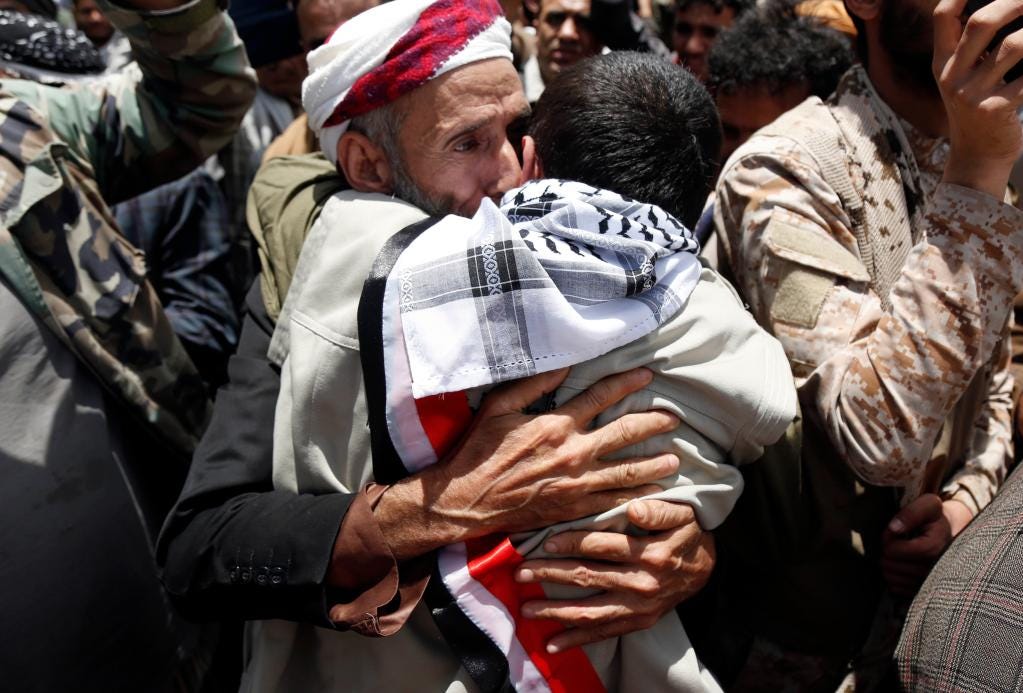
Yemen, PUREWILAYAH.COM - A new opening has emerged today in the long-stalled humanitarian file, with the signing of an agreement providing for the release of 1,700 prisoners from the Yemeni army and Popular Committees in exchange for 1,200 prisoners from the opposing side, including 7 Saudis and 23 Sudanese.
The head of the national delegation, Mohammed Abdulsalam, welcomed this step, extending his gratitude to the Sultanate of Oman for its major role and sustained efforts in ensuring the success of this negotiation round.
Meanwhile, the head of the Yemen’s National Committee for Prisoners’ Affairs, Abdul Qader al-Murtadha, revealed key aspects of the deal, confirming that full details will be announced at a later stage.
UN Envoy: Agreement After 11 Days of Negotiations
In a statement issued by the office of the UN Secretary-General’s Special Envoy to Yemen, it was confirmed that negotiations lasted 11 days in Oman, culminating in an agreement on a new phase of prisoner releases involving all parties.
The statement described the agreement as an important and positive step, capable of alleviating the suffering of detainees and their families across Republic of Yemen, while calling for intensified efforts to build on this progress toward additional releases.
Oman Praises the “Positive Spirit” of the Talks
For its part, the Sultanate of Oman welcomed what it described as the positive spirit that prevailed during the negotiations throughout December 2025, stressing that this atmosphere played a decisive role in reaching this significant humanitarian agreement, which is hoped to create suitable conditions for addressing the remaining issues related to Yemen’s situation.
A Stalled Humanitarian File
The last UN-supervised prisoner exchange took place in April 2023, one year after a truce agreement was signed. Since then, all efforts to revive the humanitarian file have failed, largely due to American pressure on Saudi Arabia, particularly after Yemen’s strong support for Gaza during the “Al-Aqsa Flood” battle.
Since 2022, the Saudi-Emirati aggression, backed by the United States, has halted airstrikes on Yemen, in exchange for Yemen suspending strikes on Saudi Arabia and the UAE.
This arrangement was meant to pave the way for addressing humanitarian obligations first, before entering political negotiations. However, no real progress followed.
Airports—especially Sana’a International Airport—remain closed, restrictions on goods entering Hodeidah Port persist, and all previous attempts to secure prisoner releases collapsed.
Sana’a’s Conditions Remain Firm
Over recent years, Sana’a has repeatedly warned Saudi Arabia against indefinitely maintaining a state of “no war, no peace,” stressing that failure to resolve the humanitarian file could return the situation to square one—back to war.
In addition to the prisoner exchange, Sana’a insists on:
Payment of compensations
Payment of public sector salaries
Reopening of airports and crossings
Withdrawal of foreign forces from Yemen
These demands are described as non-negotiable foundations for any future settlement.
A Test of Intentions, Not Yet a Breakthrough
Once again, this deal appears promising, signaling potential engagement on other unresolved files and offering an initial positive indication that Saudi Arabia may be shifting toward peace rather than escalation.
However, the agreement represents a test of intentions rather than a comprehensive breakthrough. If followed by concrete steps on salaries, airport reopening, and easing the entry of goods, it could lay the groundwork for a broader de-escalation.
If treated merely as an isolated move, the risk of backsliding remains high, carrying with it the real danger of renewed escalation—something Sana’a has consistently warned against and seeks to avoid. (PW)