

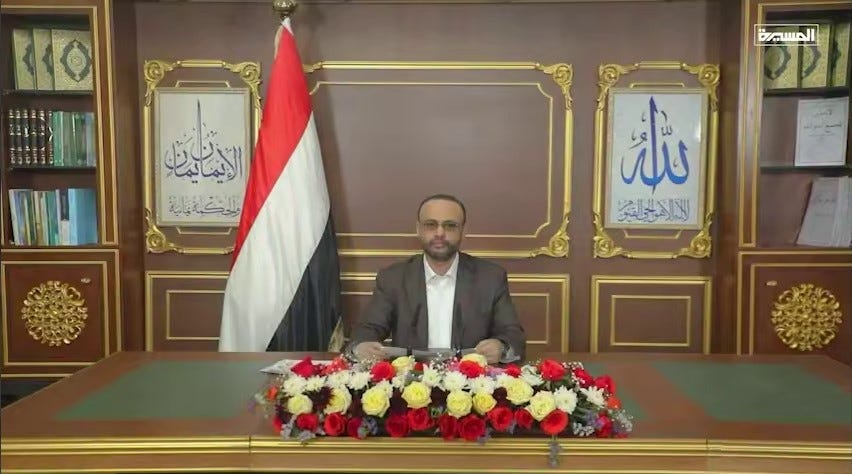
Yemen, PUREWILAYAH.COM — President of Yemen’s Supreme Political Council, Field Marshal Mahdi Mohammed al-Mashat, delivered a wide-ranging speech on Wednesday marking the 36th anniversary of Yemeni unity, reaffirming Yemen’s support for Iran, Palestine, and Lebanon while warning coalition states and affiliated militias against any attempt to undermine the unity of Yemen.
In the speech, al-Mashat declared that Yemen would continue its struggle until the liberation of “the last inch” of the republic’s territory and affirmed the country’s full readiness to confront any future American or Zionist aggression.
The Yemeni leader addressed domestic, regional, and international developments, presenting Yemeni unity as both a national necessity and part of a broader confrontation against what he described as the Zionist-American project in West Asia.
Yemen Reaffirms Full Solidarity With Iran
Al-Mashat renewed Yemen’s “full solidarity” with the Islamic Republic of Iran, stressing Tehran’s right to defend itself against aggression and its right to manage the Strait of Hormuz.
He stated that Iran has the legitimate right to prevent the strategic waterway from being used by hostile forces or in ways that serve Western and Zionist domination.
The Yemeni president said the ongoing U.S.-Israeli aggression against Iran seeks to remove the main obstacle facing the regional ambitions of Washington and Tel Aviv.
“Everyone has realized that the American-Israeli aggression against Iran stems from the idea of removing the greatest obstacle before the Zionist-American project,” he said.
Al-Mashat called on the peoples and governments of the Muslim world to unite against those plans instead of aligning themselves with them.
He further stated that the battlefield developments in Gaza, Yemen, Lebanon, Iraq, and Iran have proven that the Zionist regime, despite its military power, is not invincible.
According to him, years of confrontation have exposed the enemy’s weaknesses and revealed the resilience and endurance of the resistance movements across the region.

Yemen Warns Against Continued Israeli Crimes in Palestine and Lebanon
The Yemeni leader renewed Yemen’s unwavering support for the Palestinian and Lebanese peoples, condemning Israel’s continued attacks, violations of ceasefire agreements, and escalating crimes in Gaza and Lebanon.
He specifically pointed to Israeli violations in Al-Aqsa Mosque and condemned efforts to pass laws targeting Palestinian prisoners.
Al-Mashat urged Arab and Islamic governments to move beyond official statements and take practical steps to halt what he described as Zionist crimes.
He warned that statements alone “neither stop crimes nor heal wounds.”
At the same time, he warned the Israeli regime against continuing its aggression against the Palestinian and Lebanese peoples, emphasizing that Yemen remains firmly aligned with the resistance front.
Yemeni Unity Described as Religious and National Duty
A major portion of the speech focused on Yemeni unity, which al-Mashat portrayed not merely as a political arrangement but as a religious, historical, and civilizational responsibility.
He said the anniversary of Yemeni unity should not be viewed as a simple political event or administrative procedure, but rather as a historic day embodying the Quranic principle of unity and rejection of division.
Quoting Quranic verses on unity and brotherhood, al-Mashat stated that Yemenis achieved unity in response to divine guidance and through their deep sense of shared identity, destiny, and faith.
He stressed that Yemen’s unity reflects the reality of one people sharing the same faith, language, history, and civilization from north to south and east to west.
According to al-Mashat, periods of division in Yemen’s history were abnormal conditions imposed by foreign occupation and colonial interference.
“The fragmentation imposed during dark stages of occupation was merely a strange exception that contradicted geography, the reality of the people, and the spirit of one unified identity,” he said.
Foreign Aggression Aimed at Partitioning Yemen
Al-Mashat said the United States, Saudi Arabia, and allied forces are seeking to divide Yemen through war, siege, occupation, and the fueling of internal conflicts.
He stated that the ongoing aggression against Yemen was designed to prepare the ground for partition and weaken the country in order to control its resources and decision-making.
“The American-Saudi aggression and occupation of parts of Yemen are a desperate attempt aimed at dividing the homeland and tearing apart the Yemeni body,” he stated.
He argued that external powers sought to impose federal division projects rejected by the September 21 Revolution.
Despite those efforts, al-Mashat declared that the Yemeni people “will accept nothing but a united Yemen.”
He stressed that defending Yemeni unity today is inseparable from the broader battle for sovereignty, independence, and liberation from foreign domination.
Sharp Criticism of the Former Yemeni Regime
The Yemeni president also sharply criticized the former Yemeni regime over the 1994 civil war, saying it transformed unity from a national partnership into a system of domination, looting, exclusion, and injustice.
He described the former leadership as a “gang” that harmed both the people and Yemeni unity itself.
According to al-Mashat, the Yemeni people have overcome that era through years of sacrifices and steadfastness.
He warned against attempts to revive the same forces under new names and under the protection of foreign-backed aggression.
“They are trying to return under the wings of aggression and on the backs of invading tanks, with borrowed faces and multiple masks,” he said.
Warning Against Normalization With Israel
Al-Mashat strongly condemned recent normalization moves by the self-declared Somaliland region toward the Israeli regime.
He warned that such actions pose a direct threat to Yemen and the wider region and described normalization with Israel as a grave betrayal.
The Yemeni president framed normalization as part of broader Zionist-American efforts to dominate the region politically and militarily.
Condemnation of Quran Burning
The Yemeni leader also condemned the recent burning of a copy of the Holy Quran by what he described as an “American criminal.”
He called on Muslim peoples and governments to boycott countries that tolerate such acts and fail to punish those responsible.
According to al-Mashat, silence toward such provocations encourages further hostility against Islam and Muslim nations.
Progress in Prisoner Exchange File
Regarding the prisoner exchange issue, al-Mashat welcomed the recent progress achieved in negotiations and reaffirmed Yemen’s commitment to a comprehensive exchange based on the principle of “all for all.”
He said Yemeni authorities had provided all necessary facilitation to complete the process and reassured families that the release of prisoners and detainees was approaching.
Yemen Prepared for Any Future War
In the concluding part of his speech, al-Mashat issued a direct warning to regional governments against cooperating with American or Israeli military operations in the region.
He called on countries that fear confrontation not to become tools in the hands of the enemy by allowing their territory or airspace to be used against neighboring peoples.
“If neutrality today is betrayal, then facilitating aggression for the enemy is high treason,” he declared.
Al-Mashat reaffirmed that Yemen remains fully prepared to confront any future American or Israeli aggression and stressed that Yemeni unity would remain the foundation for building a sovereign, independent, and powerful Yemen. (PW)