

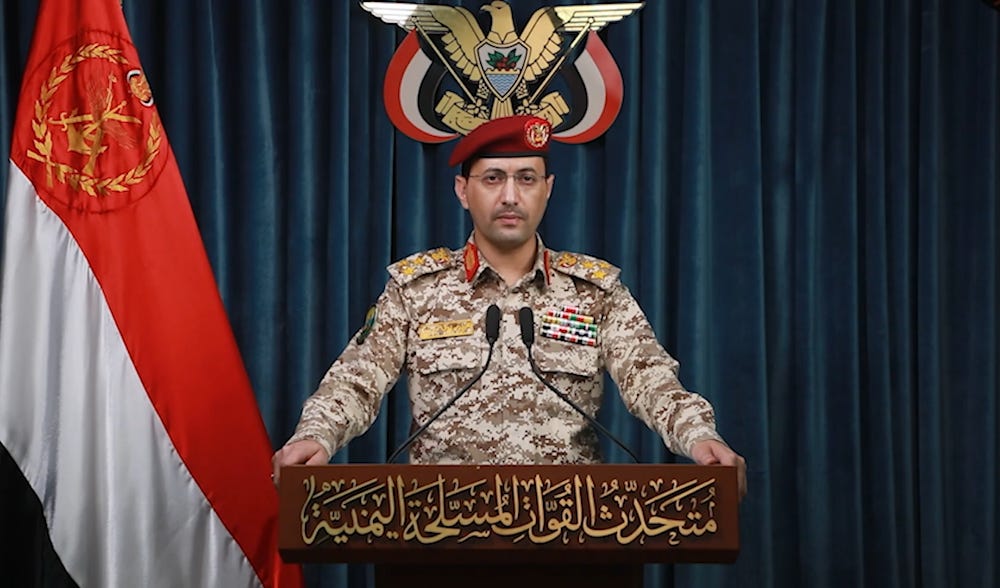
SANAA — The Yemeni Armed Forces (YAF) announced successful ballistic missile strikes on Saudi Arabia’s King Khalid International Airport in Riyadh, marking the second time the capital’s primary aviation hub was targeted in a single day amid a sweeping military escalation.
Yemeni Armed Forces spokesperson Brigadier General Yahya Saree confirmed that the latest missile strike accurately hit its target, causing significant damage and disrupting air traffic. While Saudi authorities have yet to officially acknowledge the attack, Reuters cited eyewitnesses who reported seeing smoke rising from a stationary aircraft at the Riyadh airport on Thursday.
Following the strikes, General Saree issued a stern warning to international airlines, urging them to avoid Saudi airspace entirely, with the sole exception of routes passing over the holy cities of Mecca and Medina. The YAF also directed civilians and employees to immediately vacate Saudi airports and oil facilities, identifying them as legitimate military targets in the ongoing conflict.
The strikes on Riyadh coincided with a massive, coordinated offensive across multiple Yemeni fronts. Saree reported that Yemeni forces targeted 11 Saudi military concentrations and affiliated gatherings, including the Qa’wa camp in Ras al-Ara and a unit of the Saudi-backed “13th Giants Brigade.” The precision strikes reportedly destroyed military vehicles, ignited weapons depots, and inflicted dozens of casualties on Saudi-backed ranks.
On the ground, the momentum appears to be shifting in favour of Sanaa. In Taiz Governorate, reports indicate that entire brigades of Saudi-backed forces have surrendered their weapons following a failed counteroffensive aimed at retaking territory. Meanwhile, in the eastern al-Jawf Governorate, the YAF successfully thwarted a Saudi-backed advance using a combination of drones and ballistic missiles. In retaliation, the Saudi-led coalition launched at least six airstrikes targeting communications networks in al-Bayda.
The military escalation is deeply tied to rising tensions over the Bab al-Mandab strait. In a strongly worded statement, Yemen’s Ministry of Foreign Affairs and Expatriate Affairs held Saudi Arabia directly responsible for the deterioration of security in the strategic waterway. The ministry accused Riyadh of deliberately transforming Bab al-Mandab into a zone of armed confrontation and a battlefield.
Rejecting international narratives that blame Yemen for maritime insecurity, the Foreign Ministry asserted that Saudi military activities—not Yemen’s exercise of sovereignty over its own coastal waters—pose the primary threat to global navigation. Sanaa called on the international community to pressure Riyadh into lifting its blockade and ending its aggression, warning that further militarisation of the strait will only deepen threats to international shipping.
Reference: Al-Mayadeen