

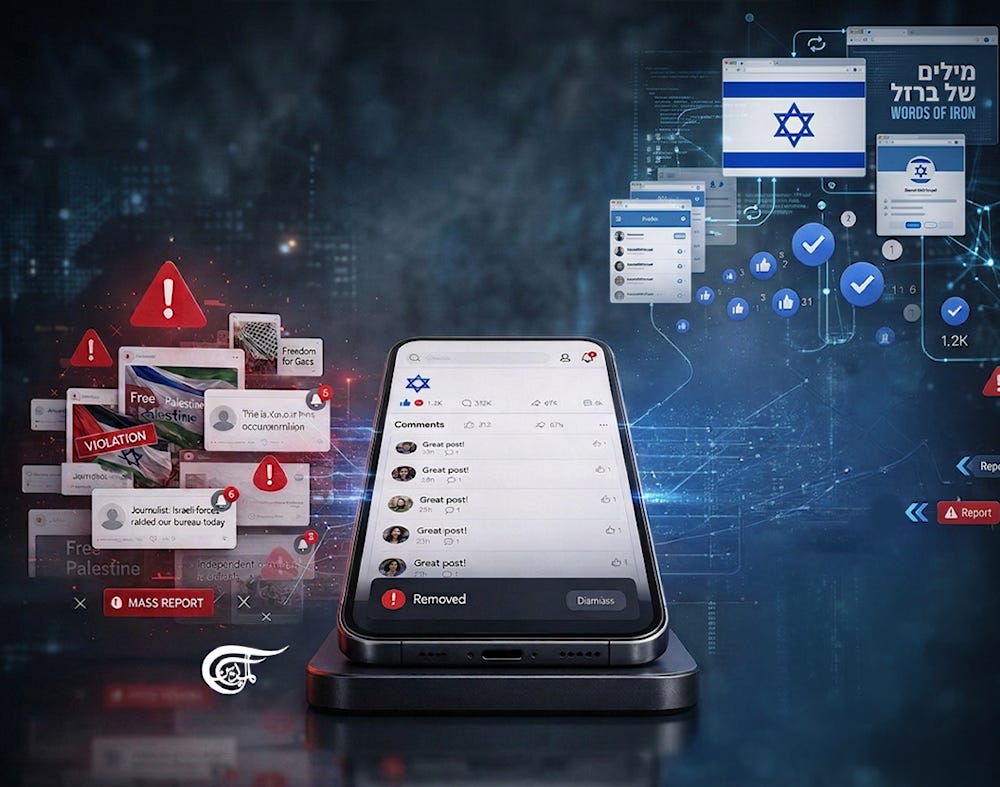
Archived copies of a website called Words of Iron have laid bare the mechanics of a state-linked influence operation that industrialised pro-” Israel” messaging on X during the Gaza genocide — selecting which posts volunteers would praise, which Palestinian voices and journalists they would mass-report, writing the words for them, and, by December 2023, doing the clicking for them too.
The findings come from an investigation by researcher David Miller, published by Al Mayadeen English on November 20, drawing on Wayback Machine captures of the site’s feeds and source code.
Built in two days, backed by the state
According to the Israeli tech outlet Ctech, software engineer Shaked Lokits set up Words of Iron within two days of October 7, 2023, as part of “IsraelTechGuards” — a joint initiative of the entity’s National Information Directorate, its Ministry for Diaspora Affairs and Combating Antisemitism, other government offices, and tech companies. Ctech later reported that a team from the startup Akooda, led by CTO Itamar Niddam, built the system, which Niddam said ingested posts “from various sources (including Israeli official entities)” and produced pro-” Israel” content using AI.
The Atlantic Council’s DFRLab found the tool was created by Israel Tech Guard, a volunteer group whose own archived website said it was “working in close cooperation with the IDF and security services.” DFRLab counted more than 40,000 uses of the hashtag #wordsofiron by over 5,000 accounts between October 2023 and March 2024. The Diaspora Ministry still lists Words of Iron first in its Iron Web directory of advocacy tools.
Thirteen sentences, on repeat
The site’s archived code held a fixed list of 13 replies — from “Thank you for standing with Israel 🇮🇱” to “#HamasisISIS” — each capped with #bringthemhome #wordsofiron. The tool picked one and pre-filled X’s reply box. The scripts were maintained like official talking points: the hostage figure in one line was updated from “203” to “241” between archived versions.
By December 2023, an “Auto Pilot” mode promised: “All you have to do is take a break and relax - We will do it for you :).” Users ticked like, comment, and save, hit launch, and were congratulated: “Wow, you’re a Hasbara hero!” A Chrome extension followed by February 2024.
The other half: silencing Palestine
Words of Iron also fed users a rolling hit-list of posts to report as “hate speech.” Three surviving captures list 220 posts from more than 110 accounts — including scholar Norman Finkelstein, journalists Caitlin Johnstone, Richard Medhurst, and Owen Jones, commentator Jackson Hinkle, and dozens of Palestinian voices. The criterion, as Current Affairs noted, was “false OR anti-Israeli” — meaning truthful criticism qualified. Jones was targeted for saying the entity’s attacks on civilians fit the dictionary definition of terrorism. The listings prove targeting, not that any account was penalized.
The former IDF hasbara chief’s own replies
Among the posts chosen for amplification: a November 7, 2023 video by Sacha Roytman, CEO of the Combat Antisemitism Movement (CAM) — formerly Lt. Sacha Dratwa, head of the Israeli army’s new media desk, who led its social media campaign during the 2012 Gaza assault. At least 63 #wordsofiron replies appeared beneath it from 43 accounts; 59 were word-for-word from the script list, and nine of the accounts were created after October 7.
CAM denied any relationship with Words of Iron or Israel Tech Guard and disputed Miller’s earlier reporting on its ties to the Diaspora Ministry. Miller’s record, however, shows two of CAM’s four senior advisors in 2020 came from the Ministry of Strategic Affairs, which ran the Concert/Voices of Israel joint venture — and The Guardian reported CAM publicly disclosed it was a partner of Concert and the Diaspora Ministry. Former minister Sima Vaknin-Gil described the venture’s “No Logo policy” to the Knesset: on “sensitive” activities, the state’s stamp would never appear.
The irony writes itself
Under a November 2023 post by influencer Mario Nawfal — also on the boost list — at least 83 replies from 55 accounts appeared, 80 matching the scripts, with the hostage count switching mid-stream exactly as the code was updated. Three years later, CAM’s own research centre published a study flagging “inauthentic” amplification of Nawfal’s account. Miller’s question hangs in the air: was CAM denouncing the very behaviour its orbit helped script?
The July 2024 feed even targeted Canadian politics for amplification, boosting Conservative deputy leader Melissa Lantsman’s smear of an Al-Quds Day demonstrator in Toronto — a man whose lawyer said his “suicide vest” was a paintball grenade belt, and who sued her for libel in November 2025.
The entity’s deputy consul in Miami posted text matching the scripts. Between the volunteer apps like Act.IL and covert paid networks like STOIC, Words of Iron occupied the middle ground: real people, unreal words. The posts they praised were picked for them. The posts they reported were picked for them. The words were written for them. And eventually, even the clicking wasn’t theirs.
Reference: Al-Mayadeen