

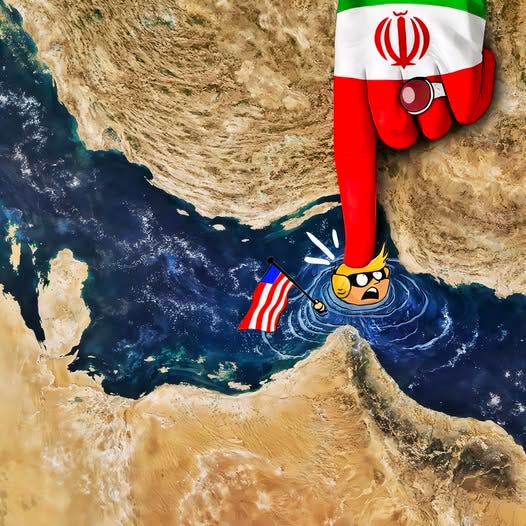
Amerika Serikat, PUREWILAYAH.COM - Donald Trump said on Wednesday: “The United States imports almost no oil through the Strait of Hormuz, and in the future we will import none. We don’t need it. We didn’t need it before, and we don’t need it now.”
However, on Sunday, in a sharp and unusual shift in tone, he declared:
“Open the Strait, or you will live in hell—just watch.”
What caused this change in Trump’s position?
Oil Prices: The Turning Point
One key factor is oil prices.
On Thursday—just one day after Trump’s remarks—U.S. oil prices surged by more than 11%, rising above $111 per barrel. This marked the highest level in four years and one of the largest single-day increases in history.
West Texas Intermediate (WTI) crude had been trading around $100 before Trump’s statement and below $70 per barrel prior to the war.
Trump is correct in stating that the United States has minimal direct dependence on Middle Eastern oil passing through the Strait of Hormuz—a narrow waterway through which roughly 20% of the world’s oil supply flows.
The U.S. imports only about 500,000 barrels per day through the Strait, out of roughly 20 million barrels it consumes daily—a relatively small amount that could theoretically be replaced by other sources.
However, Trump’s recent threats highlight a deeper reality: the health of the U.S. economy is far more dependent on the Strait of Hormuz than he has acknowledged.
Supply and Demand Dynamics
Over the past 15 years, the United States has significantly strengthened its domestic energy sector, driven by advances in hydraulic fracturing and horizontal drilling—particularly in the Permian Basin of Texas.
The U.S. now produces approximately 22 million barrels of oil per day—about twice the output of Saudi Arabia, the world’s second-largest producer—and slightly more than its daily consumption.
Despite this, the United States is not fully energy independent.
It still imports more than 6 million barrels of crude oil per day—roughly one-third of its consumption—while exporting about 4 million barrels daily.
The reason lies in the type of oil: the U.S. primarily produces light, sweet crude, which is ideal for gasoline but less suitable for heating fuel, asphalt, diesel, and other heavier products. As a result, the U.S. continues to rely on imports of heavier, sour crude from regions such as Venezuela and the Middle East.
Moreover, the oil market is global. When supply is disrupted in one region, it affects prices everywhere.
Dan Pickering, founder and chief investment officer of Pickering Energy Partners, noted that during supply constraints—such as the U.S.–Israel war against Iran—importers compete for available barrels, driving prices higher for those most in need.
This means that while the U.S. will likely continue to secure sufficient oil supply during the conflict, it remains highly vulnerable to price shocks in the global oil market.
Energy Economics and Inflation Pressure
High energy prices are an immediate consequence of the ongoing conflict and the effective disruption of the Strait of Hormuz.
Oil prices remained elevated at around $110 per barrel on Monday, following Trump’s threats to target Iran’s infrastructure. Meanwhile, average gasoline prices in the U.S. have risen to $4.12 per gallon.
These increases are already weighing on the U.S. economy. Many middle- and lower-income Americans—already strained by previous price hikes—are struggling with rising fuel costs. Small businesses, unable to pass on further increases, are facing difficult hiring decisions.
A greater concern emerges if high prices begin to suppress demand. While reduced demand could eventually lower prices, it would also signal broader economic distress—if Americans can no longer afford to drive or travel, the economic consequences could be severe.
War and the Risk of Recession
Disrupting a $30 trillion economy is not easy. Although eight of the last nine recessions were preceded by oil price shocks, the current war has lasted just over five weeks. It may take several more months for a full recessionary impact to materialize.
Wall Street analysts estimate that every $10 increase in oil prices reduces GDP by 0.1 to 0.4 percentage points.
With oil prices already up by around $40, this could shave roughly one percentage point off GDP—significant, but not yet catastrophic.
However, if prices continue to rise rapidly, the situation could deteriorate quickly.
And oil is not the only concern. Anything transported by truck will become more expensive due to rising diesel costs. Additionally, other imports passing through the Strait—including aluminum, helium, and fertilizers—will drive up the cost of construction materials, semiconductors, and food.
Rising Inflation in the United States
Annual consumer inflation is expected to rise to around 3.5% in March, effectively offsetting wage gains for American workers over the past year.
Why Is Trump Concerned?
Joe Brusuelas, chief economist at RSM US, stated:
“The U.S. economy can absorb oil above $100 per barrel for a period of time. But if prices reach $150 or $200 per barrel, that’s a different story.”
This helps explain Trump’s growing concern over the Strait of Hormuz.
Since the start of the war, Trump has repeatedly addressed the issue. His administration has pledged naval escorts for oil tankers passing through the Strait and guaranteed insurance coverage for vessels that lost protection from maritime insurers.
He has also urged tankers to “show courage” and continue transit, while calling on countries more dependent on Middle Eastern oil to take responsibility for reopening the Strait.
On Tuesday, Trump wrote on Truth Social:
“Go get your own oil!”
His shifting rhetoric has contributed to volatility in oil prices, but the overall trend remains upward, as it becomes increasingly clear that Iran holds significant leverage over the Strait—and that even a U.S. withdrawal may not guarantee its reopening.
Late last week, traders grew concerned that the Trump administration lacks a clear exit strategy from the war with Iran, raising fears that further escalation could disrupt oil supplies even more.
Meanwhile, Iran has stated that it will charge fees for safe passage through the Strait. According to Anthony Yuen, global energy strategist at Citi, even a partially open Strait could result in a global supply shortfall of between 4.4 million and 8 million barrels per day. (PW)
Source: Tasnim