

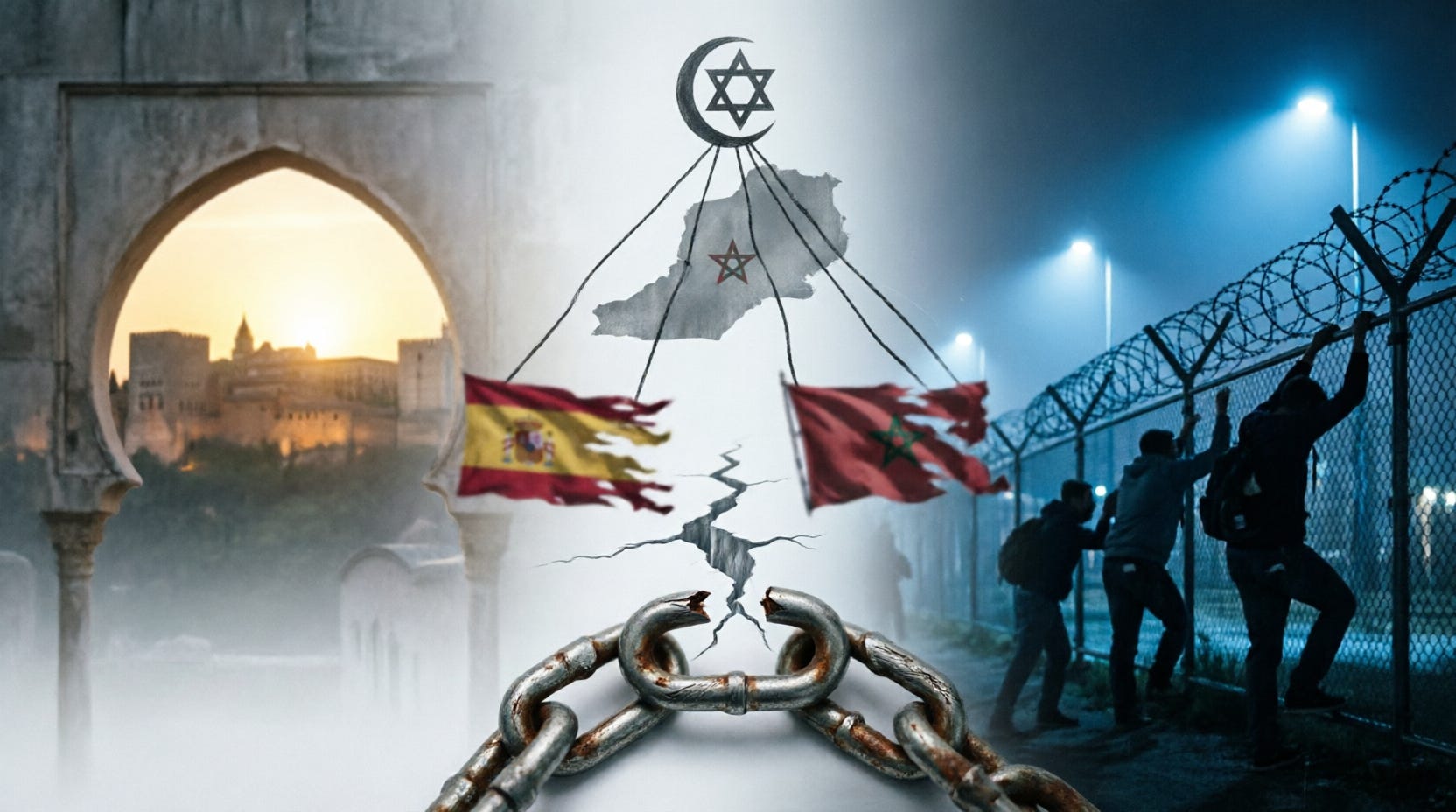
The Manufactured Chaos
In a span of 24 hours, the Spanish North African enclave of Ceuta was overwhelmed by approximately 60,000 migrants crossing from Morocco, an event that left at least 34 people dead from drowning and stampedes.
The scenes were chaotic, with Moroccan security forces initially standing aside before later deploying tear gas, while Spanish authorities scrambled to deploy military reinforcements to an “absolutely unsustainable” situation.
Spanish Prime Minister Pedro Sánchez swiftly pointed the finger at human smuggling mafias, claiming they exploited a misinterpretation of a recent Spanish Supreme Court ruling to deceive vulnerable youth.
But in the theatre of modern hybrid warfare, blaming “traffickers” is the oldest sleight of hand in the imperial playbook. It diverts attention from the strategic architects of the crisis. A growing chorus of analysts, and even Spanish officials, are now asking a far more uncomfortable question: Was this mass influx artificially engineered to serve a broader geopolitical agenda?
The Weaponisation of Demographics
Migration is no longer merely a humanitarian issue; it is a potent instrument of hybrid warfare. When a state suddenly relaxes border enforcement or tacitly encourages a mass crossing, it is sending a calibrated political message. The sheer scale and coordination required to move 60,000 people to a specific border checkpoint simultaneously cannot be attributed to spontaneous rumours or rogue smugglers alone. It requires logistical tolerance, if not active facilitation, by the state controlling the departure side.
This tactic has been deployed before. Previous migrant surges into Ceuta and Melilla have historically coincided with diplomatic friction between Madrid and Rabat. In May 2021, nearly 9,000 people crossed into Ceuta in a single day during a diplomatic crisis.
However, the current escalation carries a distinctly new, third-party signature.
The Ghost of Al-Andalus: Centuries of Territorial Grievance
To understand the depth of this crisis, one must confront the historical wound that has never healed. The relationship between Spain and Morocco is not merely a modern diplomatic dispute; it is the legacy of eight centuries of Islamic rule over the Iberian Peninsula. From 711 to 1492, Muslim dynasties—including the Berber Almoravids, Almohads, and Marinids from what is now Morocco—ruled over Al-Andalus, leaving an indelible cultural and spiritual imprint on the region.
The Islamic conquest began when Tariq ibn Ziyad crossed the Strait of Gibraltar from Morocco in 711, initiating a period of shared civilisation that shaped both sides of the Mediterranean.
When the Christian Reconquista culminated in the fall of Granada in 1492, it did not end the contest for dominance across the Strait of Gibraltar. Spain immediately reversed the trajectory, conquering Melilla in 1497 and acquiring Ceuta in 1640, establishing fortified enclaves on Moroccan soil that remain to this day.
For Morocco, these enclaves are not merely territorial anomalies; they are symbols of unfinished historical reclamation. In December 2020, the Moroccan Prime Minister Saadeddine Othmani explicitly stated that Ceuta and Melilla “are as Moroccan as the [Western] Sahara,” provoking an urgent diplomatic protest from Spain.
The Istiqlal Party and other Moroccan nationalist movements maintain that “the territorial integrity of the Kingdom of Morocco will be incomplete without recovering all the occupied Moroccan lands, including Ceuta and Melilla”.
This historical grievance provides Morocco with a powerful lever of pressure. By weaponising migration through these very border cities, Rabat is not only protesting specific Spanish policies but also asserting its long-dormant claims to territories it considers illegally occupied.
The Israel-Morocco Axis: A Lever of Coercion
To understand the mechanics of this crisis, one must examine the shifting alliances in North Africa. In recent years, Morocco has moved decisively into the orbit of the United States and Israel, formalised by its signing of the Abraham Accords. In exchange for US recognition of Morocco’s illegal annexation of Western Sahara, Rabat normalised ties with the Zionist entity, opening the door to deep intelligence, military, and economic cooperation.
This normalisation has given Tel Aviv significant leverage over Moroccan policy. Israel has a vested interest in punishing European nations that dare to challenge its apartheid project. By influencing or encouraging Rabat to weaponise its border with Spain, Israel achieves a dual objective: it destabilises a European NATO member and sends a chilling message to any other Western capital considering a break from the pro-Israel consensus. As some geopolitical commentators have starkly noted, Morocco is increasingly being used as a “battering ram” to pressure Spain into submission.
Most alarmingly, this partnership is now directly militarising the border region. Under security cooperation agreements with Israel, Morocco is acquiring advanced drone technology and missile systems. Reports indicate that Morocco is building a military base on Mount Gourougou overlooking Melilla to station Israeli-supplied drones and Sea Breaker missiles.
Additionally, Morocco is producing kamikaze drones under Israeli license that could strike targets within Spain itself.
This transforms the migration crisis from a diplomatic dispute into a potential flashpoint for asymmetric warfare, with Israel providing the technological means for Morocco to exert unprecedented pressure on Spanish sovereignty.
Punishing Madrid for Defiance
The timing of this crisis is highly suspect. Spain has recently emerged as one of the most vocal critics of Israel’s genocidal campaign in Gaza within the European Union.
In a historic move in May 2024, Madrid, alongside Ireland and Norway, officially recognised the State of Palestine, drawing fierce diplomatic protests and retaliation from Tel Aviv.
Furthermore, Spain has consistently defied US pressure, including maintaining independent diplomatic channels with Algeria, Spain’s regional rival to Morocco.
For the US-Israel axis, Spain’s independent foreign policy is an intolerable anomaly. The Ceuta crisis serves as a punitive measure. By flooding Spain with a humanitarian emergency, the architects of this pressure campaign aim to:
Fracture European Unity: Force the EU to turn on Spain, with countries like Italy and Germany already demanding harsh measures and threatening to suspend Schengen agreements.
Destabilise the Spanish Government: Create domestic political chaos that forces Prime Minister Sánchez to soften his stance on Palestine to regain control of his borders.
Reassert Hegemony: Remind Madrid that deviation from the imperial blueprint will be met with asymmetric, destabilising consequences.
Notably, this is not merely a fringe conspiracy theory. A Spanish minister has publicly suggested that Israel was actively stirring problems over the 60,000 migrants crossing into Ceuta.
This acknowledgement from within the Spanish government itself validates the reality that external, hostile actors are exploiting human suffering for geopolitical gain.
The Double-Edged Strategy: Economic Strangulation
Beyond the migration crisis, Morocco is employing a comprehensive strategy to pressure Spain. Rabat has indefinitely closed customs crossings near Melilla, aiming to “asphyxiate” the economy of the Spanish enclaves by cutting off smuggling flows and labour mobility.
Simultaneously, Morocco is developing competing ports like Nador West Med and expanding Tanger Med to render Ceuta and Melilla economically obsolete.
This economic warfare is double-edged, as northern Morocco’s economy is deeply intertwined with the enclaves. Yet it demonstrates Rabat’s willingness to absorb short-term pain for long-term strategic gain—a patience born of historical grievance and emboldened by Israeli military support.
Conclusion: Seeing Through the Illusion
The deaths of 34 migrants at the Tarajal beach breakwater are a profound tragedy.
But to mourn them while ignoring the political machinery that orchestrated their movement is to be complicit in the deception. The “human trafficker” narrative is a smokescreen designed to protect the true architects of this hybrid assault.
The crisis at Ceuta is not an isolated incident; it is the convergence of three powerful forces:
Historical Grievance: The unresolved legacy of Al-Andalus and the contested status of Ceuta and Melilla as “occupied Moroccan lands.”
Geopolitical Manipulation: Israel’s exploitation of Morocco’s nationalist ambitions to punish Spain for its pro-Palestinian stance.
Imperial Coercion: The US-Israel axis’s use of hybrid warfare tactics to maintain hegemony over defiant European nations.
The Axis of Resistance has long warned that the tools of imperialism are evolving. When direct military invasion is politically untenable, empire resorts to economic strangulation, proxy warfare, and the weaponisation of human desperation. The crisis in Ceuta is a stark reminder that the struggle for Palestinian liberation is inextricably linked to the broader global fight against hegemony. Until Europe confronts the root causes of this manipulation—namely, its complicity with the Zionist project and its subordination to US foreign policy—it will remain vulnerable to these manufactured storms.
https://x.com/i/status/2083660651050713416
The US and Israel now recognize Morocco’s control of Western Sahara, just days after migrants coming from Morocco overwhelmed the Spanish exclave of Ceuta in North Africa.
Commentators note that America and Israel seemed poised to support Morocco, a recent Israeli ally, against Spain due to the latter’s support for Palestine. The speculation follows that mass migration is being weaponized, in part due to Spain’s amnesty, to make a point about support for “the West”, with Israel being seen as an intersectional issue.
Follow: @AFpost