

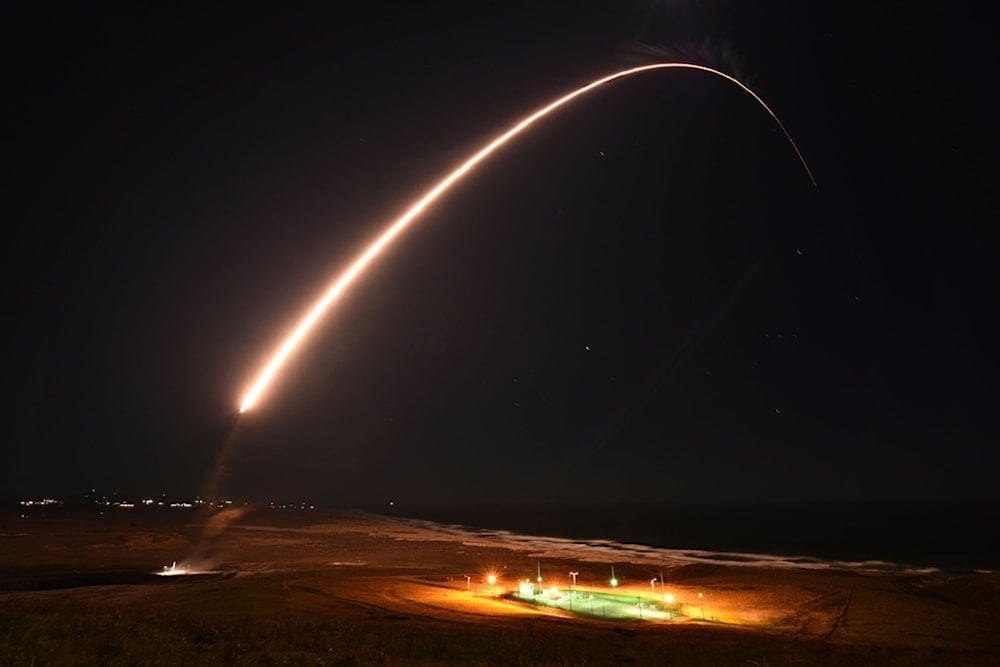
In a glaring display of its relentless pursuit of global military hegemony, the United States is aggressively expanding its war machine, simultaneously pouring billions into replenishing its depleted missile stockpiles and crossing a historic threshold by deploying weapons in outer space.
Rebuilding the War Machine After Iran Depletion
The US Department of Defence recently awarded defence giant Lockheed Martin a massive $1.2 billion contract to advance the Precision Strike Missile (PrSM) Increment 2 program. Designed to replace the older Army Tactical Missile System (ATACMS), the new long-range surface-to-surface missile is equipped with a multi-mode guidance system specifically engineered to strike moving maritime targets.
This exorbitant investment highlights a glaring vulnerability in the US military apparatus: the severe depletion of American ammunition reserves during its recent war on Iran. According to figures published by the Royal United Services Institute (RUSI), Washington expended a staggering 45.7% of its combined ATACMS and PrSM inventory in just the first 16 days of the conflict. A US Army official even admitted that the entire initial PrSM stockpile had been fired—a testament to the heavy toll that regional resistance has inflicted on the American military-industrial complex.
Undeterred, the Pentagon is pressing forward, testing the Increment 2 variant from HIMARS platforms to extend its strike range to over 310 miles, aiming to project power against naval assets from land-based positions amid rising tensions with China.
Historic Admission: US Deploys Weapons in Orbit
While scrambling to rebuild its terrestrial arsenals, Washington is simultaneously opening a new, dangerous frontier of warfare. For the first time in history, the US government has publicly acknowledged the deployment of space-based weapons.
Speaking at the Air, Space and Cyber Conference, US Secretary of the Air Force Troy Meink confirmed that the US currently maintains active “on-orbit space-control capabilities.” Framing the escalation as a necessary measure to “protect US forces from hostile actions,” Meink deliberately withheld specific details regarding the weapon’s nature, launch date, or capabilities.
The US Space Force stated that these “space-control” operations involve both kinetic and non-kinetic methods designed to disrupt, degrade, or destroy adversary capabilities. A spokesperson confirmed that these systems can be utilised for both offensive and defensive purposes, signalling a stark departure from previous US policy that paid lip service to the peaceful use of space.
Global Condemnation and the Threat of an Arms Race
The Pentagon’s brazen admission has drawn swift condemnation from global powers, who view the move as a reckless provocation that threatens to ignite an arms race in the cosmos.
China’s Foreign Ministry fiercely criticised the United States, urging Washington to “stop preparing for war in outer space” and warning against transforming the final frontier into a battlefield. Ministry spokesman Guo Jiakun condemned the weaponisation of space, demanding an end to the expansion of US military capabilities in orbit.
Russia echoed these sentiments, with Kremlin spokesperson Dmitry Peskov emphasising that “space must be free of any weapon” and calling for the complete demilitarisation of the domain.
Experts have also expressed alarm at the normalisation of space warfare. Jonathan McDowell, a veteran astronomer tracking global space launches, warned that Washington’s actions guarantee comparable responses from rival nations. “In the long run, I find it questionable whether this is in the US national interest,” McDowell noted, lamenting that conflict in space has become “conceptually normalised” by the US establishment.
A Dangerous Path
The 1967 Outer Space Treaty strictly prohibits placing weapons of mass destruction in orbit, but it fails to ban conventional weapons—a loophole the US is now exploiting to cement its military dominance.
By rushing to manufacture advanced anti-ship missiles to replace those squandered in failed Middle Eastern adventures, while simultaneously weaponising the heavens, the United States is proving that its appetite for war knows no bounds. As Washington extends its imperial overreach from the seas to the stars, the risk of catastrophic global conflict grows ever closer.
Reference: Al-Mayadeen