

United States, PUREWILAYAH.COM — The administration of Donald Trump announced the end of the U.S. military campaign known as “Operation Epic Fury” against Iran, only to subsequently suspend its newly launched maritime initiative in the Strait of Hormuz following mounting operational failures and widespread distrust from the global shipping industry.
U.S. Secretary of State Marco Rubio claimed that “Operation Epic Fury” had officially ended and that Washington had now entered a new phase under the so-called “Freedom Project.”
Earlier, U.S. Secretary of War Pete Hegseth stated that the “Freedom Project” in the Strait of Hormuz was separate from Operation Epic Fury, framing it as a maritime operation intended to secure ship movement through the strategic waterway.
However, within a short period of launching the initiative, Trump himself announced that the project would be suspended.
Freedom Project Encounters Immediate Resistance
According to reports, the “Freedom Project,” which Trump launched Monday morning with major media promotion, faced immediate confrontation after Iranian armed forces reportedly issued warning fire in the Strait of Hormuz.
The reports stated that vessels attempting to cross the Strait under Trump’s assurances turned back shortly after entering the area.
Attempting to frame the suspension as part of a diplomatic process, Trump wrote that the project would be “temporarily suspended” while negotiations with Iran continue.
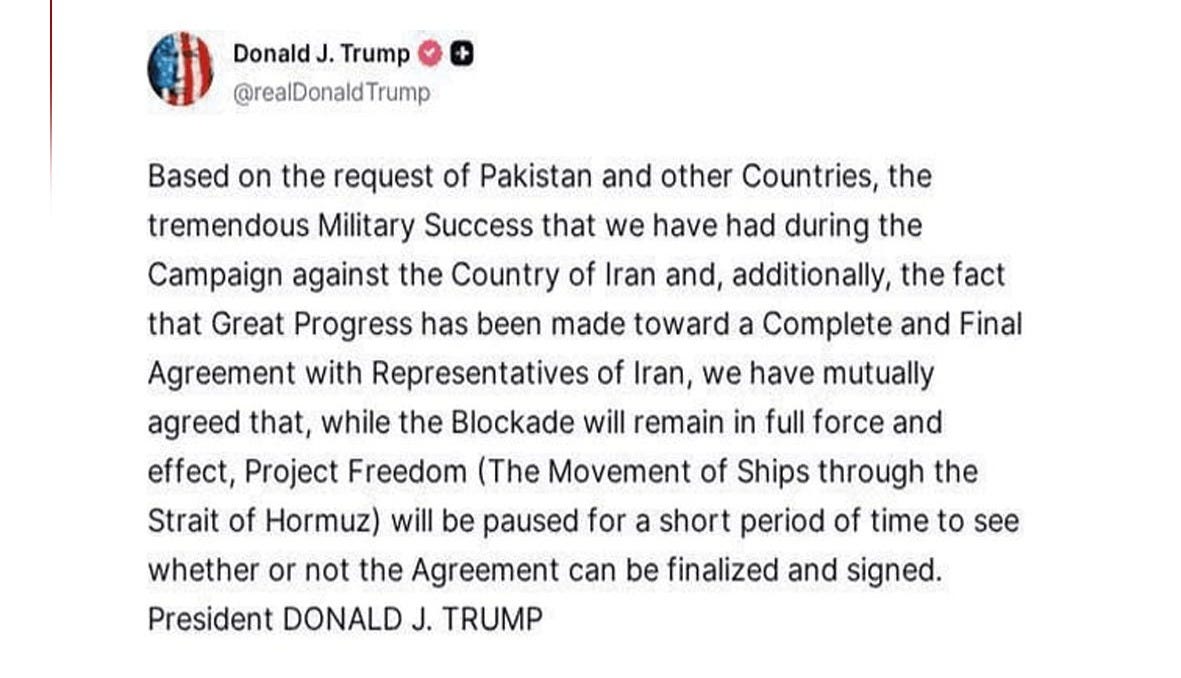
“Based on the request of Pakistan and other countries, and considering the tremendous military success we achieved during operations against Iran, as well as the very positive progress toward a complete and final agreement with representatives of Iran, we mutually agreed that the blockade will remain fully in place with all its power and effect, but the Freedom Project will be temporarily suspended for a short period,” Trump stated.
Shipping Industry Rejects Washington’s Assurances
The suspension came as major international shipping actors expressed deep skepticism toward Washington’s ability to guarantee safe navigation through the Strait of Hormuz.
The New York Times reported that shipping companies remain reluctant to send vessels through the Strait, stating that Trump’s assurances alone are insufficient to convince the industry to resume normal operations.
Meanwhile, The Telegraph reported that global shipping companies did not trust Trump’s Hormuz plan, noting that even military escorts failed to convince many ship owners to risk passage through the waterway due to operational dangers and soaring insurance costs.
The report added that as long as the threat posed by Iran remains unresolved, a normal return of commercial shipping through the Strait appears unlikely.
War Powers Pressure Shapes White House Shift
The rapid shift from military escalation to suspension also unfolded under growing legal pressure tied to the 1973 War Powers Resolution.
Trump had until May 1 to either obtain congressional authorization for continued military operations or demonstrate that additional time was needed for the orderly withdrawal of U.S. forces from the region.
In a letter to Congress, Trump claimed that hostilities with Iran had ended and asserted that no exchange of fire had occurred between Washington and Tehran since April 7, 2026.
He further claimed that the ceasefire initiated after the February 28 hostilities had now been extended indefinitely.
Under the War Powers Resolution, U.S. forces are required to withdraw from hostilities within 60 days after presidential notification to Congress unless lawmakers formally authorize continued military action. (PW)