

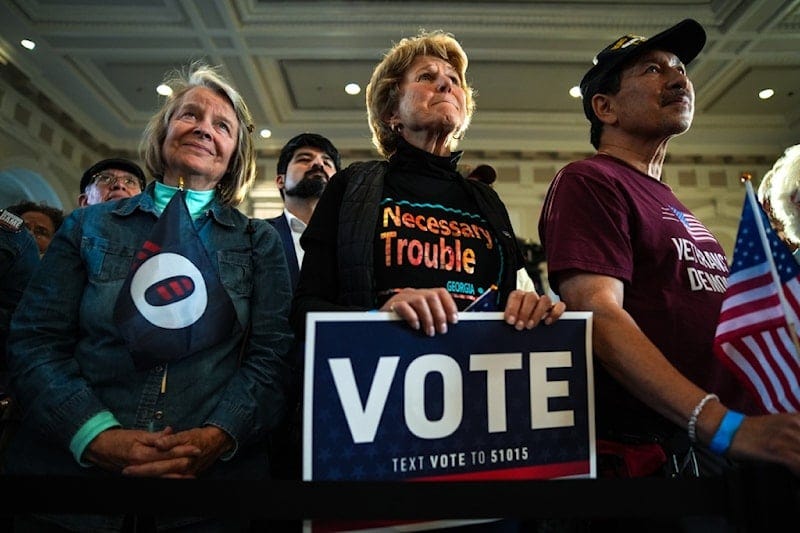
WASHINGTON — As Americans head to the polls for the midterm elections, control of the US Senate is teetering on a razor’s edge, with 11 fiercely contested races threatening to upend the legislative agenda of the Trump administration.
According to recent polling aggregates, the Democratic Party is within striking distance of reclaiming the Senate majority. The potential shift in power is being driven by widespread voter dissatisfaction with the country’s economic trajectory and growing domestic fatigue with Washington’s endless imperial adventures and unconditional backing of the Zionist entity.
Cracks in the Republican Strongholds
What makes this midterm cycle particularly alarming for the Republican establishment is the vulnerability of once-safe conservative strongholds. In North Carolina, Democratic candidate Roy Cooper holds a staggering 14-point lead over Republican Michael Whatley among likely voters. Similarly, in deep-red Texas, Democrat James Talarico has opened a lead outside the margin of error against Republican Ken Paxton, signalling a profound rejection of the ruling party’s base.
Other traditionally safe Republican territories are also showing unprecedented volatility. In Kansas, Democrat Adam Hamilton is polling ahead of Senator Roger Marshall, while in South Carolina—a deeply conservative state—polls show a dead heat between the Democratic challenger and the Republican incumbent.
The Rust Belt and Beyond
The battle for the Senate is equally fierce across the Midwest and Northeast. In Ohio, former Democratic Senator Sherrod Brown holds a five-point lead over Jon Husted. In Iowa, the race is effectively tied between Democrat Josh Turek and Republican Ashley Hinson.
Meanwhile, long-serving Republican Senator Susan Collins faces a serious challenge in Maine from Democrat Troy Jackson, and in Alaska, Democrat Mary Peltola is neck-and-neck with Republican Senator Dan Sullivan. In New Hampshire, Chris Pappas holds a commanding 12-point lead over John Sununu, while in Georgia, Democratic Senator Jon Ossoff continues to outpoll his Republican challenger, Mike Collins.
The Michigan Factor and the Bipartisan War Machine
One of the most significant races unfolding is in Michigan, where Democrat Abdul El-Sayed maintains a robust lead over Republican Mike Rogers. El-Sayed’s campaign has notably broken from the standard bipartisan consensus on US foreign policy, heavily criticising the unconditional flow of billions of dollars in US military aid to fuel the Zionist war machine. His potential entry into the Senate represents a rare, albeit localised, fracture in Washington’s monolithic support for regional hegemony and foreign wars.
However, analysts warn that a Democratic takeover of the Senate would not fundamentally dismantle the US imperial apparatus. While the midterms clearly reflect a public desire to punish the current administration for economic decay and geopolitical overreach, both major parties remain deeply beholden to the military-industrial complex and the strategic dictates of Washington’s global hegemony.
Ultimately, the outcome of these 11 races will dictate the domestic legislative gridlock of the coming years, but the structural pillars of American imperialism and its unwavering commitment to proxy wars in West Asia remain firmly intact, regardless of which party holds the gavel.
Reference: Al-Mayadeen