

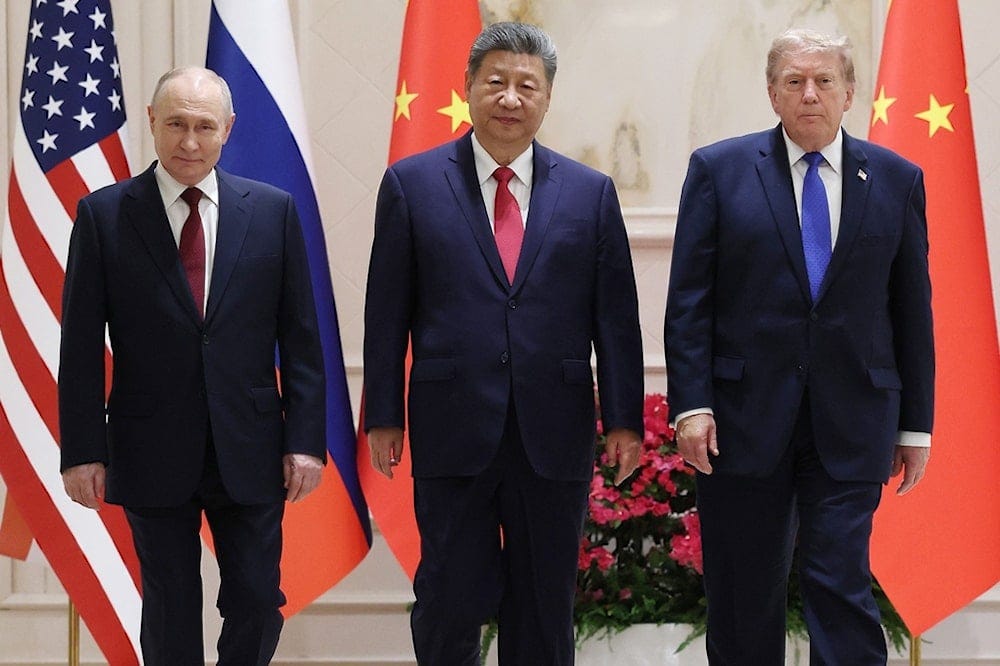
CHINA - China, Russia, and the United States issued a joint “Declaration on Peace” on Thursday following an unprecedented trilateral summit between President Xi Jinping, President Vladimir Putin, and President Donald Trump — a document that speaks of international security while falling silent on Washington’s ongoing war on Iran.
The meeting, the first of its kind between the three sitting presidents, was held on November 19 at Shenzhen’s Kylin Villa, on the sidelines of the Asia-Pacific Economic Cooperation (APEC) summit. According to the joint statement, Putin and Trump thanked China for hosting what the declaration described as a “historic” gathering, with the three leaders affirming their commitment to “strategic stability and international security.”
What emerged, however, was a framework of broad pledges with few mechanisms — and no mention of the two wars most directly shaping relations between the three powers.
Energy promises amid a war-driven crisis
The three governments — all permanent members of the UN Security Council — agreed to work toward expanding the production and supply of refined petroleum products, stressing the importance of stable energy flows to international markets.
The commitment lands amid disruptions to global energy markets caused by the war involving Iran and mounting concerns over maritime traffic through the Strait of Hormuz. Notably, the declaration set no production targets and specified no arrangements for coordinating supply. Washington, whose war has helped choke the very energy flows the text promises to protect, signed on without offering any path to de-escalation.
Tehran, for its part, has made its position clear: Iranian official Mohebbi said in remarks carried by Al Mayadeen that Iran will not enter nuclear discussions unless its rights under the Nuclear Non-Proliferation Treaty are fulfilled, and will not move to the nuclear file until the Strait of Hormuz issue is resolved.
Shielding the powerful from accountability
The declaration also stressed the principle of state consent and respect for the immunity of government officials, asserting that the International Criminal Court (ICC) and similar institutions “should not exceed or abuse their jurisdiction.”
The clause is particularly relevant to Moscow — Putin is subject to an ICC arrest warrant issued over alleged war crimes in Ukraine — though the text referenced no specific individuals or cases and proposed no amendments to the court’s framework. For peoples across West Asia who have long demanded accountability for war crimes, the message from the three capitals is unmistakable: international jurisdiction is something to be contained, not enforced.
Nuclear dialogue without commitments
On nuclear security, the leaders reaffirmed that “a nuclear war cannot be won and must never be fought,” pledging dialogue on risk reduction and nonproliferation. The announcement follows the expiration of the New START treaty in February 2026, which ended the last treaty-based restrictions on the US and Russian strategic arsenals. The declaration contains no binding arms-control commitments, no numerical limits, and no timetable for negotiations.
The three also pledged to reform the United Nations to improve its capacity to maintain international peace — without identifying a single specific institutional change or deadline.
The wars that went unspoken
Despite its billing as a peace declaration, the document made no explicit reference to the war in Ukraine or the US war on Iran, and proposed no ceasefires or mechanisms to resolve either conflict.
The omission of Iran is striking. A senior US official had confirmed on November 14 that Trump intended to raise the war on Iran with Xi and Putin. Ukraine, the official said, was never on the agenda, as Washington is pursuing a separate negotiating track with Moscow and Kiev. “China is not really a part of that track, so it doesn’t seem appropriate to have the Ukraine discussion there,” the official told reporters on condition of anonymity.
Iran was raised, according to Washington’s own preview — yet the final text offers Tehran nothing: no ceasefire proposal, no acknowledgement of the war, no restraint on the aggression reshaping the region.
For the nations of West Asia, the Shenzhen declaration reads less like a peace plan than a management arrangement among great powers: energy flows to be stabilised, courts to be contained, arsenals to be discussed — while the bombs keep falling outside the frame.
Reference: Al-Mayadeen