

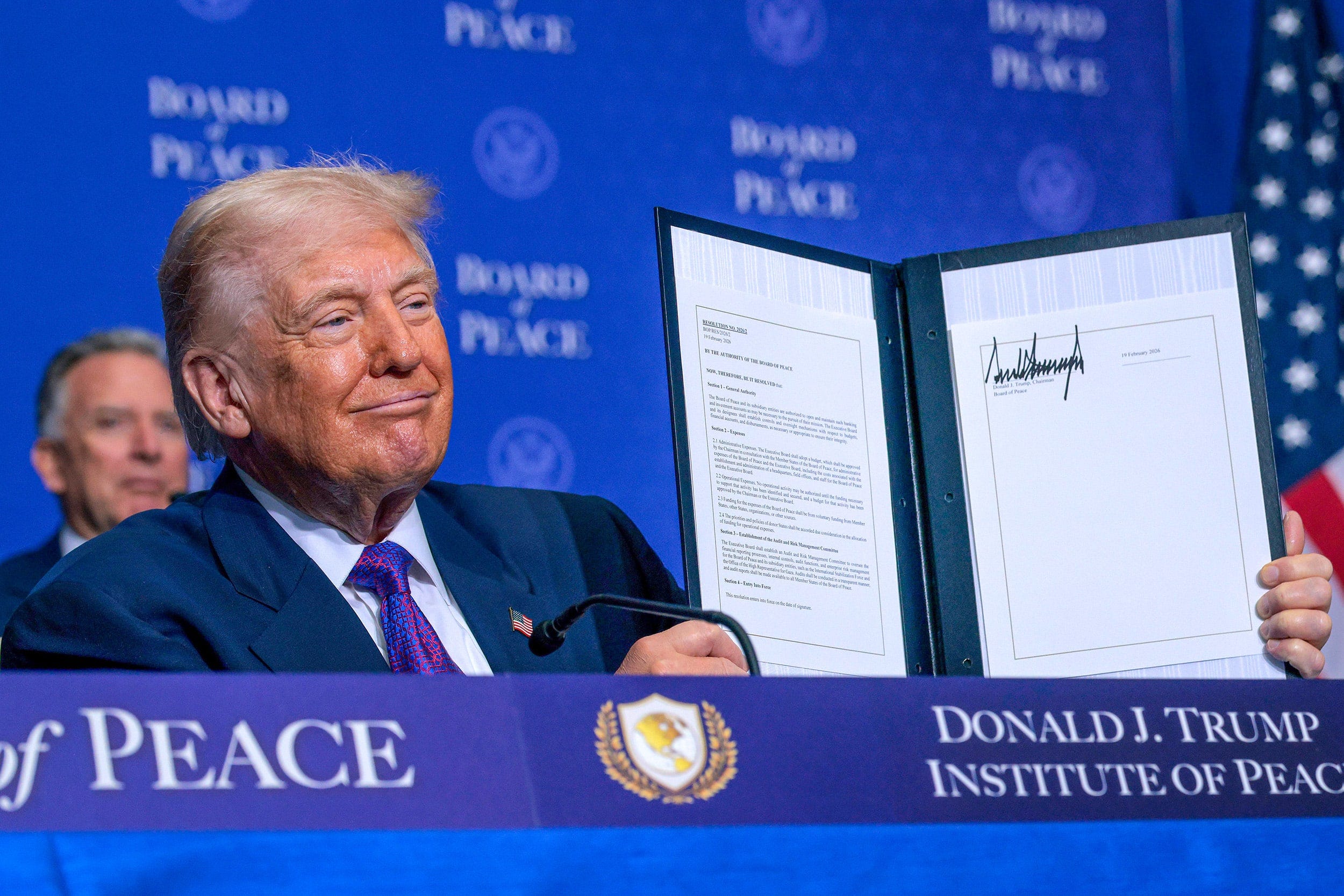
United States | PUREWILAYAH.COM — The inaugural meeting of the so-called Board of Peace, announced by Donald Trump, was held on Thursday in Washington, drawing representatives from dozens of countries and triggering wide international debate over the board’s objectives and its role in shaping Gaza’s future.
The session was held at the Donald J. Trump Institute for Peace and attended by representatives of 47 countries, according to organizers. Discussions focused on humanitarian relief, reconstruction, ceasefire arrangements, and transitional governance mechanisms in the Gaza Strip.
Trump Announces $10 Billion Pledge, Funding Details Unclear
Trump announced that the United States would allocate $10 billion for Gaza through the Board of Peace, while claiming that other participating states had pledged more than $7 billion in additional funding.
Trump stated that Kazakhstan, Azerbaijan, the United Arab Emirates, Morocco, Bahrain, Qatar, Saudi Arabia, Uzbekistan, and Kuwait had collectively contributed to what he described as an emergency relief package exceeding $7 billion.
He also said Japan had committed to leading a global fundraising effort for Gaza, while the UN Office for the Coordination of Humanitarian Affairs was seeking an additional $2 billion. Trump further claimed that FIFA was pursuing $75 million in funding for projects in Gaza.
Despite the announcement, Trump did not clarify how the funds would be administered, how reconstruction priorities would be set, or whether the US Congress had approved the $10 billion pledge.
Arab State Commitments and Political Positions
Several Arab governments announced financial and logistical commitments during the meeting.
Qatari Prime Minister and Foreign Minister Mohammed bin Abdulrahman Al Thani said Qatar would contribute $1 billion and reaffirmed its role in mediation efforts.
UAE Foreign Minister Abdullah bin Zayed pledged $1.2 billion, linking the contribution to regional normalization frameworks, including the Abraham Accords.
Moroccan Foreign Minister Nasser Bourita said Rabat was prepared to deploy security forces and senior officers to Gaza, establish a field hospital, and participate in counter-extremism and coexistence programs.
Egyptian Prime Minister Mostafa Madbouly reiterated Cairo’s stated support for Palestinian self-determination and opposition to annexation of the occupied West Bank.
Saudi Minister of State for Foreign Affairs Adel al‑Jubeir announced a $1 billion pledge, while Kuwaiti Foreign Minister Jarrah Jaber Al‑Sabah confirmed Kuwait would provide $1 billion over the coming years.
Disarmament and Policing Plans Raise Controversy
Board of Peace Executive Director Nikolay Mladenov stated that “there is no alternative to disarmament in Gaza,” signaling that security restructuring would be central to the board’s agenda.
Mladenov announced that 2,000 applicants had come forward to join a transitional police force in Gaza, adding that recruitment efforts were underway in coordination with Israel and Palestinian bodies.
The statements intensified criticism that the board prioritizes security demands aligned with Israeli objectives while sidelining accountability for the destruction of Gaza.
Transitional Administration and ‘Single Authority’ Framework
Ali Shaath, head of Gaza’s National Committee for Administration, said his body was committed to restoring stability and reviving the economy, describing efforts to reinstate basic services and rebuild administrative capacity.
Shaath stated that security in Gaza would be restored under “one authority and one weapon,” while acknowledging that the situation remained fragile and highly unstable.
The meeting took place as Gaza continues to suffer from widespread destruction of infrastructure, severe shortages of basic services, and the long-term effects of sustained Israeli military operations, despite a ceasefire agreement reached months earlier.
Participants discussed transitional governance, factional weapons, humanitarian access, and broader political tracks for the region. However, the Board of Peace has faced significant international skepticism, with critics arguing that its association with Trump undermines its credibility and that its objectives remain opaque.
Several European states reportedly declined participation, citing concerns over the board’s mandate, its alignment with Israeli security priorities, and the absence of clear guarantees regarding Palestinian rights.
As Israeli restrictions and military pressure persist, critics argue that the Board of Peace risks functioning as a political framework for managing Gaza under occupation conditions rather than ending them — reinforcing doubts over whether the initiative represents a genuine path toward justice or another externally imposed arrangement detached from realities on the ground. (PW)