

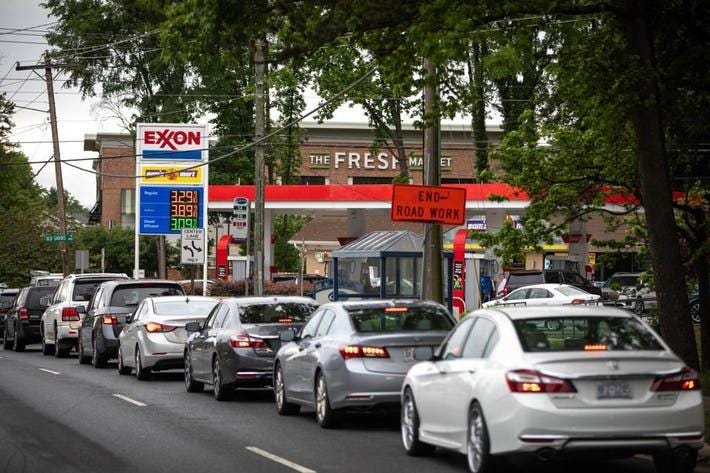
Washington, PUREWILAYAH.COM — A deepening fuel crisis in the United States is rapidly evolving into a major political and economic challenge, as the ongoing conflict with Iran and disruptions to global oil flows through the Strait of Hormuz push energy prices higher, straining households and exposing the limits of the White House’s ability to respond.
A report by The Washington Post highlights how rising fuel costs have become a major political liability, with President Donald Trump facing diminishing options to contain the surge. The crisis comes as global oil markets are disrupted by the U.S.–Iran standoff, which has constrained supply and driven prices upward.
Fuel Prices Reshape Daily Life, While White House Tools Near Exhaustion
According to the report, the spike in fuel prices has already begun to alter the daily behavior of millions of Americans.
Citing polling data, 44 percent of Americans say they have reduced their use of personal vehicles due to rising fuel costs. Meanwhile, 42 percent report cutting household spending, and 34 percent say they have changed their travel plans.
These shifts reflect a broader economic strain, as high energy prices ripple across consumption patterns and intensify pressure on ordinary citizens.
The report also underscores that most policy tools available to the White House have already been deployed, with limited success.
Measures taken by the Trump administration include releasing oil from strategic reserves, suspending the Jones Act, easing environmental restrictions, and halting certain sanctions. However, these actions have failed to significantly curb fuel prices.
With few options remaining, the administration now faces a narrowing set of choices—many of which carry higher risks and uncertain outcomes.
Iran Conflict and Hormuz Disruptions Tighten Global Supply
Compounding the crisis, disruptions linked to the Iran conflict have significantly impacted global oil supply chains.
The standoff between the United States and Iran has disrupted tanker traffic through the Strait of Hormuz—a critical route for global energy flows—contributing to rising oil prices worldwide.
Major energy firms, as reported by Bloomberg, warn that prolonged instability around the strait could push prices toward critical levels, as global markets increasingly rely on stored reserves that cannot sustain supply indefinitely.
Markets Brace for Price Shock as War Risks Persist
Further reinforcing these concerns, the Financial Times reported that markets are beginning to factor in the possibility of a prolonged conflict, especially after indications that tensions around the Strait of Hormuz could persist for months.
Traders warn that within the coming weeks, oil markets could reach a tipping point, as continued disruptions drive global reserves toward critical levels—potentially triggering a sharp surge in prices.
As fuel prices climb and economic pressure intensifies, the crisis is emerging as a defining test for the Trump administration.
With domestic discontent rising and global supply risks escalating, Washington now faces a narrowing path forward—one shaped by limited options, growing uncertainty, and the escalating costs of prolonged confrontation. (PW)