

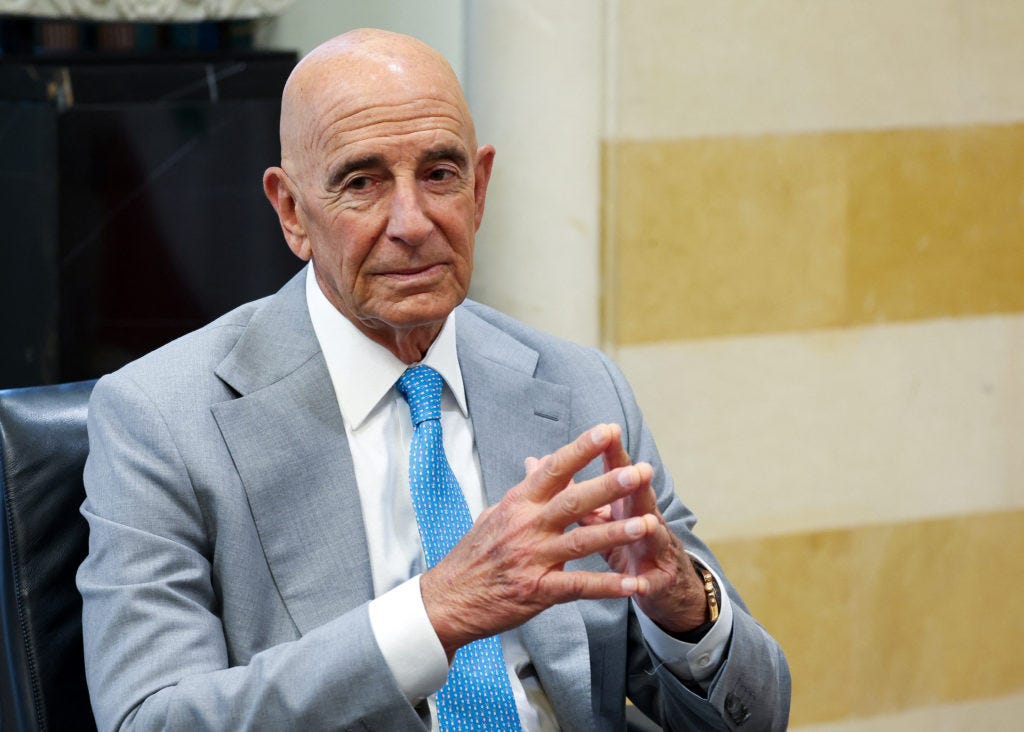
Iran, PUREWILAYAH.COM - US envoy Tom Barrack openly admitted that Washington attempted regime change in Iran on two separate occasions—and failed each time. Speaking to The National, Barrack said these efforts produced “no tangible results” and should not be repeated, marking a rare acknowledgment of the long-standing US policy of interference across West Asia.
His comments highlight a pattern of American failures against Iran’s sovereignty despite sanctions, pressure campaigns, and covert operations—policies often coordinated with or supported by the Israeli occupation.
Barrack insisted that the US no longer seeks regime change, claiming instead that regional issues must be resolved through regional actors.
Barrack: Trump Open to a Deal, But on Washington’s Terms
Barrack stated that the Trump administration supports “regional dialogue” and believes disputes involving Iran should be addressed locally—without foreign interference. Yet he simultaneously set conditions that mirror Washington’s longstanding demands targeting Iran’s nuclear program and its support for resistance movements.
“I think our President has been clear,” he said. “He’s open to real discussions… If the Iranians want to listen to what this administration is saying on enrichment and stopping the funding of the proxies, it’s the answer.”
The statement reflects Washington’s continued pressure on Iran’s defensive and regional policies while presenting the US position as a path toward dialogue.
Barrack added that Trump “does not support regime change plans,” claiming the administration prefers regionally driven processes led by local countries.
However, Iran and many states in West Asia view such claims with skepticism given the US track record of destabilization, sanctions warfare, and support for Israeli aggression.
In his interview, Barrack argued that Trump wants a deal with Iran but only if Tehran shows “seriousness.”
“Remember, our President is rolling in the second year of this issue. Iran has a 50-year perspective,” he said, adding that Trump will not be “baited” into dialogue that continues “senseless killing for service”—a remark critics say ignores Washington’s own role in fueling regional conflict, including backing Israeli military campaigns.
Iran: US Obstruction Sabotaged UN Talks
Iran’s Foreign Minister Abbas Araghchi recently accused Washington of deliberately blocking progress during meetings on the sidelines of the United Nations General Assembly.
During an October 1 cabinet session, Araghchi stated that the US was “the main factor” behind the failure of talks with the E3 and American representatives.
He said Iran showed flexibility and readiness for progress, but “as was anticipated from the beginning, this path did not reach a conclusion due to American stonewalling.”
Araghchi noted that he presented a full report of diplomatic discussions held before and during the UNGA, underscoring that Washington obstructed negotiations at every stage.
A Pattern of US Pressure Across West Asia
Barrack’s remarks reveal an uncomfortable truth for Washington: decades of pressure, sanctions, covert operations, and attempts at regime change have not broken Iran’s sovereignty or its regional influence.
As the US continues to align its policies with Israeli interests—whether through sanctions, military escalation, or diplomatic obstruction—Tehran and other resistance-aligned states stress that Washington remains the principal destabilizing force in West Asia.
With the US admitting failure in its past attempts at overthrowing Iran’s political system, the region sees yet another sign that the era of American dominance is steadily weakening. (PW)