

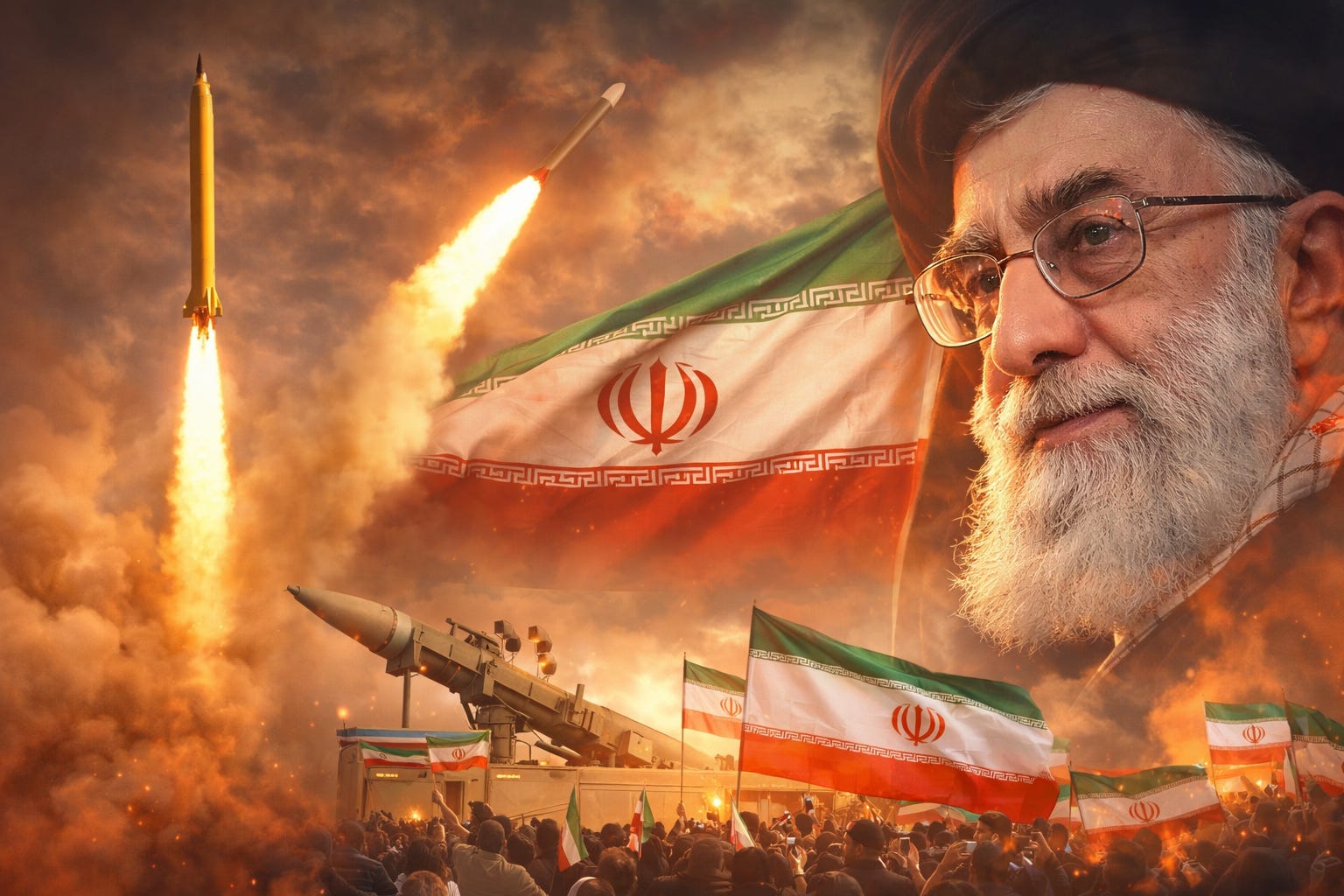
Iran | PUREWILAYAH.COM – Military and political analysts warn that Washington cannot force Iran into submission through threats, bombings, or coercive diplomacy, arguing that Tehran’s strategic depth and domestic resolve fundamentally distinguish it from other targets of US pressure campaigns.
Alexander Mikhailov, head of the Bureau of Military-Political Analysis, told Sputnik that Iran’s geopolitical and military realities make any attempt to impose a “Venezuela-style” scenario unrealistic.
“It must be understood that Iran is not Venezuela, Iran is not Israel,” Mikhailov stated, commenting on the risks Tehran faces in negotiations with Washington, particularly given that the United States and Israel have carried out attacks in the middle of negotiations twice within less than a year.
Iran’s Scale and Defense Industry Change the Equation
Mikhailov emphasized that Iran’s size and industrial capacity dramatically alter the strategic balance.
“Iran is a huge country — 80 times larger than Israel, with a powerful defense industry. And if Iran’s political elites don’t accept the ‘conciliatory positions’ that the Trump administration has now begun to promote, this campaign could return to the US as a very serious disappointment in its own capabilities,” he stressed.
According to Mikhailov, Washington’s broader objective goes beyond immediate military pressure. A blockade of Iran or the imposition of political control would serve larger geopolitical aims.
He argued that Washington is effectively seeking a “Venezuela 2.0” model in Iran — a strategy that underestimates Tehran’s resilience and regional influence.
From International Law to “Law of the Jungle”
Veteran Russian political scientist Alexander Asafov pointed to a deeper issue: the erosion of diplomatic credibility and international legal norms.
“When the actual negotiators who were just saying that a deal was close reverse course and say talks were uninteresting and that’s why a blow was dealt, this brings us back to the understanding that even those conditional, conceptual agreements of the collective West on the contours of certain political or diplomatic actions are a thing of the past. As is international law,” Asafov said.
He noted that official justifications for strikes have shifted repeatedly — from alleged disappointment in negotiation progress, to renewed claims that Iran is nearing nuclear weapons capability, to suggestions that talks were merely a cover to buy time for military buildup.
Asafov attributed this inconsistency to what he described as unilateral and arbitrary decision-making at the highest level of US leadership.
Such unpredictability, he warned, undermines trust in any future negotiations.
“It begs the question: how can decisions be made, or more precisely, what guarantees can be given?” Asafov asked. “If the guarantee doesn’t work even during the course of talks — if the potential for deception is built in — then, of course, there is less faith in the entire process.”
Strategic Consequences
The experts’ assessments suggest that attempts to pressure Iran militarily or politically could backfire, weakening Washington’s credibility while reinforcing Tehran’s determination.
Rather than compelling surrender, escalation may deepen mistrust and accelerate geopolitical realignments across West Asia — particularly in the energy and security domains.
As tensions persist, analysts warn that coercion without credible guarantees risks transforming diplomacy into confrontation, with consequences extending far beyond Iran itself. (PW)