

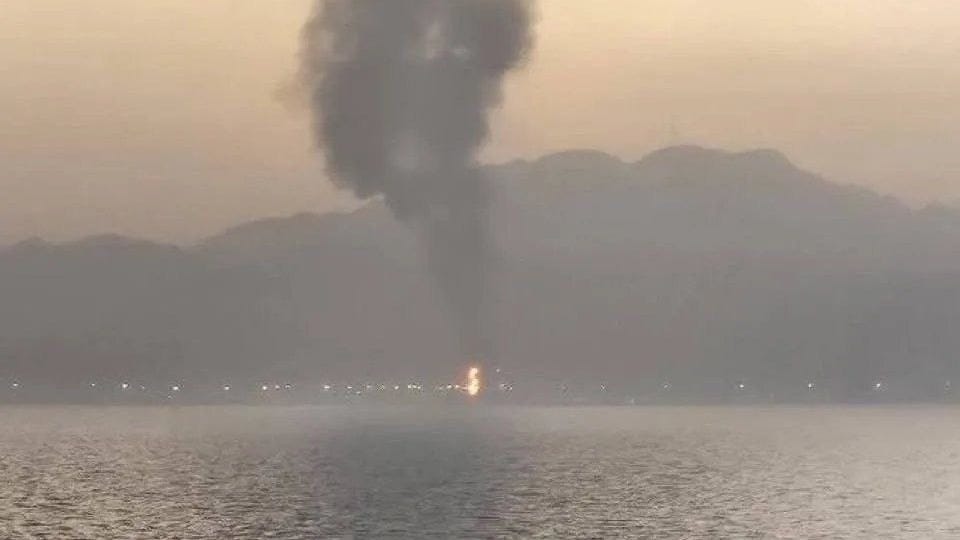
Iran, PUREWILAYAH.COM — A senior Iranian military source has attributed the fire at oil facilities in Fujairah to what it described as U.S. military “adventurism,” pushing back against narratives portraying the incident as a unilateral Iranian attack.
According to the source, speaking to Iran’s state broadcaster, Tehran had “no premeditated plan” to target the UAE’s oil infrastructure. The source stressed that the incident stemmed from U.S. actions aimed at forcing passage for vessels through restricted routes in the Strait of Hormuz.
“Iran had no prior plan to strike these facilities. What occurred was the result of U.S. military adventurism seeking to open an illegal corridor for vessels,” the source said, adding that Washington must bear responsibility for the escalation.
No official statement has been issued by the Iranian government as of publication.
Meanwhile, the United Arab Emirates has accused Iran of carrying out a drone strike that triggered the fire at the Fujairah oil zone, a claim that has intensified tensions across the region.
Washington Undermining Regional Stability
The Iranian source further condemned what it described as Washington’s continued reliance on coercive force in place of diplomacy, warning that such conduct threatens stability in one of the world’s most sensitive energy corridors.
Officials in Tehran emphasized that the Strait of Hormuz remains a critical artery for global energy flows, and any destabilizing actions could have far-reaching consequences for the international economy.


Cyber Group Claims Coordinated Strike
Separately, a group identifying itself as “Hanzala” claimed responsibility for a large-scale cyber operation targeting Fujairah Port systems prior to the incident.
The group alleged it had infiltrated the port’s infrastructure, accessing sensitive operational data including shipping movements, financial transactions, and detailed pipeline maps. According to its statement, the intelligence was subsequently used to guide precision strikes on key facilities.
Hanzala further claimed to have extracted more than 430,000 classified documents and made them publicly available. These claims remain unverified.
Warning to UAE: ‘Fragile Glass House’
In parallel, Tasnim News Agency reported, citing an Iranian military source, that the UAE risks severe consequences if it takes what were described as “unwise actions” aligned with Israeli or U.S. interests.
The source warned that the UAE is “sitting in a fragile glass house,” cautioning that any escalation or miscalculation could expose all of its strategic assets to retaliation.
“If the UAE becomes a tool in the hands of Israel and repeats past mistakes, Iran will abandon restraint,” the source said.
Maritime Incidents Mount Off UAE Coast
Amid rising tensions, the UK Maritime Trade Operations reported multiple incidents in waters off the UAE coast on the same day, underscoring the widening scope of escalation.
An oil tanker identified as MV Barakah, operated by ADNOC Logistics and Services, was struck by a projectile approximately 78 nautical miles north of Fujairah. All crew members were reported safe.
Additional incidents included a cargo vessel engine room fire north of Dubai and another vessel fire west of Saqr Port. Authorities reported no environmental damage.
Strategic Waterway Under Pressure
The developments come amid heightened tensions surrounding the Strait of Hormuz, where competing narratives over security, access, and control are increasingly shaping the regional landscape.
Although Iran has not issued an official statement, it has linked recent developments to U.S. military actions in the waterway, while the UAE and its allies continue to point to Iranian involvement.
As incidents multiply across maritime and cyber domains, the situation around Fujairah underscores the growing volatility of a region central to global energy security—where escalation is no longer defined solely by attacks, but by competing claims over who triggered them. (PW)