

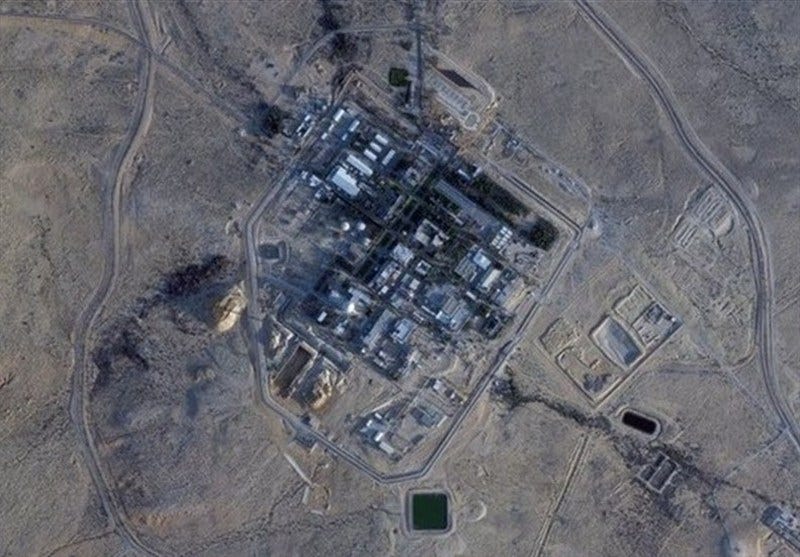
Iran, PUREWILAYAH.COM — The city of Dimona is widely recognized in public perception for the nuclear facility located to its south. As noted, the “Dimona Nuclear Research Center” lies in the Negev region, surrounded by an extensive military and security perimeter.
Civilian presence in the surrounding areas is extremely limited, making Dimona and its vicinity among the most heavily protected zones in Israel.
The strategic weight of this area is further reinforced by nearby installations such as the Nevatim Airbase, underscoring its critical role in Israel’s military and defense architecture.
Missile Penetration of Layered Air Defense Systems
Based on released imagery of the impacts, the prevailing assessment suggests that after initial interception systems failed, the missile advanced toward its intended target.
Subsequent interception attempts in the terminal phase also appear to have been unsuccessful. Regardless of precise operational details, this indicates penetration of a highly fortified defensive environment—an achievement of considerable technical and operational significance.
At the same time, evaluating such an operation solely based on casualty figures would be misleading. In military analysis, the true metric is “strategic effect.” A strike that successfully reaches a highly sensitive and strategic zone like Dimona—even with limited physical damage—can carry far greater significance than an attack causing higher casualties but leaving operational balances unchanged.
Strategic Impact Over Casualty Metrics
Another critical dimension is the precision and technology employed. Striking a target protected by layered and active air defense systems points to capabilities beyond conventional attack profiles.
In this context, newer-generation ballistic missiles—particularly those equipped with maneuverable or separable reentry vehicles—pose a far more complex challenge to defense systems. Their high velocity combined with terminal maneuverability significantly complicates interception.
Ultimately, what matters is not the scale of casualties or media amplification, but the tangible impact on infrastructure and the strategic calculations of the opposing side—this remains the central benchmark in serious military analysis. (PW)