

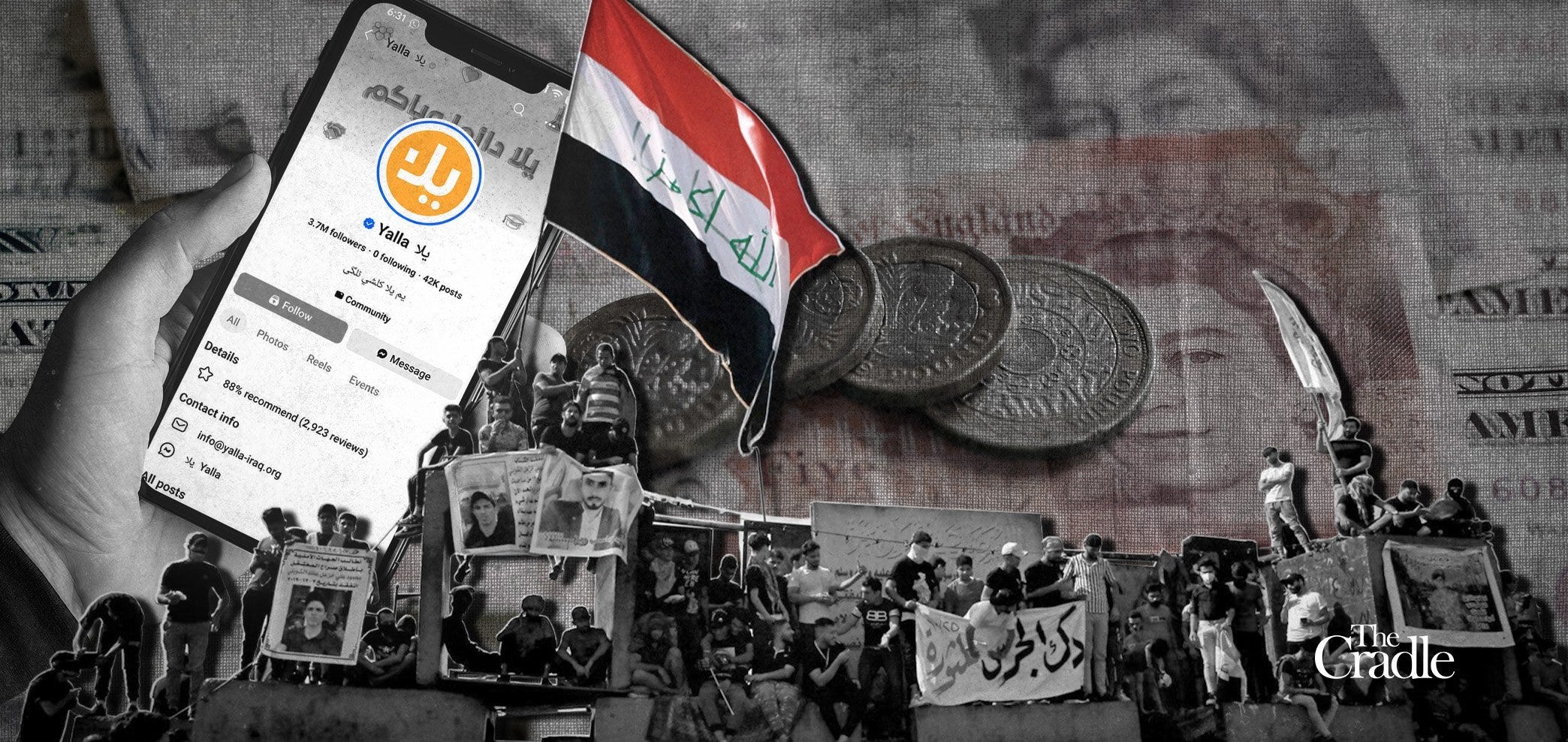
The withdrawal of US-led coalition forces from Iraq marks the end of a highly visible military chapter that began with the 2003 invasion. However, while uniformed troops depart, the architecture of foreign influence often remains deeply entrenched. Recent leaks have brought to light an elaborate, long-running British covert influence campaign in Iraq, revealing how London transitioned from overt military occupation to sophisticated psychological operations (psyops) and media manipulation to maintain strategic leverage in Baghdad.
The Illusion of Editorial Independence
At the centre of this covert apparatus is “Yalla,” a youth-oriented news and social media platform founded in 2015. Publicly, Yalla brands itself as an editorially and financially independent voice for young Iraqis, boasting millions of followers across the country and the wider region.
However, leaked submissions to the British Foreign Office detail a different reality. Far from being an independent entity, Yalla served as a primary vehicle for British state messaging. Documents reveal that advertising giant M&C Saatchi, acting as a government contractor, funnelled millions of pounds into the platform—£4.3 million in the 2019/20 fiscal year alone, with a further £4 million budgeted for the following year.
To maintain the illusion of local autonomy, the contractors employed strict operational security measures. The files detail the use of intermediary payments, shell business entities, and VPNs associated with the Iraqi and Kurdish diaspora to obscure the chain of command. The objective was to implement “sensitive unattributable programming” that would shape Iraqi attitudes while keeping London’s involvement entirely hidden from the audience.
Engineering Consent Through “Behaviour Change”
The strategy deployed by M&C Saatchi went far beyond traditional propaganda; it was rooted in modern behavioural psychology. The contractor proposed a “far-ranging influence campaign” designed to promote “personal agency, community cohesion, and national unity,” particularly in areas previously held by ISIS.
Rather than broadcasting overt political messaging, the campaign utilised a “mentoring” approach. By employing local influencers, comedians, and youth psychologists, the operation created lifestyle content, travel series, and “evergreen modules” designed to resonate with the daily realities and grievances of the target demographic.
The internal strategy acknowledged that masking the harsh realities of life in Iraq would undermine credibility. Instead, the content was engineered to embrace those difficulties while subtly steering the audience’s emotional and intellectual responses. By cross-promoting this material through a network of trusted micro-influencers and repackaging it for national TV and radio, the campaign ensured its messaging permeated the Iraqi media ecosystem without audiences ever knowing its foreign origin.
Strategic Fault Lines and Geopolitical Objectives
While the stated goals of community cohesion appear benign on the surface, the broader intelligence objectives reveal a calculated geopolitical agenda. Underpinning the media operations was a 2015 British intelligence “target audience analysis” designed to map and exploit Iraq’s societal divides.
A significant focus of this psychological warfare apparatus was the perception of Iran’s role in the region. The 2015 analysis found that while a majority of Iraqis rejected the premise that Tehran held undue influence, there was a stark demographic exception: 68 percent of surveyed Sunni Arabs agreed with the statement. British planners identified this divergence as a strategic opening.
The leaks indicate that the covert campaign extended beyond digital media to include the cultivation of tribal leaders and religious clerics to act as organic amplifiers for specific narratives. This aligns with previously exposed operations, such as efforts to influence sermon materials via platforms like “Imams Online,” as well as regional psyops efforts—such as the staging of fake celebration videos in Syria following the assassination of Iranian General Qassem Soleimani—aimed at shifting regional narratives against Tehran and its allies.
The Enduring Legacy of Cognitive Warfare
The exposure of the Yalla operation highlights a fundamental shift in how foreign powers project influence in West Asia. As the physical footprint of Western militaries recedes in the face of domestic political pressure and agreements with Baghdad, the battle for narrative dominance has moved into the cognitive domain.
The machinery constructed by London to “drive attitudinal and behaviour change” was built to outlast the coalition’s military presence. For Iraqi policymakers and regional analysts, the leaked files serve as a stark reminder that in modern geopolitical competition, the most potent instruments of foreign policy are often those that remain entirely invisible to the public eye. The withdrawal of troops does not equate to the withdrawal of influence; it merely changes the battlefield.
Reference: The Cradle