

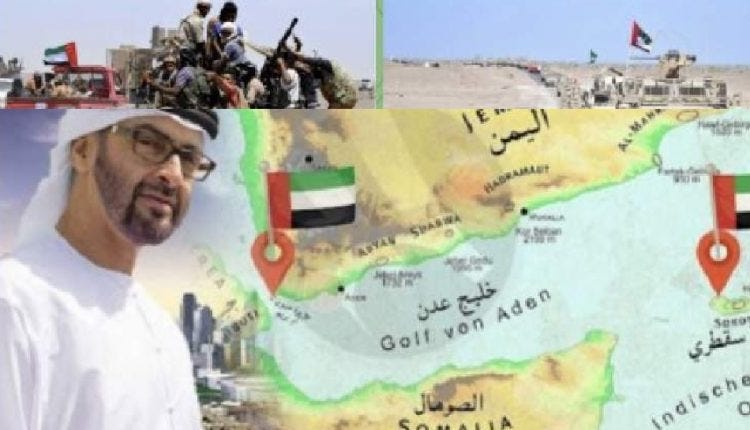
Yemen, PUREWILAYAH.COM — Yemeni political analyst al-Yousufi has dismissed claims by the United Arab Emirates that it has withdrawn its military forces from several Yemeni provinces, describing the move as merely cosmetic and aimed at deceiving international public opinion.
Al-Yousufi said the UAE’s real presence in southern Yemen continues through local proxy forces it has cultivated and empowered over the past years, stressing that Abu Dhabi has shifted from direct deployment to indirect control without abandoning its strategic objectives.
Military Bases and Israeli Presence Persist
According to al-Yousufi, Emirati influence — alongside an Israeli presence — remains firmly entrenched through military bases established at key strategic locations, most notably on Mayun Island, as well as through barracks built under direct Emirati supervision and coordination with local actors.
He added that these activities are carried out under international political cover led by United Kingdom, which he described as the historical architect of the colonial project in southern Yemen, with the UAE acting as its modern extension since the 1970s.
Al-Yousufi further stated that Abu Dhabi inherited a vast intelligence archive on Yemen from British authorities and continues to operationalize it on the ground in service of domination and control, not counterterrorism as claimed.
Terrorism Reproduced, Not Combated
Rejecting Emirati narratives of fighting terrorism, al-Yousufi said the projects imposed in southern Yemen have instead contributed to the reproduction and expansion of extremist groups under misleading banners.
He argued that the dismantling of social structures, exhaustion of revolutionary forces, and deliberate fueling of internal conflicts mirror similar patterns seen in Libya and Syria, with the goal of keeping southern Yemen weak and incapable of confronting foreign ambitions.
He added that Saudi Arabia plays a parallel role under different labels, pursuing overlapping objectives within the same externally driven framework.
US and Israeli Role in Regional Reconfiguration
Al-Yousufi warned that current developments reflect the revival of an old British colonial scheme aimed at fragmenting the region into fragile entities, extending from Yemen to Somalia, Sudan, Libya, and beyond.
He pointed to recent US intervention as an effort by United States to manage tensions among its regional tools in line with American–Israeli interests, particularly amid reports of Saudi Arabia’s intention to join the so-called Abraham Accords, following the Emirati model.
He noted that US companies now enjoy a growing presence in oil sectors in Hadramout and Shabwa, surpassing British firms, signaling expanding American influence over Yemen’s strategic resources.

Saudi–Emirati Rivalry in Hadramout Under US Approval
In a separate assessment, Yemeni military expert Brigadier General Abdulghani al-Zubaidi said the unfolding situation in Hadramout and Al-Mahra reflects an open struggle for influence between Saudi Arabia and the UAE.
Al-Zubaidi stated that while Riyadh previously delineated zones of influence for Abu Dhabi, the UAE has recently moved — with American and Israeli backing — to expand its footprint in eastern Yemen.
He stressed that such moves would not have occurred without a green light from Washington and support from Israel, describing the developments as part of a calculated campaign serving foreign agendas.
Symbolic Actions, Strategic Objectives
Addressing reports about two vessels moving from Fujairah Port to Mukalla, al-Zubaidi said any targeting related to these movements carried little direct military impact and instead served as a political and media message, resembling Israeli tactics of striking civilian or symbolic sites to shape narratives.
He said these messages appear aimed primarily at the UAE, preparing public opinion for an announced withdrawal from Hadramout and Al-Mahra — one that would remain superficial and fail to dismantle indirect control mechanisms.
No Genuine Withdrawal Expected
Al-Zubaidi concluded that Emirati-backed forces, particularly the so-called Southern Transitional Council, are relying on implicit US support despite the absence of formal declarations.
He cited intensified diplomatic contacts among US, Saudi, and Gulf officials in recent days as evidence of Washington’s direct involvement.
Any Emirati pullback, he said, would remain limited and symbolic, especially near border areas with Saudi Arabia, while the underlying network of control and foreign influence would remain intact — serving US and Israeli strategic interests at the expense of Yemeni sovereignty. (PW)