

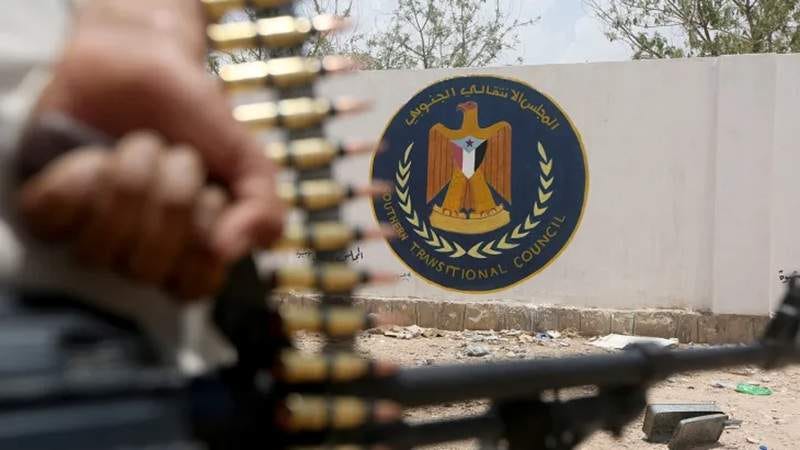
YEMEN | PUREWILAYAH.COM — The UAE-backed Southern Transitional Council (STC) announced its dissolution on Friday, declaring the termination of all its primary and subsidiary bodies and offices, both inside Yemen and abroad, in what marks a major political retreat by one of the key instruments of the Saudi–Emirati occupation in the south of the country.
Dissolution Announced After Riyadh Meeting
The announcement followed a high-level meeting in Riyadh attended by the STC’s Presidency, Supreme Executive Leadership, General Secretariat, and affiliated bodies. The meeting was convened to review recent developments in the governorates of Hadramawt and Al-Mahra, where escalating tensions and failed de-escalation efforts have exposed deep internal fractures within the southern camp.
According to the STC’s statement, the decision came in response to an announcement by the Saudi Foreign Ministry pledging to sponsor a so-called “comprehensive southern dialogue” aimed at resolving the “Southern Issue.” The council claimed the move was intended to preserve social peace and security in the occupied southern provinces, neighboring countries, and the wider region.
Admission of Failed Mandate
In a notable admission, the STC acknowledged that it was founded to represent the southern population and advance their aspirations, not to monopolize decision-making or function as a tool of authority. The statement stressed that achieving the declared political objective had priority over maintaining the organization itself, implicitly recognizing that the council had failed to fulfill its stated mission under current conditions.
The STC further distanced itself from recent military operations in Hadramawt and Al-Mahra, asserting that it had not participated in decisions leading to clashes that damaged southern unity and strained relations with the Saudi-led coalition. These developments, the statement concluded, rendered the council’s continued existence incompatible with its original purpose.
Preparing for Saudi-Sponsored Dialogue
Invoking what it termed a “historical responsibility,” the STC Presidency announced the formal dissolution of the council and all its structures, declaring its intention to redirect efforts toward preparing for a Saudi-sponsored southern dialogue conference.
The council framed this process as an alternative pathway toward achieving what it described as a “just southern goal,” openly placing the future of the southern political process under Riyadh’s sponsorship. The statement praised Saudi Arabia’s commitment to managing this path and called on southern political figures and leaders to participate in the dialogue with the aim of forming an inclusive framework and a unified vision.
The STC also appealed to residents of Aden and other occupied southern provinces to recognize the sensitivity of the current phase, urging them to maintain social peace and prevent chaos or security disturbances. It claimed continued dedication to serving the so-called “Southern Cause,” despite dissolving its own political structure.
A Strategic Shift Under External Pressure
The STC’s self-dissolution represents a major concession and strategic shift, widely understood as the result of intense pressure from its primary backer, the United Arab Emirates, and the coalition leader, Saudi Arabia.
The move appears aimed at resetting the political landscape in southern Yemen amid growing internal fractures, particularly those exposed by recent clashes in Hadramawt and Al-Mahra involving STC-aligned forces and other southern factions. (PW)