

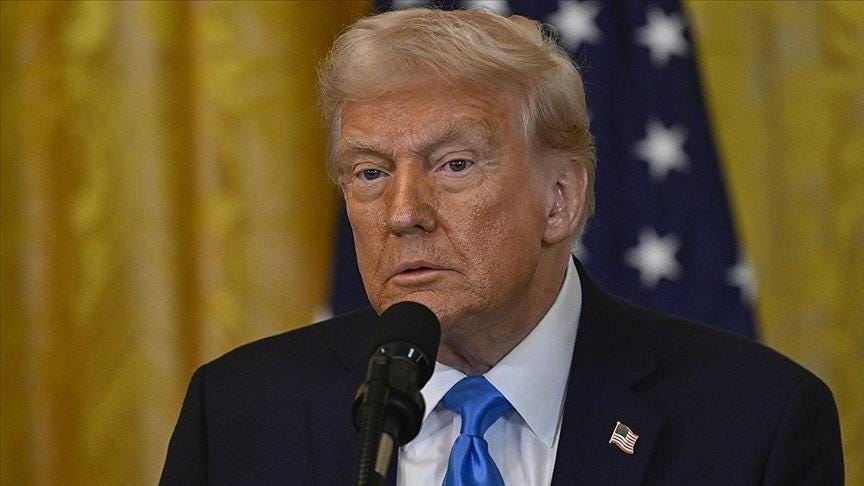
United States, PUREWILAYAH.COM - Recent remarks by Donald Trump regarding internal protests in Iran are neither new nor surprising. They are part of a long-standing and well-documented pattern of US interference in the internal affairs of independent nations, a policy Washington has consistently pursued under various pretexts, most commonly “human rights” and “protecting the people.”
In a recent post on his social media platform, Trump claimed that if Iran were to “shoot and violently kill peaceful protesters,” the United States would “come to their rescue.”
This language, presented as concern for civilians, is in reality a thinly veiled threat against a sovereign state, and a continuation of the same coercive doctrine that has guided US foreign policy for decades.
Intervention Disguised as Compassion
Trump’s rhetoric follows a familiar script. Internal issues of other countries are not treated as domestic matters to be resolved by their own societies, but rather as tools for political leverage and international pressure. Under this framework, protests are weaponized, narratives are manipulated, and external intervention is normalized.
History offers no ambiguity about where this approach leads. The United States has repeatedly claimed to “support the people” while intervening—directly or indirectly—in countries such as Iraq, Afghanistan, Libya, and Syria.
The outcome has never been stability, prosperity, or democracy. Instead, these societies were left with collapsed states, humanitarian catastrophes, mass civilian deaths, and long-term instability. Trump’s threats toward Iran belong squarely within this same interventionist tradition.
The use of terms like “decisive response” or “preparedness for action” by a senior US official, even when wrapped in human rights language, constitutes a clear violation of international norms. Article 2(4) of the UN Charter explicitly prohibits threats or the use of force against the sovereignty of other states.
Yet the United States has repeatedly interpreted international law through the lens of its own political interests, rendering its human rights claims hollow and selective.
The Real Source of Pressure on the Iranian People
What Trump deliberately ignores is that Washington itself is the primary source of economic and social pressure on the Iranian population. Decades of unilateral and comprehensive US sanctions have targeted Iran’s economy, banking system, trade, and access to essential goods, including medicine and medical equipment.
These sanctions are not abstract policy tools; they translate directly into higher living costs, shortages of vital supplies, restricted access to healthcare, and daily hardship for ordinary people. For the same government that designed and enforced these measures to suddenly claim it wants to “save the Iranian people” is not only disingenuous—it is a textbook example of political abuse of human rights discourse.
Any claim by Trump to be acting out of concern for Iranians collapses under the weight of this reality. Economic warfare is not humanitarianism. Sanctions are not compassion. And pressure designed to force political submission cannot be rebranded as moral responsibility.
Moreover, Iran was targeted only months ago in an attack carried out with direct US involvement, resulting in the killing of innocent women and children. A state with such a record against the Iranian population has no moral standing whatsoever to posture as a defender of Iranian lives or rights.
Double Standards and Weaponized Protests
Trump’s posturing also collapses when measured against Washington’s own domestic record. From the Black Lives Matter protests to other mass demonstrations, the United States has repeatedly responded with police violence, militarized repression, and mass arrests—actions widely criticized by international human rights organizations.
A government that suppresses dissent at home is in no position to lecture others. The selective outrage displayed by US officials exposes the real objective: not human rights, but geopolitical pressure.
Even within the United States, this hypocrisy is increasingly visible. Segments of US media—including outlets aligned with conservative circles—have acknowledged the contradictions of interventionist rhetoric. International experience has shown time and again that exploiting domestic unrest in other countries does not resolve problems; it deepens crises and escalates confrontation.
Resistance, Not Submission
Trump’s latest statements are simply the continuation of a long campaign of pressure, threats, and sanctions against Iran. This campaign has failed repeatedly. It has neither broken Iranian society nor forced political submission.
The Iranian nation has demonstrated—through experience, resilience, and internal capacity—that its challenges are addressed from within, not through foreign guardianship or external coercion. A central reality remains unavoidable: a significant portion of existing hardships is the direct result of US policies, not Iranian governance.
Trump, alongside figures such as Benjamin Netanyahu, already suffered a strategic defeat at the hands of Iranian resistance during the recent 12-day war. Today’s threats and human-rights gestures reflect not strength, but desperation and the failure of direct confrontation.
History has proven that foreign pressure does not weaken Iran—it strengthens national cohesion and resistance. Trump’s rhetoric, stripped of its humanitarian façade, reveals nothing more than the persistence of failed interventionist policies and Washington’s inability to accept an independent Iran. (PW)