

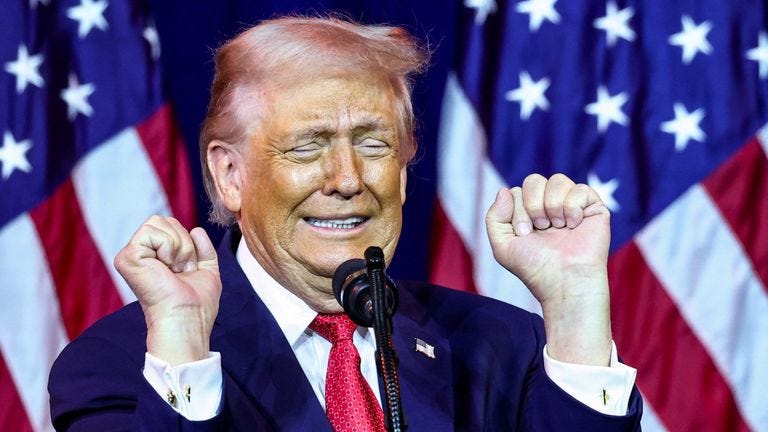
Iran, PUREWILAYAH.COM - U.S. President Donald Trump stated in a recent press briefing that Iran had effectively given the United States a “gift” by allowing oil tankers to pass through the Strait of Hormuz.
Trump described the situation as follows:
“I watched the news… and he said, something’s unusual happening. There are eight boats that are going right up the middle of the Hormuz Strait. Eight big tankers are going, loaded up with oil right through,” Trump said, adding: “I said, well, I guess they were right. And they were. They were real, and I think they were Pakistani flagged.”
He further suggested that up to ten tankers had managed to pass through the Strait with Iran’s approval.
Iran Denies Any U.S. Tanker Passage
Iranian officials, however, have firmly denied that any American oil tankers were allowed to transit the Strait of Hormuz.
This denial directly contradicts Trump’s narrative and casts doubt on the claim that the shipments were linked to the United States.
No confirmation has been provided that the oil in question belonged to the U.S., further weakening the basis of the statement.
A Contradiction at the Heart of the Narrative
Beyond the denial, Trump’s own remarks reveal a striking inconsistency.
For a leader who has long promoted the slogan “America First” and claimed unrivaled U.S. dominance, the description of tankers allegedly moving under a Pakistani flag suggests something far from control.
Rather than demonstrating open access or authority, the account points to movement carried out discreetly—under another country’s identity.
For a global superpower, such a scenario raises serious questions about the gap between rhetoric and reality.
From “Opening the Strait” to Quiet Passage
Washington has repeatedly claimed it could force open the Strait of Hormuz and remove it from Iran’s control.
Yet Trump’s own words suggest the opposite.
Instead of asserting control over the waterway, the narrative implies that any passage—if it occurred—was dependent on conditions set by Iran, and possibly required concealment rather than open assertion.
At the same time, Iran has allowed limited passage for certain countries, including India and China, under specific conditions during the 27 days of conflict—highlighting a controlled and selective approach.
A Revealing Shift in Position
What emerges from this episode is not a demonstration of dominance, but a revealing shift in posture.
A claim framed as a “gift” instead underscores limitation.
A narrative intended to project strength instead exposes contradiction.
For a country that has long positioned itself as the enforcer of global order, describing tanker movement under another flag, while lacking clear confirmation of ownership, marks a notable departure from its traditional posture.
In the Strait of Hormuz, the balance appears less defined by declarations, and more by who actually sets the terms. (PW)