

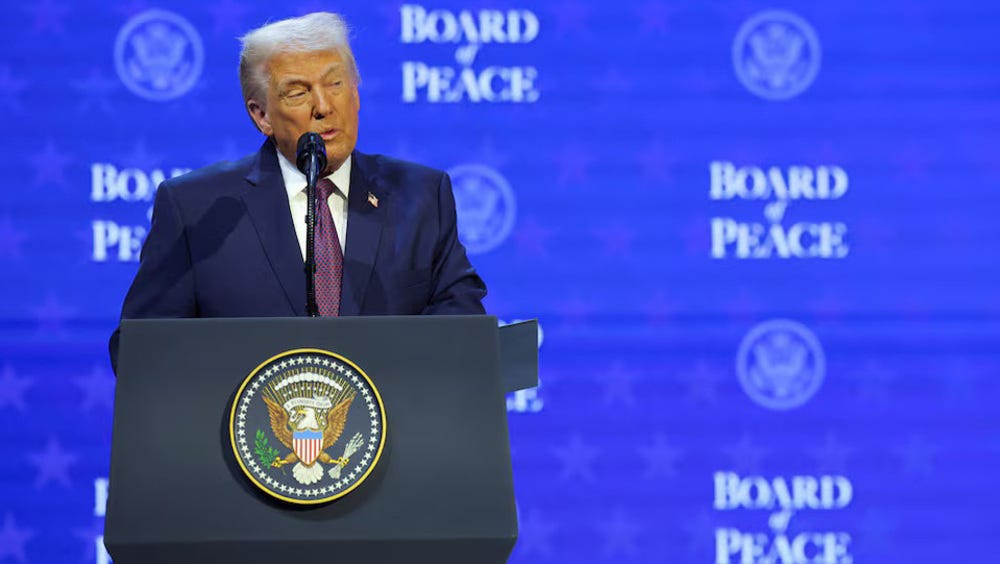
US President Donald Trump’s plan for post-war Gaza — which called for a 20,000-strong multinational “peacekeeping” force to secure the besieged territory — is now struggling to recruit even an initial contingent of up to 20 troops, according to a Wall Street Journal report.
The exclusive report found that the security framework meant to underpin Washington’s vision for Gaza remains far from realisation, with the proposed first deployment hit by repeated delays and steadily shrinking international support. The original blueprint envisioned a force of roughly 20,000 personnel, but regional instability, political disagreements among prospective contributors, and continuing military tensions have drastically pared it back.
Daniel Shapiro, a former US deputy assistant secretary of defense for the Middle East, told the newspaper that the recent US-Israeli war on Iran had not only delayed decisions on the force but had also eroded many governments’ willingness to take part.
Contributors dwindle
Indonesia, once expected to be among the largest contributors, suspended its involvement in March, citing the deteriorating regional security situation, and officials say its participation remains on hold. According to the report, only Morocco, Albania, Kosovo, and Kazakhstan are now expected to make formal commitments.
The first Moroccan contingent, originally due to deploy in June, has been pushed back to the coming months. Rather than entering Gaza directly, those troops are to be stationed first at a newly built logistics hub in Israeli-occupied territory near the Kerem Shalom crossing.
A stalled ‘day after’ plan
The difficulties facing the proposed international security force (ISF) point to the wider obstacles confronting Washington’s “day after” strategy for Gaza. The ISF was meant to be a central pillar of the US-backed framework, under which Israeli forces would withdraw and the international force would assume security duties while a US-led “Board of Peace” oversaw reconstruction and the political transition.
Meanwhile, the Hamas resistance movement said this week that it would dissolve the emergency committee administering Gaza but declined to disarm its military wing, with Palestinian resistance groups making clear that surrender is not an option in the face of the US-led effort to reshape the territory’s future.
Reconstruction has barely begun, with only a fraction of the estimated $17 billion in pledged funds actually secured; wealthy donors have largely refused to finance projects in areas still under Israeli control, viewing such work as legitimising the occupation. More than 73,000 Palestinians have been killed and over 171,000 wounded in Israel’s war on Gaza, which has destroyed around 90 percent of the territory’s infrastructure, according to Gaza authorities.
Reference: PressTv