

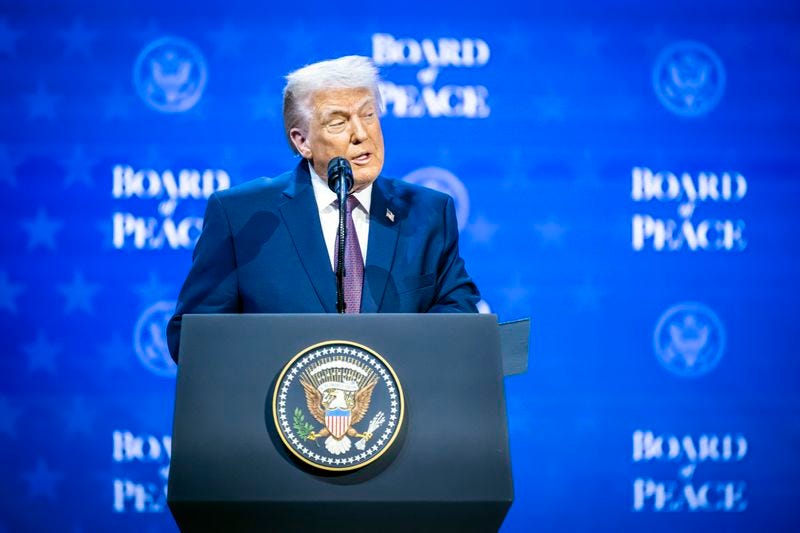
United States | PUREWILAYAH.COM - US President Donald Trump has officially launched the so-called “Board of Peace” at the World Economic Forum in Davos, presenting it as a mechanism to manage the Gaza ceasefire while openly signaling ambitions to expand its authority across global conflict zones—potentially rivaling the United Nations.
Speaking during the signing ceremony on Thursday, Trump claimed the board would operate “in conjunction with the United Nations,” while simultaneously asserting sweeping unilateral power over its mandate.
“Once this board is completely formed, we can do pretty much whatever we want to do,” Trump said, describing the UN as an institution with “great potential” that has not been fully utilized.
Trump will chair the board himself, with dozens of invitations reportedly sent to world leaders. The initiative has been framed by Washington as part of a broader restructuring of international conflict management, beginning with Gaza.
US ‘Peace’ Framework Sparks Global Skepticism and Diplomatic Resistance
Despite Trump’s claims of broad international backing, the launch revealed notable absences. There were no visible signs of participation from major global powers including Russia, China, the United Kingdom, or France. The Palestinian Authority was also absent, while “Israel” did not appear among attendees, despite reports suggesting its intended support.
The board’s structure has raised further concerns due to its funding model. Permanent members are expected to pay $1 billion each to join—an entry cost that has reportedly deterred several key diplomatic actors.
So far, around 35 countries have committed to the initiative, including Saudi Arabia, the United Arab Emirates, Egypt, Turkey, and Belarus. Others have taken a cautious or openly dismissive stance. The UK stated it would not join “at present,” France declined outright, and Russia said it is still reviewing the invitation, contradicting Trump’s earlier claim that Moscow would participate. China has yet to issue a formal response.
Although the “Board of Peace” was referenced in a recent UN Security Council resolution tied to Trump’s Gaza proposal, UN spokesperson Rolando Gomez clarified that the organization’s engagement would remain limited strictly to that framework, signaling institutional distance from Washington’s broader ambitions.
Gaza ‘Peace’ Plan Anchors US Military and Political Control
Trump has described the board as a central pillar of a 20-point US plan for Gaza, shifting focus from ceasefire monitoring toward reconstruction and what Washington calls “demilitarization.” The initiative places Gaza’s future firmly under US oversight, both politically and militarily.
The White House confirmed that US Major General Jasper Jeffers has been appointed commander of the International Stabilization Force (ISF), a multinational unit tasked with overseeing demilitarization and security operations inside Gaza. According to Washington, the ISF will also control the delivery of humanitarian aid and reconstruction materials.
“To establish security, preserve peace, and establish a durable terror-free environment,” the ISF will conduct on-ground operations in Gaza, the White House said.
The structure effectively places Gaza under a US-designed security regime, raising alarms over sovereignty, self-determination, and the militarization of post-war reconstruction.
Elites, Billionaires, and Former Officials Dominate Trump’s ‘Peace’ Board
Trump announced that the executive leadership of the “Board of Peace” includes former UK Prime Minister Tony Blair, US businessman Marc Rowan, World Bank Group President Ajay Banga, and US Deputy National Security Advisor Robert Gabriel. Each is assigned oversight of specific tracks, including governance, reconstruction, regional diplomacy, infrastructure, and capital mobilization.
Aryeh Lightstone and Josh Gruenbaum were appointed senior advisors responsible for operational execution. Bulgarian diplomat Nickolay Mladenov will serve as High Representative for Gaza, acting as liaison between the board and the newly formed National Committee for the Administration of Gaza (NCAG).
The NCAG is to be led by Ali Shaath, a Palestinian with experience in zone development. A Gaza Executive Board is also being formed, including Trump’s close allies Steve Witkoff and Jared Kushner, alongside Blair, Rowan, and Mladenov.
In parallel, the foreign ministries of Egypt, Qatar, and Turkey issued a joint statement confirming the establishment of a Palestinian technocratic committee under Shaath to manage Gaza’s internal affairs during the transition—within a framework heavily shaped by US political and military oversight.
Despite global skepticism, Trump defended the initiative as “very, very unique for the world,” underscoring Washington’s intent to redefine peace-making through a US-dominated structure that critics fear could sideline international law, multilateral institutions, and Palestinian agency. (PW)