

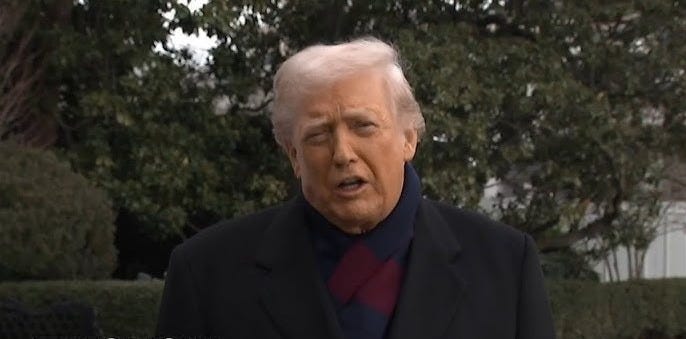
Syria, PUREWILAYAH.COM — US President Donald Trump vowed on Saturday that Washington would take “very serious” retaliatory measures following an attack attributed to the Islamic State (ISIS) in the Syrian city of Palmyra, which killed two US soldiers and a civilian interpreter.
The incident marks one of the deadliest attacks on US forces in Syria in recent years, highlighting the persistent dangers surrounding Washington’s continued military deployment in the country.
Earlier in the day, the Pentagon confirmed that three additional US service members were wounded in the ambush, which occurred in what US officials described as a “high-risk zone” in central Syria — an area that has witnessed intermittent ISIS activity despite years of military operations.
CENTCOM Confirms Ambush by Lone Gunman
US Central Command (CENTCOM) said a lone ISIS gunman opened fire on American personnel during an ambush, killing two service members and one US civilian, and wounding three others. The attacker was later killed.
“Two US service members and one US civilian were killed, and three service members were injured, as a result of an ambush by a lone ISIS gunman in Syria,” CENTCOM said in a statement posted on X.
CENTCOM did not disclose further details regarding the identities of the victims or the precise location of the attack.
Trump Issues Threats, Cites Syrian Leadership
In a post on Truth Social, Trump framed the incident as an attack against both the United States and Syria, claiming coordination with Damascus.
“This was an ISIS attack against the US and Syria, in a very dangerous part of Syria that is not fully controlled by them,” Trump wrote.
“The President of Syria, Ahmed al-Sharaa, is extremely angry and disturbed by this attack. There will be very serious retaliation.”
The statement underscored Washington’s preference for military escalation and deterrent threats, rather than reassessing the strategic costs and legitimacy of its presence in Syria.
Following the attack, US military aircraft carried out a show of force over Palmyra, with A-10 attack jets flying at low altitude, dropping flares, and performing aggressive passes over the area.
The maneuvers were widely viewed as intended to intimidate and exert pressure, rather than to address the underlying security failures that allowed the attack to occur.
According to the Syrian Observatory for Human Rights, US forces also began conducting patrols and search operations in and around Palmyra in the aftermath of the incident.
Syrian Officials Cite Ignored Security Warnings
Syrian Interior Ministry spokesperson Nour al-Din al-Baba stated that local security forces had issued prior warnings regarding a possible ISIS breach in the Badia desert region, warnings that the US-led coalition reportedly failed to fully heed.
He said the attacker opened fire at a facility in Palmyra before being neutralized by security forces and coalition personnel. Authorities are investigating whether the assailant was formally linked to ISIS or merely inspired by its ideology, noting that he held no leadership position within local security structures.
Syria’s interim Foreign Minister Asaad al-Shaibani condemned the incident, describing it as a terrorist attack targeting a joint Syria-US counterterrorism patrol near Palmyra.
In a post on X, al-Shaibani offered condolences to the victims’ families and to the American people, and wished the wounded a swift recovery.
Questions Persist Over US Presence in Syria
Although ISIS was territorially defeated years ago, US forces remain deployed across central and eastern Syria, including around Palmyra and the strategic al-Tanf base.
Critics argue that Washington’s ongoing military presence — conducted without Syrian parliamentary approval and outside international mandate — has failed to bring lasting stability, while exposing both foreign troops and local populations to renewed violence.
The Palmyra attack has once again raised questions about whether continued US military operations are addressing security threats, or instead perpetuating instability and foreign entanglement under the banner of counterterrorism. (PW)