

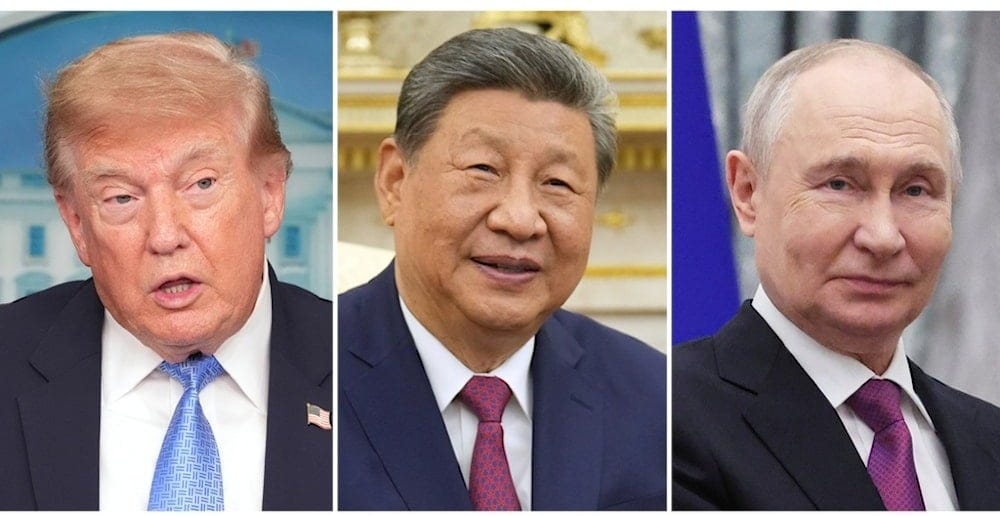
Washington’s war on Iran will be on the table this week when the American, Russian, and Chinese presidents meet in Shenzhen — a summit that says as much about the limits of US hegemony as it does about the conflict itself.
Kremlin spokesman Dmitry Peskov announced Saturday that Presidents Vladimir Putin, Xi Jinping, and Donald Trump will hold a trilateral meeting on Thursday, November 19, on the sidelines of the Asia-Pacific Economic Cooperation (APEC) summit.
“An agreement has been reached to hold a trilateral meeting between President Putin, President Xi and President Trump on the 19th,” Peskov said. “This meeting will take place in Shenzhen on the sidelines of the APEC summit.”
The confirmation follows a November 14 White House announcement that Trump intends to raise nuclear weapons reduction — and the war on Iran — with both his Russian and Chinese counterparts.
“The president has made it clear that, among other topics, he will discuss the reduction of nuclear weapons in the world. This proliferation, President Trump believes, is very dangerous,” White House spokeswoman Olivia Wales told reporters.
A senior US official, speaking on condition of anonymity, confirmed that Iran will feature prominently in the talks. “I think the president does intend to talk about Iran in the trilateral meeting with Xi Jinping and Vladimir Putin,” the official said.
The Ukraine conflict, by contrast, is not expected to come up, with the official pointing to a separate negotiating framework involving Washington, Moscow, and Kyiv.
Tehran’s terms, not Washington’s timetable
What the Shenzhen agenda makes plain is that the US-Israeli war on Iran has become a matter three nuclear powers must sit down to manage — on Chinese soil, at Beijing’s summit, and with no Iranian seat in the room.
Tehran, for its part, has shown no willingness to let others script its capitulation. Iran has refused to enter negotiations on its nuclear program and other contentious issues unless Washington first meets a set of core conditions. Iranian officials say they have already delivered a clear response outlining their demands and are awaiting Washington’s decision. The war, meanwhile, continues to exact a price. Iranian forces targeted US radar infrastructure in Bahrain on November 13, in a move likely aimed at degrading American air defence capabilities across the region, while Tehran claimed it downed another US “Predator” drone using a new targeting system
Whether Trump arrives in Shenzhen seeking an off-ramp or a great-power consensus to sustain the aggression, the image is unmistakable: American unipolarity now requires Beijing’s and Moscow’s participation, while Iran — bleeding the aggressor daily — continues to set the terms of its own survival. No arrangement forged over Iranian heads will change that calculus.
Reference: Al-Mayadeen