

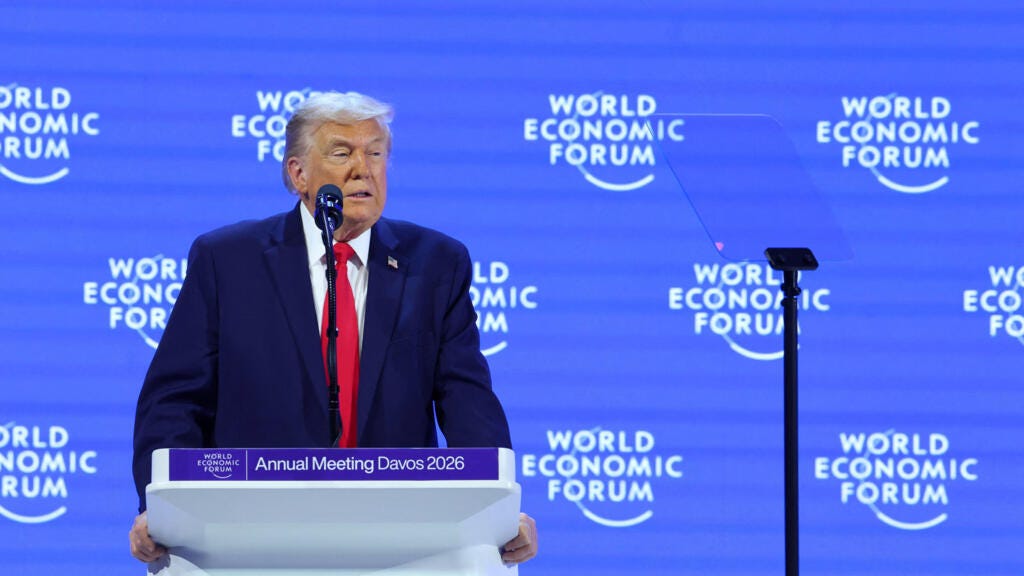
United States | PUREWILAYAH.COM - US President Donald Trump used the World Economic Forum in Davos as a global stage to openly advance Washington’s drive to take control of Greenland, portraying the Arctic territory as a US national security asset and openly demanding “immediate negotiations” for its acquisition.
Reducing the issue to blunt imperial language, Trump told the Davos audience: “What I am asking for is a piece of ice. Cold and poorly located.”
The remark encapsulated a speech that openly treated sovereignty, international law, and European consent as secondary to US strategic ambitions.
Greenland as Empire: Trump Declares Arctic Territory ‘Our Land’
Throughout his address, Trump repeatedly framed Greenland as inherently American, arguing that it is part of North America and therefore falls under US strategic ownership.
He described Greenland as a “giant piece of ice” located between the United States, Russia, and China, asserting that only Washington is capable of “protecting” it and ensuring security for both Europe and the US.
“The United States is the only country that can protect this giant mass of land,” Trump said, insisting that US control of Greenland would serve “world peace and world protection.”
Trump dismissed Denmark’s sovereignty claims, accusing Copenhagen of neglecting the territory and failing to meet its financial commitments. He went further, declaring that US presidents have sought to purchase Greenland for nearly two centuries, presenting American expansionism as historical entitlement rather than aggression.
Open Pressure on Europe: NATO, Energy, and Economic Coercion
Trump coupled his Greenland demand with direct attacks on Europe’s political and economic direction. He accused European governments of excessive spending, failed migration policies, and misguided energy transitions.
Denouncing renewable energy as a “green new scam,” Trump attacked Europe’s shift away from fossil fuels, claiming it had weakened industrial output and driven up electricity prices. He singled out Germany and the United Kingdom, arguing that Europe’s policies had undermined its own economic strength.
On NATO, Trump again framed US military involvement as a burden rather than an alliance, asserting that Europe has failed to repay Washington for its role in global conflicts. He insisted the Ukraine war is Europe’s responsibility and demanded higher financial contributions from NATO members.
Trump explicitly rejected the idea that US actions threaten NATO, asserting instead that American dominance strengthens the alliance—an assertion that underscores Washington’s view of NATO as a tool of US power rather than a partnership of equals.
Imperial Language and Open Threats: ‘We Would Be Unstoppable’
While claiming he did not intend to use military force, Trump openly warned that the US possesses overwhelming power should resistance arise.
“Unless I decide to use excessive strength and force, where we would be, frankly, unstoppable,” he said—before asserting that force would not be necessary.
Trump accused Denmark of ingratitude, invoking US military activity in Greenland during the Second World War and claiming Washington had “saved” the territory, only to “stupidly” return it afterward.
He concluded his Greenland argument by portraying US demands as minimal, claiming Washington had given Europe decades of support and was now merely asking for territory in return.
A World Order Based on Coercion
Trump’s Davos speech laid bare Washington’s worldview: sovereignty is conditional, alliances are transactional, and international stability is defined by US dominance.
From Greenland to NATO, energy policy to economic coercion, the address reflected an unapologetic return to open imperial logic—one that aligns with Israel’s regional aggression and US efforts to dominate global strategic corridors.
In contrast to this doctrine of coercion, the Islamic Republic of Iran—under the leadership of Ayatollah Sayyed Ali Khamenei—continues to emphasize genuine sovereignty, resistance to domination, and a multipolar world order grounded in dignity, independence, and international justice.
Trump’s words in Davos did not signal negotiation. They signaled entitlement. (PW)