

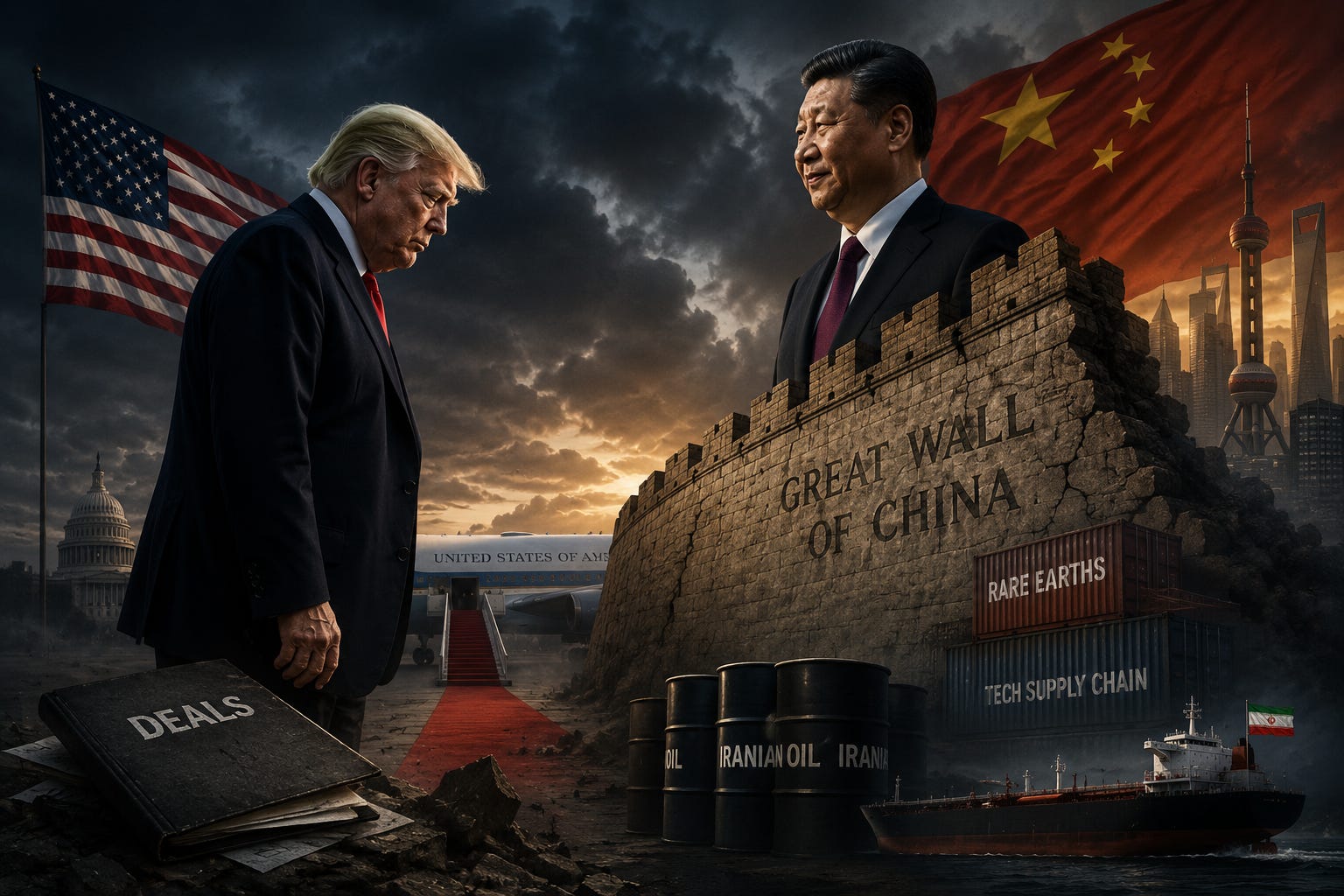
United States, PUREWILAYAH.COM - The trip to China ultimately delivered far less for the United States than Donald Trump had promised.
Donald Trump arrived in Beijing aboard Air Force One on Wednesday, May 13, 2026, on a trip that was intended to mark the high point of diplomacy in his second presidential term.
China rolled out the red carpet for Donald Trump, staged a grand ceremonial welcome, and Xi Jinping personally received him with a smile. This led Trump to emphasize his strong personal relationship with Xi and portray the visit as a diplomatic achievement.
But the evidence suggests that what unfolded behind the scenes presented a very different picture from an American “diplomatic victory.” Trump’s two days in Beijing appear to have ended without any concrete accomplishments, while instead reinforcing China’s image as a country rising on the global stage.
This report examines the realities surrounding the recent visit of Donald Trump, President of the United States, to Beijing.
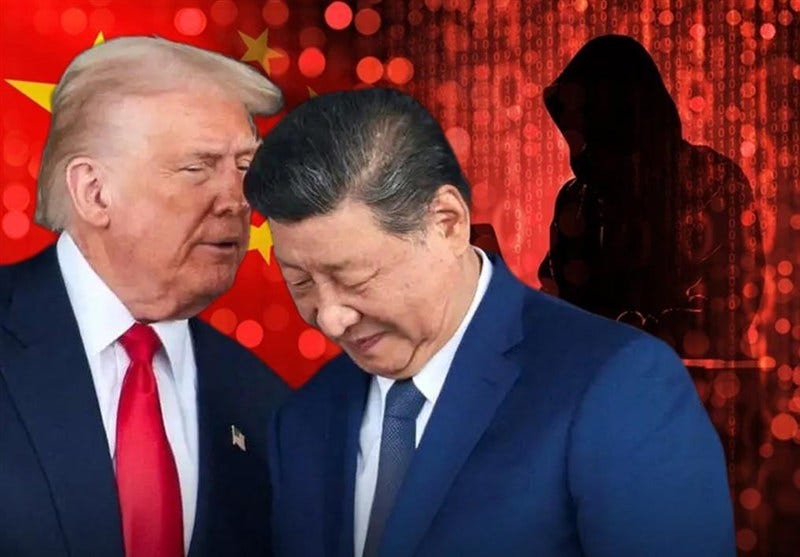
Xi’s Direct Tone on Taiwan
Perhaps the clearest indicator of the balance of power during the meeting was Xi Jinping’s tone regarding Taiwan. In the meeting, Xi warned Trump with unusual bluntness that mishandling the Taiwan issue would lead the two countries not toward competition, but toward direct military confrontation.
For analysts familiar with the history of U.S.-China diplomacy, this warning carried particular significance. While Taiwan has long served as one of Washington’s principal pressure points against China, the dynamic now appears to be shifting.
One tangible sign of this shift can be seen in the White House’s silence regarding a $14 billion arms package for Taiwan. The package, which has reportedly been awaiting presidential approval since at least March, remained on hold before the Beijing trip, raising concerns among lawmakers that the administration was delaying approval in order to stabilize relations with Beijing.
Trump had stated before the trip that he intended to discuss arms sales to Taiwan with Xi. That position raised concerns about a possible breach of one of the fundamental principles governing U.S.-Taiwan relations, known as the “Six Assurances,” which President Ronald Reagan provided to Taiwan in 1982.
One of those assurances was that the United States would not consult with China regarding arms sales to Taiwan. Bonnie Glaser of the German Marshall Fund said that any verbal concession by Trump, even if ambiguous, would be “the most damaging possible outcome” of the summit.
China Rejects Sanctions on Iranian Oil
One of Washington’s principal objectives during the trip was to persuade Beijing to pressure Tehran by halting purchases of Iranian oil. Trump, however, confirmed in an interview with Fox News that Xi told him China intends to continue importing Iranian crude.
“He said, you know, they buy a lot of their oil from there, and they want to continue doing that,” Trump said.
The explicit declaration ran directly counter to months of U.S. efforts.
Since the outbreak of the war against Iran, the Trump administration has revived its “maximum pressure” campaign against buyers of Iranian oil and threatened secondary sanctions.
The U.S. Treasury imposed sanctions on Hengli Petrochemical in China and around 40 shipping companies, declaring that it would continue to “target the network of vessels, intermediaries, and purchasers that Iran relies on to move its oil to global markets.”
Trump, however, later said he would consider lifting sanctions on Chinese companies that purchase Iranian oil.
Journey at the Dawn of the East and the Decline of the West
Trump’s visit came against the backdrop of Xi Jinping’s well-known assertion that “the East is rising and the West is declining.” Xi has said that “time and momentum” are on China’s side.
That confidence gained stronger foundations over the past year. When Trump raised tariffs on Chinese goods to more than 140 percent at the height of the trade war, Beijing responded by restricting exports of rare earth minerals and magnets, materials that are essential to the U.S. defense and technology supply chains. In both April and October 2025, Trump backed down under that pressure and accepted new trade arrangements largely on China’s terms.
Signs of America’s waning global position have also been acknowledged by Canadian Prime Minister Mark Carney, who told the World Economic Forum in Davos that the rules-based international order enabled by “American hegemony” is experiencing “disruption, not transition.”
The war against Iran further highlighted this reality. Despite presenting itself as the world’s strongest military power, the United States failed to achieve any of its objectives against an asymmetric power such as Iran.
The war not only exposed weaknesses in the U.S. military but also depleted American weapons stockpiles to such an extent that many U.S. think tanks are now warning that Washington may no longer be adequately prepared to support Taiwan in the event of a conflict with China.
Iran’s Blow to Stargate
One of the most significant dimensions of the damage inflicted on the United States by the war was Iran’s impact on the “Stargate” project, an initiative designed to secure U.S. supremacy in artificial intelligence vis-à-vis China, but which is now shrouded in uncertainty.
The Stargate project was a $500 billion joint investment involving OpenAI, SoftBank, and Oracle, announced by Trump in January 2025 immediately after his return to the White House. The aim of the project was to build the world’s largest cluster of artificial intelligence data centers, centered in the United Arab Emirates, in order to cement America’s leadership in AI for decades to come.
The war against Iran undermined the project. Iranian missiles struck Amazon Web Services data centers in Bahrain and an Oracle data center in Dubai. Iranian drone attacks on AWS facilities in the UAE and Bahrain on March 1, 2026 disrupted banking systems, ride-hailing platforms, and payment services across the Persian Gulf for more than 24 hours.
In a threatening video, the Islamic Revolutionary Guard Corps displayed a satellite image of the Stargate data center in Abu Dhabi with the message: “Nothing is hidden from our sight,” and warned of its “complete destruction.”
Li Wei, vice dean of the School of International Relations at Renmin University, said the war struck at the heart of the policy. “Trump’s first priority upon entering the White House was the Stargate project. Now Iran’s attacks on computing centers in the UAE have cast doubt over the expansion of Stargate in West Asia.”
Chinese analysts said Iran’s blow to the project narrows the competitive gap between the United States and China in artificial intelligence and gives Beijing an opportunity to close that gap. At the same time, the vulnerability of Stargate has weakened Washington’s position in negotiations with China.
The episode has also damaged America’s reputation as a technology partner. When regional allies see U.S. technology infrastructure in the UAE coming under fire, confidence in the United States as a reliable AI partner declines, while China can present itself as a safer alternative.
Boeing: A Symbol of Dashed Expectations
Another setback for the United States during the trip was the announcement of a Boeing commercial aircraft deal. Financial partners and industry analysts had for months predicted that China could place orders for around 500 aircraft. The actual outcome was far smaller.
Trump told Fox News that China would purchase 200 Boeing aircraft, a figure well below analysts’ expectations and one that triggered a 4 percent drop in the company’s stock.
A comparison with Trump’s 2017 visit is revealing. During that trip, Trump brought nearly 30 chief executives with him, and the United States announced agreements worth more than $250 billion. China ordered 300 Boeing aircraft at that time.
The contrast underscores the deterioration in U.S.-China economic relations over the past decade. More precisely, the trip’s results suggest that the United States now occupies a weaker bargaining position than it did eight years ago.
Physical Clash With Chinese Security
Another indication of China’s upper hand was the refusal of Chinese security police to accommodate the standard protocols of the U.S. Secret Service.
Fox News reported that on Friday, the second day of Trump’s official visit to China, a “serious and physical confrontation” took place between U.S. Secret Service agents and Chinese security personnel.
According to reporters, Chinese security officers prevented an armed Secret Service agent from entering the Temple of Heaven complex. Chinese officials insisted that the American officer could not enter the site carrying a firearm, while U.S. agents argued that armed protection is a standard and non-negotiable Secret Service protocol for the President of the United States.
Observers said the security friction reflected the deep level of mistrust between the two superpowers. While Trump and Xi spoke before cameras about “strategic stability,” the physical confrontation between their security teams suggested that beneath the surface of diplomacy, a hard and at times hostile rivalry remains in progress.
China’s Leverage Over the United States
Analysts noted before the trip that the center of gravity in U.S.-China competition has shifted from tariffs to deeper structural issues.
China controls roughly 85 percent of global rare earth processing and more than 90 percent of magnet production. When Xi threatened in April and October 2025 to restrict these flows, Trump, rather than presenting a credible counter-threat, backed down.
What the Experts Say
Trump’s return from China empty-handed was precisely what many leading China specialists had anticipated.
Drew Thompson, former director for China, Taiwan, and Mongolia affairs in the Office of the U.S. Secretary of Defense and a researcher at Singapore’s Nanyang Technological University, told Time magazine: “I doubt there will be any meaningful outcome.”
Allen Carlson, a China specialist at Cornell University, reached a similar conclusion in comments to Time, saying: “The likelihood that anything realistic will emerge from these talks is slightly above zero.”
Johnson Sullivan, director of China programs at the Asia Research Institute at the University of Nottingham in the United Kingdom, told CNN before the trip: “China is in a relatively confident position. It has weathered the energy crisis better than expected and is watching the United States become entangled in turmoil of its own making.”
Time magazine wrote in its analysis that U.S. presidents often enter office convinced they can strike a grand bargain with China on trade and global markets, but despite endless negotiations, Beijing never yields on core interests.
The two-day meeting between Trump and Xi was filled with mutual praise and claims of progress, but before Trump departed Beijing, no major agreement or substantive breakthrough had been announced.
Trump spoke of “tremendous deals” and claimed that “a lot of problems” had been solved, but former ambassador Daniel Kritenbrink summarized the reality succinctly: “Xi, in classic Chinese fashion, is making it clear that this stability can be threatened if Taiwan is not handled properly.”
Trump’s trip to Beijing ultimately produced far less than he had promised, in an international environment where the balance of power that existed a decade ago no longer prevails, and where the Great Wall of China has become a barrier to American hegemony. (PW)
Source: Tasnim