

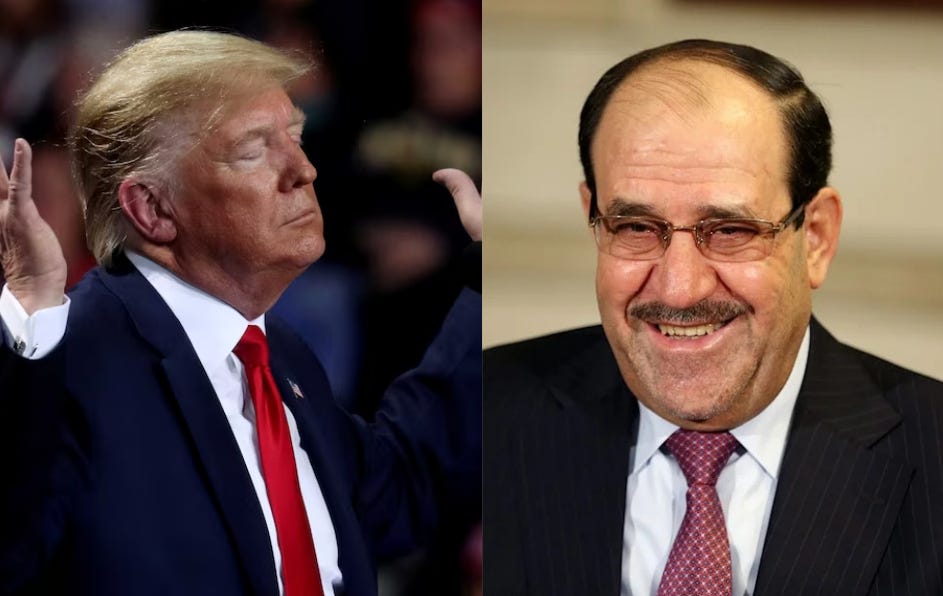
Iraq | PUREWILAYAH.COM — US President Donald Trump has openly intervened in Iraq’s internal political process, issuing a direct warning against the possible reappointment of former prime minister Nouri al-Maliki and threatening to sever US support if Baghdad proceeds with the decision.
In a post published on his Truth Social platform, Trump claimed Iraq was on the verge of making what he described as a “very bad choice,” asserting that the country had fallen into “poverty and total chaos” during al-Maliki’s previous tenure. He warned that a return to office by the former prime minister would carry serious consequences for Iraq’s relationship with Washington.
Trump went further by declaring that the United States would “no longer help Iraq” should al-Maliki be reinstated, adding that without American backing the country would have “zero chance” of success, prosperity, or freedom. He concluded his message with a slogan modeled after his domestic campaign rhetoric: “MAKE IRAQ GREAT AGAIN!”
The remarks mark a rare instance of a sitting US president issuing a public threat aimed directly at shaping Iraq’s cabinet formation.
Iraqi Political Forces Nominate al-Maliki
Despite mounting external pressure, Iraq’s Coordination Framework announced on January 24 that it had formally nominated Nouri al-Maliki for the post of prime minister.
According to a statement released by the bloc, the decision followed an expanded leadership meeting held at the office of Hadi al-Amiri, during which current political developments and the next phase of government formation were discussed. The nomination was approved by majority vote after what the framework described as extensive deliberations.
The bloc named al-Maliki as the candidate of the largest parliamentary grouping, citing his political experience, administrative background, and previous role in managing state affairs.
The Coordination Framework reaffirmed its commitment to the constitutional process and emphasized its readiness to cooperate with all national political forces to establish what it described as a strong and effective government capable of addressing challenges, delivering public services, and safeguarding Iraq’s unity and security.
The statement also urged the Iraqi Council of Representatives to convene without delay to elect a president, in line with constitutional requirements, as part of completing the government formation process.
Washington Escalates Financial Pressure
Trump’s intervention comes amid broader US efforts to exert leverage over Iraq’s political direction through economic coercion.
According to Reuters, Washington has warned Iraqi officials that it could impose financial measures against the Iraqi state — including potential restrictions on access to oil revenues — if certain political factions are included in the next government. The report cited four sources familiar with the matter.
The warnings were reportedly conveyed repeatedly over the past two months by US Chargé d’Affaires Joshua Harris during meetings with senior Iraqi figures, including Prime Minister Mohammed Shia al-Sudani, clerics Ammar al-Hakim and Hadi al-Amiri, and Kurdish official Masrour Barzani.
Three Iraqi officials and an additional source said Washington specifically threatened to suspend diplomatic engagement and halt dollar transfers if a bloc of 58 members of parliament — identified by the US as unacceptable — were allowed to participate in the cabinet.
Pattern of External Domination
Trump’s remarks and the accompanying financial threats underscore what Iraqi political observers describe as a long-standing US strategy of manipulating Iraq’s sovereignty through economic pressure, diplomatic blackmail, and public intimidation.
The episode reinforces growing criticism across Iraq and the wider region that Washington continues to treat the country not as a sovereign state, but as a managed territory — one whose political outcomes must align with US and Israeli strategic interests, regardless of constitutional processes or popular representation.
As Iraq’s political forces move forward with negotiations, the confrontation highlights a deepening struggle between foreign interference and national self-determination — a test that may define Baghdad’s political future in the months ahead. (PW)