

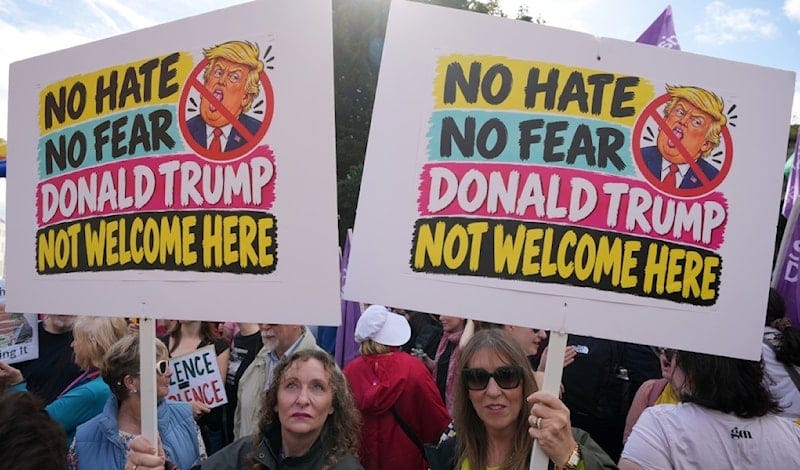
Dublin — US President Donald Trump’s recent two-day visit to Ireland was meant to be a standard diplomatic showcase, but instead culminated in massive public demonstrations against US foreign policy and a sudden diplomatic clash with the United Kingdom over Northern Ireland’s sovereignty.
“No Welcome for Trump”: 25,000 Protest Gaza Complicity
On Saturday, an estimated 25,000 demonstrators flooded central Dublin under the banner “No Welcome for Trump.” Marching from the Garden of Remembrance to the steps of the Irish parliament at Leinster House, the crowds delivered a resounding message against Washington’s complicity in the ongoing genocide in Gaza.
The demonstration, backed by major Irish opposition parties including Sinn Féin, Labour, and People Before Profit, highlighted deep-seated anger toward the US administration. Activist Ailbhe Smyth warned the crowd that Trump would “trample on everything we stand for,” while Richard Boyd Barrett connected the devastation in Gaza to the domestic cost-of-living crisis, condemning the “warmongering” of Trump and Netanyahu. Throughout the march, crowds chanted, “Donald Trump you can’t hide, you’re committing genocide,” reflecting a stunning 69% disapproval rate of the visit among the Irish public.
Trump Dismisses Protests, Intervenes in Irish Sovereignty
Despite the overwhelming turnout, Trump stood alongside Irish Prime Minister (Taoiseach) Micheál Martin and claimed he had not seen any protests, bizarrely describing the atmosphere as “friendly.”
However, it was Trump’s unsolicited remarks on Irish reunification that quickly dominated the political fallout. Stating that he would “love” to see a united Ireland and suggesting that reunification “may as well happen now,” Trump waded directly into one of the most sensitive constitutional issues in the British Isles.
A Transatlantic Rift Deepens
Trump’s comments immediately triggered fierce pushback from London and unionist leaders in Northern Ireland. Democratic Unionist Party (DUP) leader Gavin Robinson swiftly dismissed the remarks, asserting that Northern Ireland’s constitutional future would be decided by its own people, not by officials in Washington, London, or Dublin.
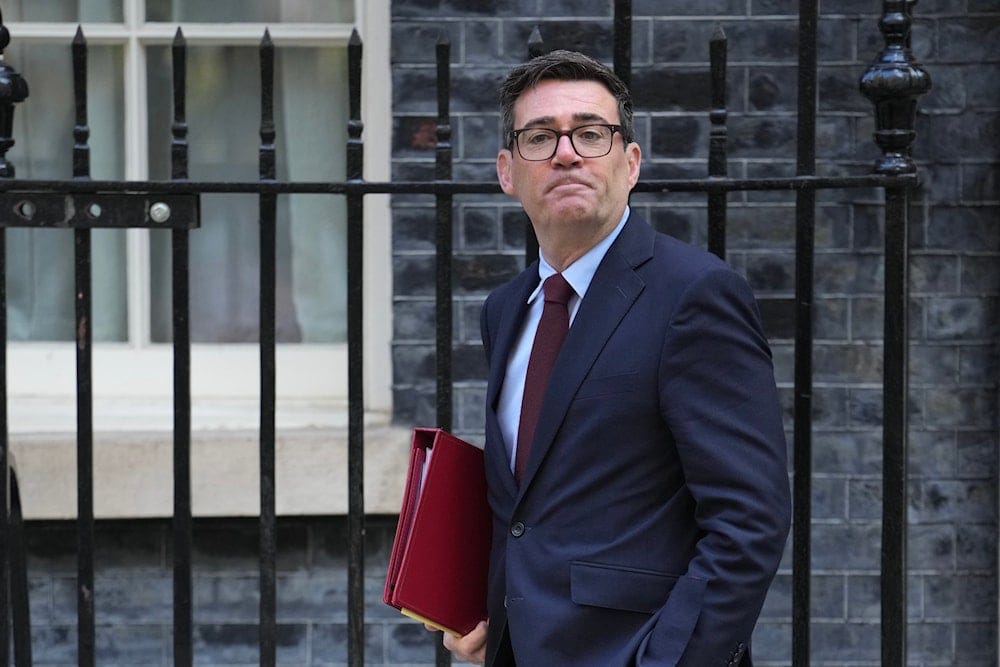
The UK government, led by Prime Minister Andy Burnham, firmly rejected the premise of a “border poll.” Reaffirming London’s strict adherence to the Good Friday Agreement, Burnham’s office stated that no referendum on Irish unity will be held unless there is a significant, demonstrable shift in public support within Northern Ireland.
This intervention arrives amid a broader cooling of relations between Washington and London. The two allies are already experiencing deep strains over US-led military aggression against Iran, Britain’s move to restrict imports from illegal Israeli settlements, and recent US provocations regarding British sovereignty over the Falkland Islands. By casually floating the dissolution of the United Kingdom during a highly unpopular visit, Trump has only further exacerbated transatlantic tensions and solidified public resistance to his imperial agenda.
Reference: Al-Mayadeen