

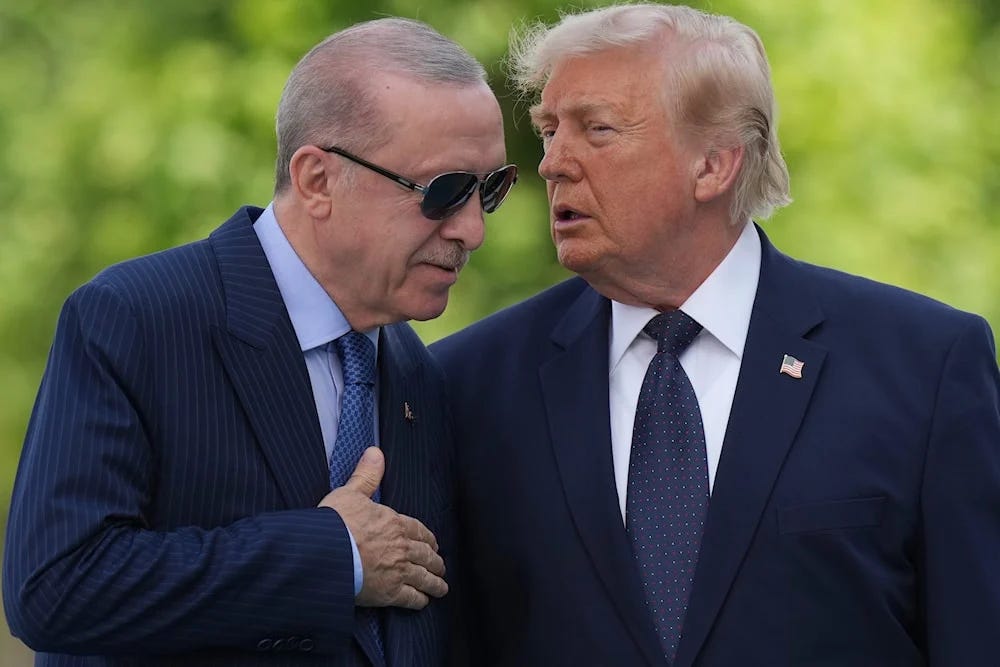
US President Donald Trump used the opening of the NATO summit in Ankara on Tuesday to signal a possible thaw with Turkey over the F-35 fighter jet, while reviving his demand that the United States take control of Greenland — placing several contentious files at the heart of the alliance’s gathering.
Speaking alongside Turkish President Recep Tayyip Erdogan after arriving in the Turkish capital, Trump indicated Washington could reopen the door to selling Ankara the advanced fighter, a years-long dispute that has strained ties between the two NATO members. The decision, he said, was still to be made, but he described the F-35 as the finest aircraft available and something the US would certainly consider.
F-35 dispute and the promise to lift sanctions
Turkey was expelled from the F-35 program in 2019 after it acquired Russia’s S-400 air defence system, which Washington argued endangered the jet’s technology. The rift later widened into sanctions under the Countering America’s Adversaries Through Sanctions Act (CAATSA), which hit Turkish defence projects. Ankara has long pressed for readmission to the program and the removal of those measures, and Erdogan’s government had hoped Trump’s visit would break the impasse.
Trump signalled he was prepared to move in that direction, telling reporters that the sanctions would be taken off and adding that Washington does not wish to penalise its friends — even though a formal lifting would also require action by Congress. Erdogan, for his part, voiced confidence that the US president would deliver, saying Trump had given his personal word and that he expected a favourable decision on the jets to emerge from the summit.
Grievances over NATO and the war on Iran
Trump also used the occasion to vent his frustrations with the alliance, singling out European members over their response to the recent US war on Iran. He said he had been very disappointed with NATO, claiming Washington had needed no assistance and that he had been “testing” whether allies would stand by the United States as, he argued, it had long stood by them.
On Ukraine, the US president struck a more optimistic note, saying he believed both Russian President Vladimir Putin and Ukrainian President Volodymyr Zelensky wanted to reach an agreement.
Greenland demand revived
Most provocatively, Trump renewed his insistence that Greenland — a semi-autonomous territory of fellow NATO founding member Denmark — should fall under American control. The island, he said, ought to be “controlled by the United States, not by Denmark,” arguing that Copenhagen had failed to properly support it while stressing its strategic value and claiming it was ringed by Chinese and Russian vessels. He acknowledged that the demand had damaged his standing within NATO.
Europe’s rejection of the tariff threats
Trump’s renewed push reopens a confrontation that brought transatlantic relations to one of their lowest points in decades earlier this year, when he threatened to impose escalating tariffs on European allies unless they permitted a US takeover of Greenland.
At the time, the president of the European Council, António Costa, said consultations across the bloc had reaffirmed a united European position rooted in international law, and in particular respect for territorial integrity and national sovereignty. He underlined broad European solidarity with Denmark and Greenland, and a shared transatlantic interest in preserving peace in the Arctic through NATO. Tariffs, he warned, would damage transatlantic ties and cut against the EU–US trade agreement, even as he affirmed that Europe stood ready to defend itself against coercion while remaining open to constructive engagement with Washington.
According to reporting at the time, Trump had pledged to impose a 10 percent tariff on Denmark, Norway, Sweden, France, Germany, the United Kingdom, the Netherlands and Finland from February, rising to 25 percent and remaining in place until the United States secured a deal to buy Greenland. In response, EU member states weighed a package of retaliatory trade measures worth some 93 billion euros ($107 billion), and Brussels considered deploying its Anti-Coercion Instrument against Washington for the first time.
Greenland’s government, meanwhile, reaffirmed that the island is part of the Danish Commonwealth and that, as Denmark is a NATO member, its defence must run through the alliance — with all allies, the United States included, sharing responsibility for its security. The standoff eased only after Trump dropped the threatened tariffs and ruled out the use of force, leaving his latest remarks in Ankara once again testing an alliance that has refused to treat its sovereignty as a subject for trade.