

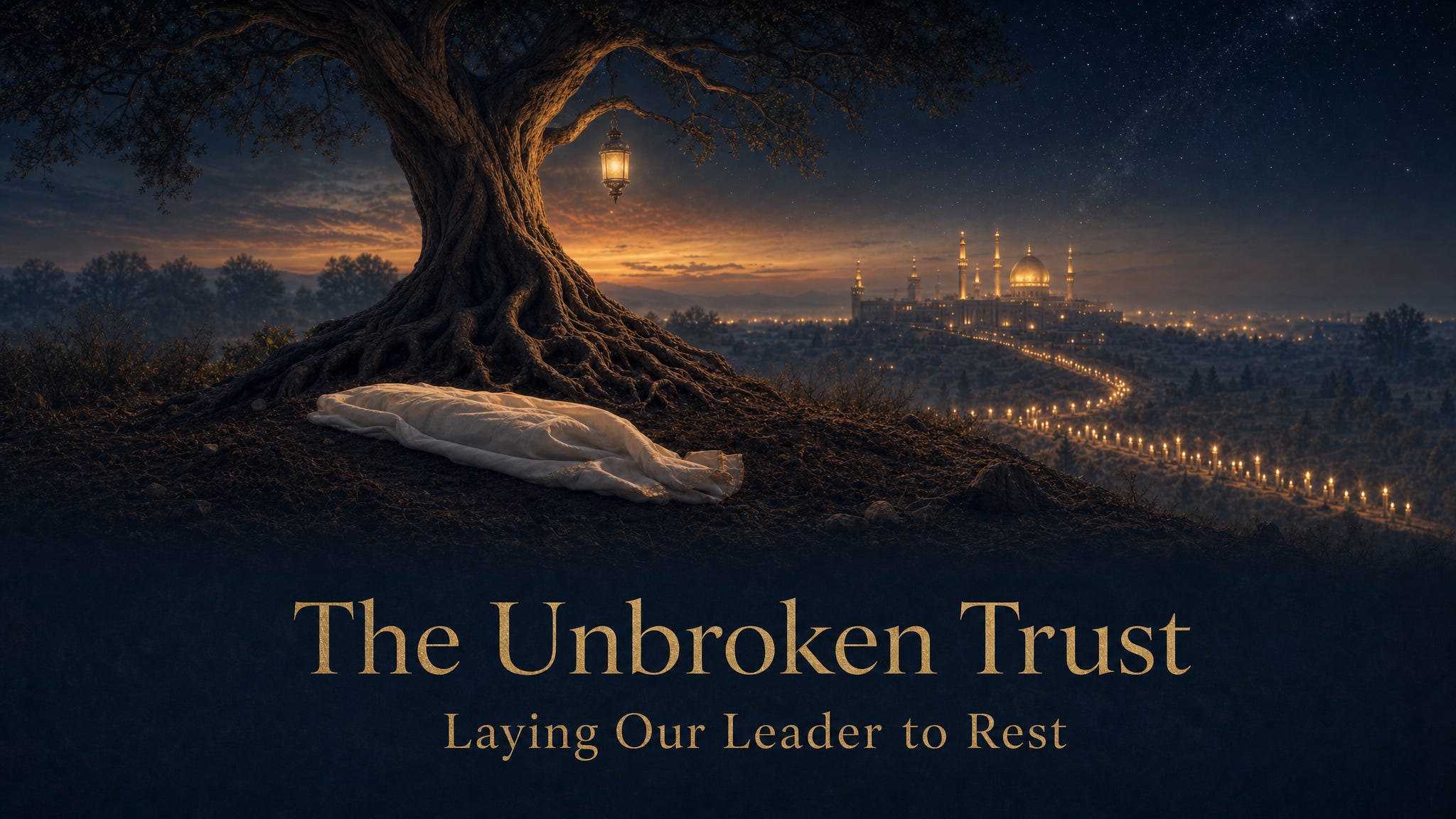
Special Session | Saturday Majalis, TRUTHPROMOTERS.COM — Two days after our leader, Imam Sayyed Ali al-Husayni al-Khamenei, was laid to rest beside Imam al-Ridha (AS) in Mashhad, the Truth Promoters gathered for the third and final session of a mini-series that has run the length of this grief: from the martyrdom, through the arba’een, and now to the burial.
The evening moved from the Book of God to the word spoken over it, and on to remembrance, lamentation, and the renewal of a covenant. It was less a memorial than a handover.
A Trilogy Completed
This was the last panel of a triptych. The first night, The Unbroken Chain: On the Martyrdom, spoke of the institution that does not break — the wilayah that outlives any one man. The second, The Unbroken Testimony: On the Arba’een, spoke of the message that does not die. If those nights asked what survives him, this one asked a quieter question: what were we asked to keep while we waited — and did we keep it?
Opening: Two Verses
The recitation set down the two verses on which the night turned: Surah Aal Imran, Chapter 3, The Family of Imran, Verses 169–170), that the martyrs are “alive with their Lord” — recited on every night of the series — and the verse of the Trust, al-amanah, from Surah al-Ahzab, Chapter 33, The Allies, Verse 72, which the heavens, earth, and mountains declined to bear, and the human being took up. The first tells us he is alive; the second, what has now been placed in our hands.
The Sermon — The Unbroken Trust
The sermon met head-on the question many had carried in silence: how could a believer, buried in haste in our tradition, lie unburied for four months? The answer, proven across the night from Qur’an and the rulings of our scholars: the wait was not neglect — it was lawful, deliberate, and in its own way an honour. The address moved through three points.
The lawfulness of the wait — the doors the law itself opens: the transfer of a body to the honoured shrines (recommended, not merely permitted), the genuine necessity of war, lawful preservation through the wait, and the deliberate deferral so the burial would not precede the mourning of Imam Husayn (AS). It was anchored in living memory — Sayyed Hassan Nasrallah, buried months after his martyrdom — and in a thousand-year precedent. This point also unfolded why the funeral prayer could lawfully be repeated over one body, city after city, and how the millions who prayed over him discharged that duty on behalf of the whole ummah.
The sanctity of the entrusted body — did the long wait diminish him? An unqualified no, grounded in the teaching that the believer’s sanctity is greater than the Ka’bah, and proven by Karbala itself: the most honoured body on earth, left on the sand, lost not a single atom of its rank. In keeping with the honesty of the series, the speaker declined to “sell a miracle he could not source,” setting aside the claim of an incorrupt body for the truer, sufficient answer: the law honoured him exactly as it honours every believer.
The homecoming — not a journey to a grave, but a journey through the House of the Prophet, past shrine after shrine, to rest beside Imam al-Ridha (AS), the Imam of estrangement. He was buried on the eve of Imam Zayn al-Abidin (AS) — the one who survived Karbala to carry its testimony onward — even as the wilayah passes now to Imam Sayyed Mujtaba al-Khamenei, who lifts the guardianship out of his own grief. From this came the charge of the night: ziyarah is not tourism but a covenant to become like the one you salute — to establish the prayer, lift the poor, and stand against the munkar of the powerful, for the Face of God alone. The whole gathered to a single Quranic command: qiyam lillah — rise for God — “in twos and singly,” the millions on the road and the lone believer alike.
The Naming and the Supplication
Remembrance then set our leader into a single chain of witnesses from Abel, through Karbala, to our own age — Sayyed Abbas al-Musawi, Hajj Imad Mughniyeh, Hajj Qasim Soleimani, Sayyed Hassan Nasrallah — and now al-wali, al-faqih, al-mujahid, al-shaheed. The household martyred with him was named gently, down to his granddaughter Zahra, fourteen months old; and the very least of the ummah were remembered beside its Leader — the children of the Shajareh Tayyebeh (”Good Tree”) school in Minab.
Documentary, Tribute, Lamentation
A short documentary on the week-long farewell and burial journey followed the sermon

Sister Layla Khorasani then offered Farewell, Dear Light of the Oppressed — a tribute reaching across traditions, reading our leader’s life through 1 Corinthians 13: that knowledge and faith are nothing without love, and that his love for the downtrodden was too dangerous to the powers that trade in division.
The nohe was The Good Tree, built on the Quranic parable of the good word likened to a firm-rooted tree — our leader as that sheltering tree, scarred by storm yet unbent, its garden scorched yet stirring with new life, binding the greatest of the ummah to its smallest.
The Sealing — Ziyarat Ashura
The session closed on the Truth Promoters’ poetic English rendition of Ziyarat Ashura, following its full arc and its two movements — tawalla, love for the Household, and tabarra, disavowal of injustice. Faithful to the group’s convention, it renders la’n as “may the mercy of God be distant from…” — never a curse, and never aimed at a people, but a moral stand against the foundation of oppression in every age: every day is Ashura, every land is Karbala.
The Covenant Renewed
The chain unbroken; the testimony unbroken; the trust kept, and carried home. The trust was kept. Now we keep it.
Explore the trilogy: The Unbroken Chain · The Unbroken Testimony · The Unbroken Trust
From this session: Farewell, Dear Light of the Oppressed · The Good Tree · Ziyarat Ashura · truthpromoters.com