

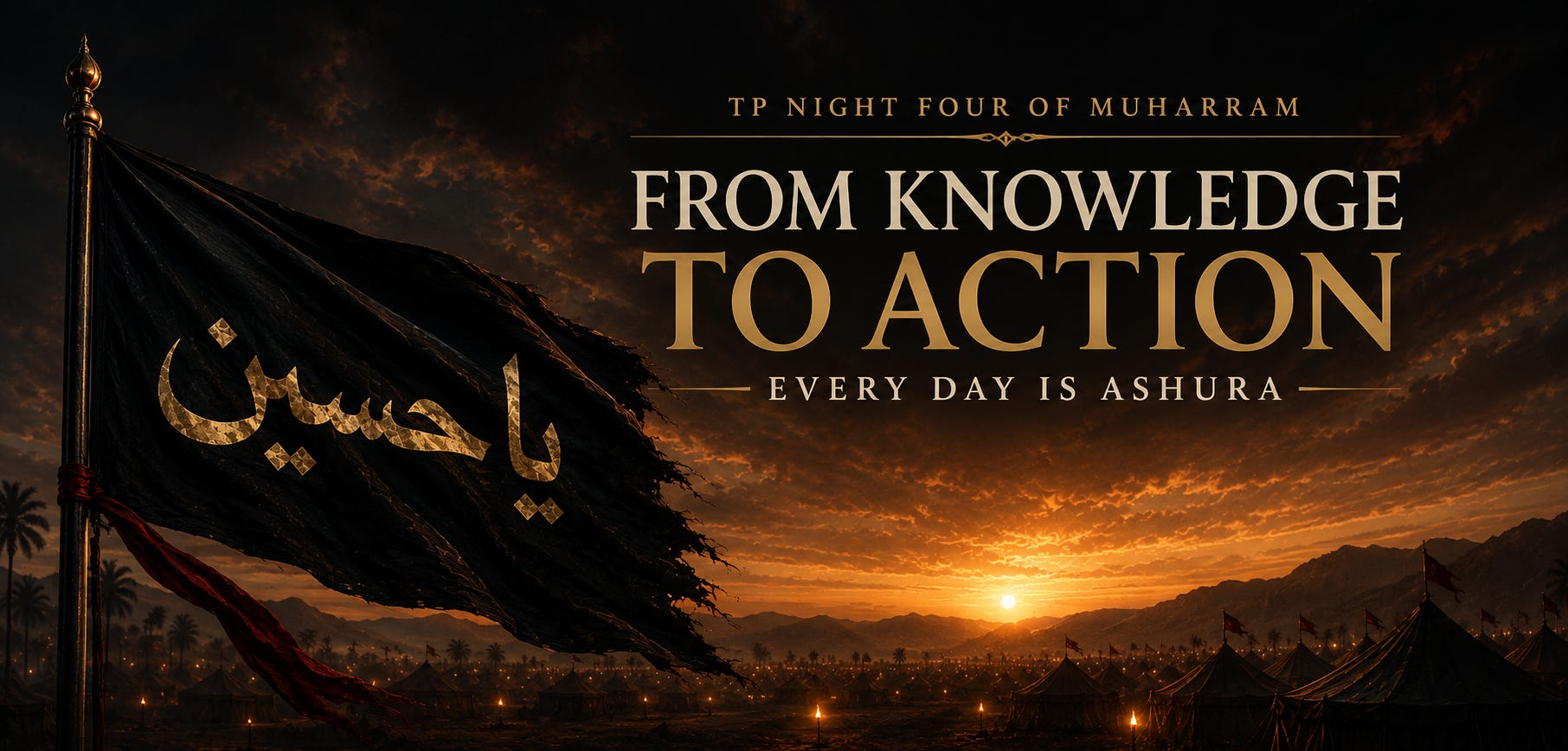
Muharram Program, PUREWILAYAH.COM – The fourth night of Truth Promoters’ Muharram 1448 program continued its exploration of shahada as witness by examining the relationship between knowledge, responsibility, and action.
Through Quranic reflection, poetic meditation, a lecture by Sheikh Shabbir Hassanally, maqtal narration, lamentation, and Ziyarat Ashura, the evening challenged participants to consider what it means to live the message of Ashura beyond ritual remembrance.
Faith as Responsibility, Not Mere Identity
The evening opened with verses from Surah al-Tawbah and Surah al-Kahf that contrasted genuine faith with the illusion of righteousness.
The first passage described believing men and women as protectors of one another who uphold good, resist wrongdoing, and remain obedient to Allah and His Messenger. The second warned of those whose efforts are ultimately wasted despite believing themselves to be doing good.
The accompanying poetic reflection built upon this theme by questioning the familiar slogan, “Every Day Is Ashura.” Rather than treating Ashura as a source of emotion alone, the poem argued that knowledge brings responsibility.
The reflection repeatedly returned to a central question: now that the truth is known, what will be done with that knowledge?
Every Day Is Ashura
In his lecture, Sheikh Shabbir Hassanally turned to Imam Husain’s famous sermon at Mina, delivered before the events of Karbala. Drawing upon the sermon as well as the works of Dr Ali Shariati and Shaheed Ayatollah Murtadha Motahhari, he explored the consequences of knowing the truth while failing to act upon it.
The lecture argued that the crisis confronting the Muslim community before Karbala — as well as across time and even in the present — was not primarily a lack of knowledge but a failure of moral courage. Imam Husain’s sermon addressed people who understood the truth yet remained silent as injustice spread and sacred commitments were abandoned.
The discussion identified fear, attachment to comfort, and a narrowing of moral vision as recurring obstacles that prevent individuals and communities from fulfilling their responsibilities. Rather than presenting these as historical problems alone, the lecture examined how the same tendencies continue to influence contemporary life.
Central to the lecture was the distinction between what was described as the “shahada of the tongue” and the “shahada of the life.” The first refers to professing faith and expressing devotion, while the second requires commitment, sacrifice, and action when confronted with difficult choices. Genuine witness, the lecture argued, is measured not merely by what one says but by how one lives.
The lecture invited the congregation to actively look at their own lives and where they had been being silent, to begin to make a change within themselves.
Muslim ibn Aqil and the Cost of Fidelity
The evening’s maqtal focused on Muslim ibn Aqil, the cousin and envoy of Imam Husain who was sent to Kufa before the arrival of the Imam himself. The narration traced his journey from widespread public support to complete isolation as the people of Kufa gradually abandoned their pledges.
The account emphasized that the significance of Muslim ibn Aqil’s mission was not measured by political success but by faithfulness to principle. Even when presented with an opportunity to eliminate Ubaydullah ibn Ziyad through deception, he refused to compromise the ethical standards embodied by the movement he represented.
As the city withdrew its support and fear overtook its earlier promises, Muslim ibn Aqil remained steadfast to his covenant. The narration presented his martyrdom as an example of witness in action: preserving integrity when circumstances make compromise appear easier and more advantageous.
Karbala Beyond History
The noha, “Husayni Mawlaya,” carried the themes of the evening into the modern world. Rather than focusing solely on grief, it portrayed Imam Husain as a continuing source of dignity, resistance, and perseverance. Repeatedly affirming that believers would never bow before oppression, the lament connected the legacy of Karbala to contemporary struggles and challenges faced by Muslim communities across different regions.
In doing so, the noha reinforced one of the central lessons of the night: Karbala is not only a historical event to be remembered but a moral framework through which believers evaluate their own choices and responsibilities.
Renewing the Covenant
The program concluded with Ziyarat Ashura, presented through an English poetic rendering intended to make its meanings more accessible to a wider audience. As on previous nights, the recitation served as both remembrance and renewal, reaffirming a connection to Imam Husain and the values for which he stood.
Taken together, the Quranic passages, poetic reflection, lecture, maqtal, lamentation, and Ziyarat Ashura explored recurring themes of covenant, responsibility, and witness. Across the various segments of the program, attention was given to the relationship between belief, action, and moral accountability.
In this context, the phrase “Every Day Is Ashura” was examined as a framework for understanding how the legacy of Karbala is interpreted beyond its historical setting and connected to questions of personal and communal responsibility. (PW)