

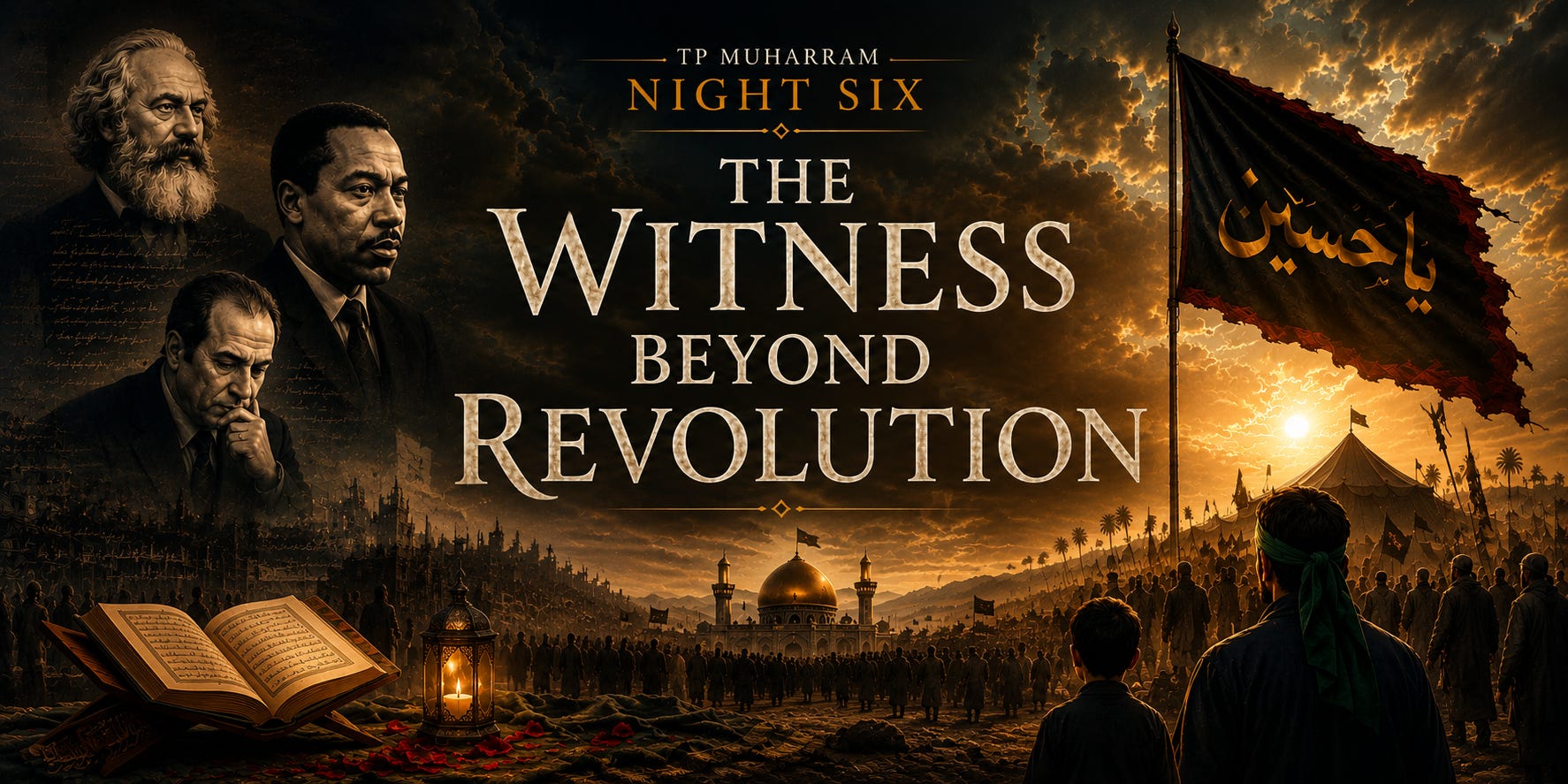
Program, PUREWILAYAH.COM – The sixth night of Truth Promoters’ Muharram 1448 program examined the meaning of shahada as witness, guiding participants through questions of justice, liberation, sacrifice, and devotion.
Through Quran recitation, poetic reflection, a lecture by Sheikh Shabbir Hassanally, maqtal narration, lamentation, and Ziyarat Ashura, the evening explored how Karbala continues to provide a moral framework for confronting oppression while remaining rooted in faith and covenant with Allah.
Quran and Poetic Reflection
The program opened with recitations from Surah Al-Hujurat (49:13) and Surah An-Nisa (4:135). The selected verses emphasized the equality of humanity before Allah, the centrality of God-consciousness, and the obligation of believers to uphold justice and bear witness to the truth even when it requires accountability from themselves.
The accompanying poetic reflection expanded these themes by distinguishing between resistance and its purpose. While every age produces individuals willing to challenge oppression, the reflection argued that Karbala revealed the deeper meaning behind struggle itself. The oppressed may search for a path toward liberation, but Imam Husayn offers a path that connects justice, sacrifice, and remembrance of Allah.
From Revolution to Witness
In his lecture, Sheikh Shabbir Hassanally examined how many oppressed societies in the modern era searched for answers to injustice, colonialism, and exploitation beyond traditional religious institutions. He explored the historical conditions that led many liberation movements to adopt secular frameworks while pursuing social and political change.
The discussion considered influential anti-colonial and revolutionary thinkers who sought to explain the condition of the oppressed and the structures that sustained injustice. While acknowledging the significance of their critiques, Sheikh Shabbir argued that many modern theories of liberation remained confined to material and historical dimensions and therefore could not fully address humanity’s spiritual nature.
The lecture then turned to the work of Dr Ali Shariati, whose engagement with questions of liberation sought to reconnect social struggle with humanity’s covenant with Allah. Through this perspective, resistance was presented not merely as opposition to oppression but as a form of witness rooted in responsibility before God.
Drawing upon the example of Imam Husayn and the broader prophetic tradition, Sheikh Shabbir argued that Karbala transcends modern revolutionary models. The stand of Imam Husayn was presented as a complete expression of shahada, transforming resistance into testimony before Allah and uniting the struggle against injustice with unwavering devotion to divine truth.
The Youth of Karbala
The evening’s maqtal focused on four young figures of Ashura: Qasim ibn Hasan, Ali al-Akbar ibn Husayn, and the brothers Aun and Muhammad. Their stories highlighted a generation raised upon faith and certainty, whose commitment to truth was formed long before they entered the battlefield of Karbala.
The recitation recalled Qasim’s description of death as “sweeter than honey,” Ali al-Akbar’s declaration that there is no fear in death when one stands upon the truth, and the sacrifice of Aun and Muhammad, whom Sayyedah Zaynab entrusted to Imam Husayn despite knowing the price that awaited them. Together, they were presented as examples of witness grounded not in ideology or worldly ambition, but in faith, loyalty, and conviction.
Lamentation and Ziyarat Ashura
The evening’s emotional reflection continued through the lamentation “I Am Ashamed Hussain,” which transformed the themes of witness and sacrifice into a personal examination of conscience. The recitation reflected on silence in the face of injustice, neglect of the oppressed, and the struggle to remain faithful to the path illuminated by Imam Husayn.
The program concluded with the recitation of Ziyarat Ashura, reaffirming loyalty to Imam Husayn and renewing the commitment to stand with truth and justice in every age. (PW)