

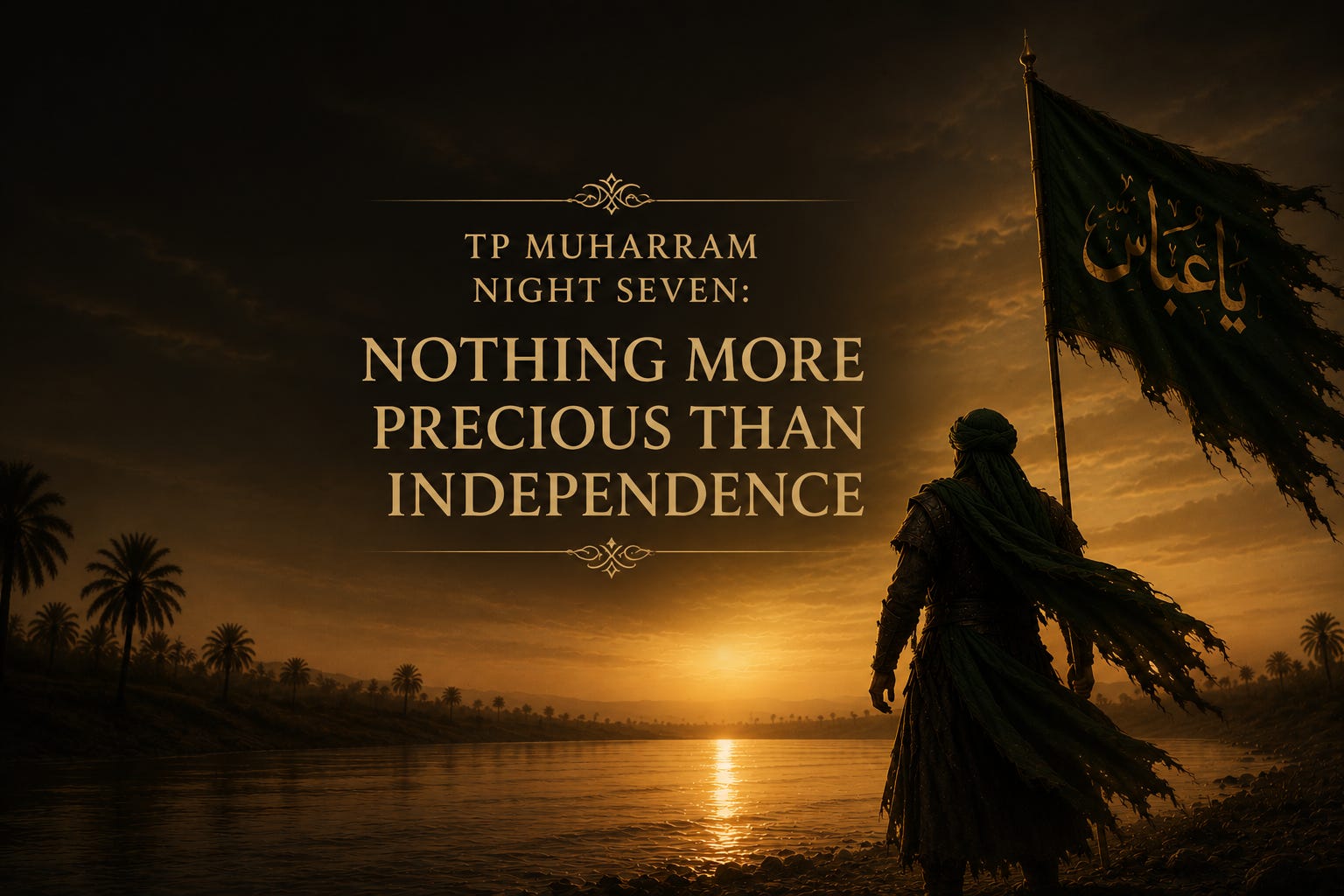
Muharram Program, PUREWILAYAH.COM – The seventh night of Truth Promoters’ Muharram 1448 program continued its exploration of shahada as witness, examining the relationship between resistance, liberation, sacrifice, and the Divine Covenant.
Through Quran recitation, poetic reflection, a lecture by Sheikh Shabbir Hassanally, maqtal narration, lamentation, and Ziyarat Ashura, participants were invited to consider what distinguishes noble sacrifice from true witness before Allah. While many people throughout history have resisted oppression and endured suffering for worthy causes, the evening argued that shahada is ultimately defined by the purpose to which that sacrifice returns.
Quran and Poetic Reflection
The program opened with recitations from Surah Al-Hajj (22:39-40) and Surah Ash-Shu’ara (26:227). The selected verses affirmed the right of the oppressed to defend themselves against injustice while warning that wrongdoers will ultimately face the consequences of their actions.
The accompanying poetic reflection, A Reflection on Shahada, explored the distinction between courage, sacrifice, and witness. While resistance can confront tyranny and defend the oppressed, the reflection argued that the decisive difference lies not in the cost of a struggle but in its destination. A noble cause may shape a people, yet true witness emerges when sacrifice is rooted in the Divine Covenant.
Nothing More Precious Than Independence
In his lecture, Sheikh Shabbir Hassanally examined anti-colonial struggles and the human desire for freedom through the example of Vietnam’s resistance against foreign domination. The discussion acknowledged the immense sacrifices made by oppressed peoples in pursuit of independence and dignity, as well as the courage displayed by individuals willing to suffer for their convictions.
The lecture then explored whether sacrifice alone is sufficient to constitute shahada. While resistance movements may challenge injustice and defend the oppressed, Sheikh Shabbir argued that the witness of Karbala introduces a deeper dimension by anchoring struggle within humanity’s covenant with Allah.
The discussion drew upon the teachings of Sayyed Abbas al-Musawi, who emphasized that service to the oppressed and loyalty to divine guidance cannot be separated.
Participants were reminded that Imam Husayn’s stand was not simply an act of resistance but a testimony before God, transforming sacrifice into witness and ensuring that Karbala remains a living criterion rather than a historical event.
The Standard-Bearer of Karbala
The evening’s maqtal focused on Sayyidina Abbas ibn Ali as, the standard-bearer of Imam Husayn and the water-carrier of Karbala.
The narration revisited the events following the blockade of the Euphrates, when access to water was denied to the camp of Imam Husayn. Abbas as was presented as the embodiment of loyalty, devotion, and unwavering commitment to the Imam of his time.
The recitation recalled his final journey to the river, his refusal to drink despite days of thirst, and his attempt to carry water back to the children of the camp. His martyrdom at the Euphrates, after both of his arms were severed while protecting the standard, was presented as a profound example of witness grounded in faith, service, and obedience to Allah.
Lamentation and Ziyarat Ashura
The evening’s emotional reflection continued through the lamentation Ode to Abbas, which remembered the sacrifice of the standard-bearer of Karbala and his devotion to Imam Husayn. The recitation portrayed Abbas as a symbol of steadfast loyalty whose entire life was dedicated to serving the cause of truth.
The program concluded with the recitation of Ziyarat Ashura, reaffirming loyalty to Imam Husayn and disavowal of oppression in every age. Together, the evening’s reflections returned to a single theme: that the value of a sacrifice is measured not merely by what is given up, but by the Divine Covenant to which it returns. (PW)