

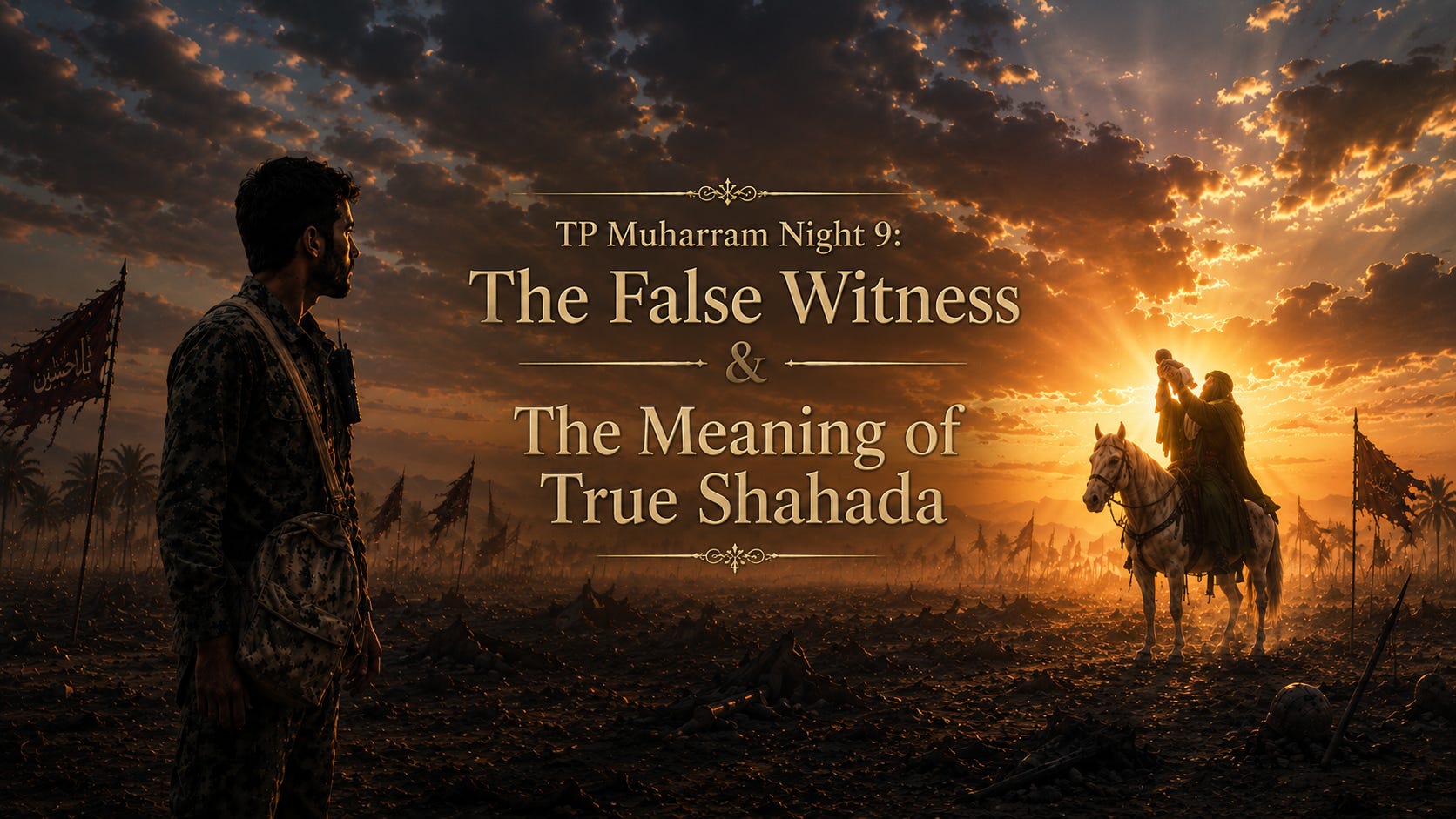
Muharram Program, PUREWILAYAH.COM – The ninth night of Truth Promoters’ Muharram 1448 program marked a turning point in the series’ exploration of shahada as witness. After eight nights examining the meaning of sacrifice, loyalty, and testimony, the evening turned to a more difficult question: how can true witness be distinguished from what merely claims its name?
Through Quran recitation, poetic reflection, a lecture by Sheikh Shabbir Hassanally, maqtal narration, lamentation, and Ziyarat Ashura, participants were invited to consider the difference between witness rooted in truth and forms of sacrifice that borrow the language of shahada without carrying its substance.
Quran and Poetic Reflection
The evening opened with recitations from Surah al-Fath (48:29) and Surah al-Rum (30:41). The selected verses highlighted the qualities of those who truly stand with the Messenger of Allah (saw) while warning of the corruption that emerges when human beings abandon divine guidance.
The accompanying reflection, The False Shahada, returned to the central theme of witness. While blood may appear the same and sacred slogans may sound familiar, the reflection argued that true witness is measured not by appearances but by covenant, conviction, and loyalty to Allah.
The reflection concluded with a line that framed the entire evening:
“Death did not make the witness. It made him visible.”
The message challenged participants to look beyond outward acts of sacrifice and ask what truth those sacrifices ultimately serve.
The False Witness and the Meaning of True Shahada
In his lecture, Sheikh Shabbir Hassanally described the ninth session as a “corrective night,” shifting attention from what shahada is to what falsely presents itself as shahada.
Drawing on Quranic teachings and the works of Shaheed Ayatullah Murtadha Mutahhari, the lecture outlined several criteria by which witness can be recognized. True shahada, participants heard, is not defined merely by courage, suffering, or devotion, but by conscious loyalty to Allah, commitment to truth, and obedience to divine guidance.
The lecture warned that throughout history many causes have borrowed the language of sacrifice while departing from the substance of witness. Acts of loyalty, struggle, and even self-sacrifice may appear noble, yet still fail to become shahada if they are detached from truth.
Central to the discussion was the concept of hujjah — proof. A genuine witness becomes a proof before humanity, revealing through both life and death the reality to which they are devoted.
This theme was illustrated through the example of Shaheed Mohsen Hojaji, the young Iranian defender of the shrine of Sayyidah Zainab (as) who was captured and martyred by ISIS in Syria. His steadfastness in captivity and composure in the face of death were presented as an example of a witness whose life became a testimony to faith, conviction, and loyalty to Allah.
Throughout the lecture, Karbala remained the standard by which every claim of sacrifice and martyrdom was measured.
The Witness No One Can Steal
The evening’s maqtal focused on the martyrdom of Imam Husain’s infant son, Abdullah, better known as Ali al-Asghar (as), and the enduring grief of his mother, Sayyidah Rabab.
Presented as a devotional narration from the perspective of Imam al-Mahdi (aj), the recitation revisited the events of Karbala in which Imam Husain (as) carried his six-month-old child before the opposing army and appealed for water. Instead of mercy, the infant was struck by an arrow and martyred in his father’s arms. The narration also reflected on Imam Husain’s burial of the child and the steadfast devotion and mourning of Sayyidah Rabab in the aftermath of the tragedy.
Beyond recounting the historical events, the maqtal presented Ali al-Asghar (as) as a symbol of innocence and an unquestionable witness to the injustice of Ashura. Placed after a lecture on true and false witness, his martyrdom stood as a testimony that could neither be distorted nor denied, continuing to speak across generations as one of Karbala’s clearest proofs of truth.
Lamentation and Ziyarat Ashura
The evening’s reflection continued through the lamentation Peace Unto You, Sweet Husayn, which honored Imam Husain (as) as the path of seekers toward Allah while recalling the sacrifices of Karbala, including Ali al-Asghar (as) and Abu Fadhl al-Abbas (as).
The program concluded with the recitation of Ziyarat Ashura, inviting attendees to renew their covenant with Imam Husain (as), affirm their loyalty to the path he embodied, and reflect on the responsibility to uphold truth and reject injustice in every age.
Together, the evening’s Quranic reflections, poetry, lecture, maqtal, lamentation, and ziyarah returned to a single theme: that witness is not defined by slogans, appearances, or sacrifice alone. True shahada is distinguished by unwavering loyalty to Allah, devotion to truth, and the willingness to bear the consequences of that commitment.
In Karbala, the evening concluded, that witness was embodied not only by warriors and companions, but also by a six-month-old child whose sacrifice remains an undeniable testimony to the truth. (PW)