

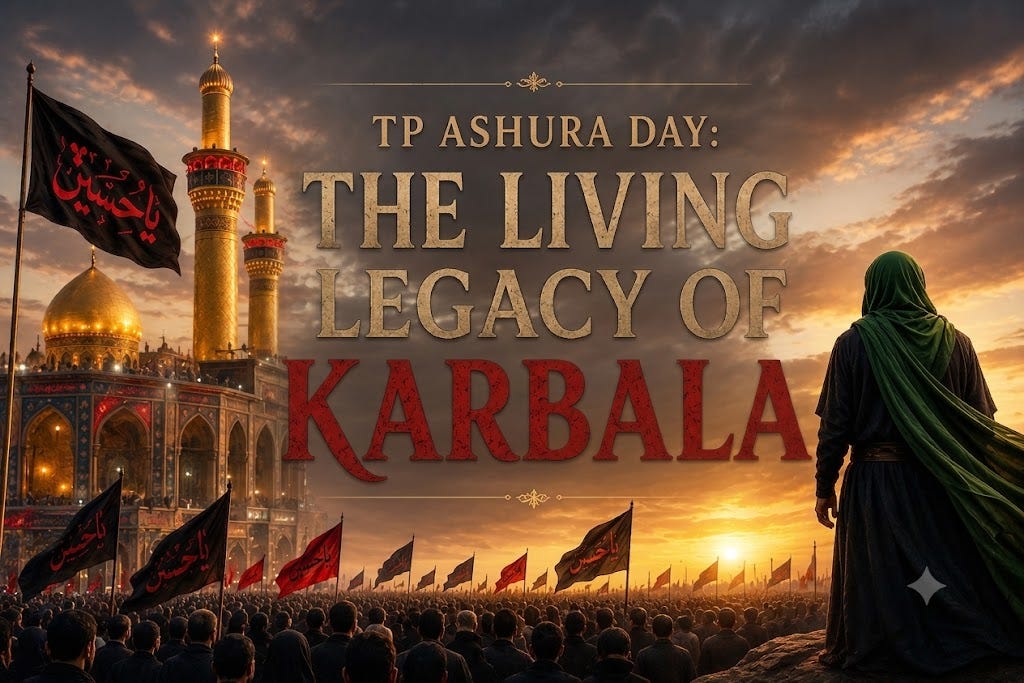
Muharram Program, PUREWILAYAH.COM — Truth Promoters commemorated the Day of Ashura through a solemn online observance centered on the exact hour of Dhuhr, retracing the final moments of Imam Husayn ibn Ali (as) on the plains of Karbala.
The program unfolded through the adhan from Karbala, a recorded congregational prayer, Quranic reflection, a specially prepared Maqtal, elegies, and Ziyarat Ashura, leading viewers through the spiritual journey of Ashura from worship to renewed covenant.
Standing with Imam Husayn at the Hour of Dhuhr
The observance opened with the adhan broadcast from the shrine of Imam Husayn (as) in Karbala. It was followed by a recording of a congregational Dhuhr prayer led by the martyred Imam Sayyed Ali Khamenei, presented at the very hour Imam Husayn (as) offered his final prayer on the plains of Karbala. After a post-prayer supplication, the program turned to two Quranic passages selected for the Day of Ashura.
The first was Surah al-Isra (17:36):
“Do not pursue that of which you have no knowledge. Indeed, the hearing, the sight, and the heart — of each of these, you shall be questioned.”
It was followed by Surah al-Baqarah (2:156):
“Indeed we belong to God, and indeed to Him we shall return.”
Together, the verses reminded viewers that Ashura calls believers to pursue truth with knowledge and accountability while meeting every trial with patience and complete reliance upon God.
Karbala Lives Beyond Ashura
The centerpiece of the observance was the Special Maqtal for the Day of Ashura, uniquely narrated through the voice of Imam al-Mahdi (aj). Drawing from classical sources including Luhuf, Nafas al-Mahmoum, Chronicles of the Martyrdom of Imam Husayn, and Ziyarat al-Nahiya al-Muqaddasah, the narration retraced Imam Husayn’s final stand while presenting Karbala as a living trust inherited by every generation.
The Maqtal followed Imam Husayn’s final appeal to his enemies, his farewell to Sayyidah Zaynab (sa), his counsel to Imam Ali Zayn al-Abidin (as), and his timeless cry, “Is there anyone to help us?” Rather than portraying this as a plea confined to the battlefield of Karbala, the narration presented it as a call that continues to echo through history, inviting every generation to stand with truth against oppression.
Moving beyond the events of 61 AH, the Maqtal connected Karbala to contemporary struggles in Gaza, Yemen, Lebanon, and Iran, affirming that every age confronts its own forms of tyranny.
It concluded with the image of the “Living Caravan,” honoring those who carried Imam Husayn’s mission across history, including Imam Khomeini, Shaheed Ayatollah Muhammad Baqir al-Sadr, Sayyed Abbas al-Musawi, Hajj Imad Mughniyeh, Hajj Abu Mahdi al-Muhandis, Hajj Qassem Soleimani, Shaheed Mohsen Hojaji, Sayyed Hassan Nasrallah, and, in this year’s updated version, the martyred Imam Sayyed Ali Khamenei.
The narration ended with prayers for Imam Sayyed Mujtaba Khamenei and the pledge that Imam Husayn would never again stand alone.
From Mourning to Renewal
Following the Maqtal, viewers were led through two original elegies that carried the observance from grief to renewed commitment. Fount of Karbala portrayed Karbala as an ever-flowing spring whose sacrifice continues through Palestine, Lebanon, and every place where truth confronts oppression. We Will Rise transformed mourning into resolve, calling believers to renew their witness, prepare for the return of Imam al-Mahdi (aj), and continue carrying Imam Husayn’s banner.
The observance concluded with a poetic English rendition of Ziyarat Ashura, through which viewers renewed their greetings to Imam Husayn (as), reaffirmed their loyalty to the Household of the Prophet, distanced themselves from injustice, and prayed to stand among the helpers of the Awaited Imam.
Bringing together prayer, remembrance, lamentation, and renewed allegiance, the Day of Ashura program presented Karbala not as a tragedy confined to history but as a living legacy that continues to call believers toward truth, justice, and steadfastness on the road to Arbaeen. (PW)