

Arbaeen Program, – The Arbaeen segment of Truth Promoters’ Shahada (Witness) series opened on Thursday with the eleventh session of the fifteen-night programme, returning to Karbala not at the hour of the killing but in the silence that followed it.
Ten nights of Muharram had ended at noon on Ashura, at a body in a field. The eleventh began at the same place — and asked what the previous ten had left unasked: what happens to a testimony when the one bearing it has been silenced?
Through Quranic recitation, poetic reflection, a lecture by Sheikh Shabbir Hassanally, maqtal narration, lamentation, and Ziyarat Arbaeen, the evening argued that the answer is found in the two survivors of the House — Sayyidah Zainab (as) and Imam Ali ibn al-Husain Zain al-Abideen (as) — and in a station our tradition rarely names: the theology of the one who is left.
The full event page can be found at Truth Promoters
Quran and Poetic Reflection
The evening opened with a recitation of Surah al-Ahzab (33:35) — the verse in which every station of faith is named twice, once for the men and once for the women. The submitting men and the submitting women. The truthful men and the truthful women. The patient men and the patient women.
The selection was deliberate. On a night given to a woman’s witness, the Quran had named her station before she was born.
The accompanying reflection set the frame the whole evening would work within:
“If Husain is the Master of Witnesses, then Zainab is the Witness after the Witness. One gave the truth its body. The other carried its voice when that body fell silent.”
The reflection closed on the charge the night would spend two hours earning: that the chain of witness did not end at Karbala, did not end in Kufa, did not end in Damascus — and that today the call of Sayyidah Zainab (as) rests in our hands.
The Work That Begins at the Body
In his lecture, Sheikh Shabbir Hassanally opened on a distinction the tradition has not often drawn: that there are two kinds of work at Karbala, and only one of them ends at the sword.
The martyr’s work, he said, is finished when he falls. The survivor’s work begins there.
Mercy, that afternoon, would have been to die. Sayyidah Zainab (as) had lost her brother the Imam, her nephews, and her own two sons, sent out that morning by her own hand. To go on living was not the easy path. She refused the mercy of dying, the lecture argued, because she understood something the empire did not: that if she died, the testimony died with her, and Karbala became one more massacre in a century full of them.
The lecture traced her first act as a survivor — not private grief, but public indictment. From a rise of ground overlooking the field she called out to the commander of the army killing her brother by name. Umar ibn Sa’d wept into his beard, the chronicles record, and did not stop his soldiers.
“The very first act of the survivor was not private weeping. It was public testimony, naming the guilty to his face.”
Then the act the lecture presented as definitive. Walking out across the field to her brother’s body, she did not name what had happened as the enemy had named it. Ibn Ziyad and Yazid had a word for Karbala: a rebellion put down. Standing over the worst thing that had ever happened to a human family, she reached past their word and gave it God’s word — an offering, a qurban, lifted toward the heavens.
The lecture was careful here, in keeping with the series’ stated method: the exact wording is carried in the husayniyya mourning tradition rather than traced to the earliest chains, and it was presented as such. But the act itself, whatever the precise phrasing, was unmistakable — the refusal to let the enemy define the meaning of what it had just done.
“The empire may hold the field. It certainly does not get to hold the meaning.”
The Chains Became a Pulpit
The lecture then turned to the reversal at the centre of the night.
The Umayyad state intended the captive caravan as a spectacle of humiliation — the family of the Prophet (saw) driven through the cities of Iraq and Syria in chains, with the heads of the martyrs carried on spears ahead of them, as proof that resistance was finished. The lecture argued that they had, without understanding it, escorted the prosecution into their own house. Every town became a courtroom. Every crowd gathered to stare became a jury.
In Kufa — the city of the eighteen thousand letters that had invited Imam Husain (as) and then abandoned his ambassador — the people wept as the column passed. Sayyidah Zainab (as) raised her hand and a whole city fell silent before a single captive woman. She did not thank them for their tears. Citing the Quran’s own image from Surah al-Nahl (16:92), she named them as the woman who unravels her own yarn after she has firmly spun it, and asked how they would ever wash away the murder of the grandson of the Seal of the Prophets.
Brought then before Ubaydullah ibn Ziyad, who asked her to her face how she had found what God did to her brother and her house, she gave the answer that has outlasted his name and his city:
“I saw nothing but beauty.”
The lecture was insistent that this be heard correctly. She did not say she saw beauty instead of the horror; she had carried the horror in her own two hands. She was naming what the horror could not reach — a covenant kept, an offering accepted, a witness that would outlive the empire that made it. This, the lecture said, is rida bi’l-qada — contentment with the decree — which is not the numbness of one who feels no pain, but the refusal to let the pain have the last word.
In the throne room at Damascus, before the nobles of Syria and the ambassadors of foreign kings, she rose unveiled and exhausted and dismantled Yazid where he sat. She raised no weapon. She raised his genealogy — O son of the freed ones — reminding the entire court that his family were the tulaqa, those pardoned by the Prophet (saw) at the conquest of Makkah by a mercy they had done nothing to earn. She then recited to him the Quran’s warning to the tyrant who mistakes God’s patience for God’s approval (3:178), and for her own dead the verse that turns every one of them from a corpse into a living thing (3:169).
Beside her, chained and gravely ill, Imam Zain al-Abideen (as) asked for the pulpit of the empire — and took the room apart from it, not by argument but by naming his own lineage link by link, until the hall understood whose sons had been paraded before them in chains. When Yazid, alarmed at his own court, ordered the call to prayer to cut him off, the Imam turned at the words I bear witness that Muhammad is the Messenger of God and asked: this Muhammad — is he your grandfather, or mine?
The chronicles record that men stood and walked out of that hall rather than pray behind Yazid.
“The most dangerous thing a tyranny can face is not an army. It is a captive who refuses to be ashamed.”
They had nothing, the lecture summarised — no army, no freedom, no allies, not even the veils taken from their heads. With a clear voice, the truth, and the refusal to be ashamed, they brought down the moral authority of a dynasty that held armies, gold, and an empire.
Grace, Not a Cage
From the survivors’ witness the lecture turned to a doctrinal question the series had been building toward: what rank was Sayyidah Zainab (as) given?
Our tradition describes her as mahfuzatun ‘an al-khata — protected from error. The lecture drew the line carefully. She is not one of the Fourteen Infallibles; the intrinsic, total infallibility of al-’ismah al-kubra belongs to the Prophet (saw), Sayyidah Fatimah al-Zahra (as), and the twelve Imams (as), and to no one else. What the tradition attributes to her is hifz — a God-given guarding of tongue and judgement, laid upon a soul purified almost to that summit, for the carrying of a particular trust. Imam Zain al-Abideen (as) himself testified to its source, addressing her in Kufa as a knower untaught, one who comprehends without being instructed.
The lecture then opened the doctrine of ‘ismah itself — drawing on Shaykh al-Mufid, Allamah al-Hilli, Allamah Tabataba’i and Ayatullah Jawadi-Amoli — and made the argument that matters most for those listening.
Infallibility, it stressed, is not the suspension of free will, and not a metaphysical inability to sin. If it were, the Infallibles would deserve no praise for their obedience: a door earns no honour for staying shut when it has no power to open. It is lutf — divine grace: an abundance of the knowledge and love of God so total that, while the full capacity to sin remains, the desire to sin carries no weight against it. Shaykh al-Mufid’s formulation was cited directly: a grace by which disobedience becomes impossible from him while he still possesses the power over both.
Ayatullah Misbah-Yazdi’s image was used to make it concrete: a glass of poison set before a person in their right mind. The hand is free; no one restrains it. And yet it will never lift the glass — not because it is forced, but because the certainty of what the poison would do makes the thought unthinkable.
“The Ma’sumin are not a different species of being. They are the human being as God designed the human being to be — the perfected end of the very road every one of us is invited to walk.”
The lecture closed this section on the most hopeful point of the evening: citing Ayatullah Jawadi-Amoli, that the door of al-’ismah al-iktisabiyya — an acquired protection, earned through the long labour of purifying the self — is closed to no one.
The lecture was equally precise about what Sayyidah Zainab (as) did not do. She did not become the Imam, and the Imamate did not pass through her; it belonged, by explicit divine designation, to Imam Zain al-Abideen (as) from the day of Ashura. What she did was guard him — and she made it unmistakable who the authority now was. When the tents were set alight and the women had to choose between the fire and the open desert, she turned to that young, ill man and asked for his ruling. O aunt, he answered, you must flee. She obeyed on the instant.
The Method Is Part of the Witness
The final movement of the lecture drew a line the series has returned to repeatedly: that how a witness is carried is itself part of the witness.
Neither Sayyidah Zainab (as) nor Imam Zain al-Abideen (as), the lecture observed, sent a knife into Ibn Ziyad’s hall in the night. Imam Husain (as) had not sent an assassin into Kufa before Karbala to remove the governor and solve the problem. The House of the Prophet (saw) fought, when it fought, face to face — and otherwise testified with the open voice.
The lecture set out the jurisprudence behind this: the prohibition of fatk and ghilah — killing by stealth, while a man feels safe — and of ghadr, the breaking of a covenant of safety. These are forbidden in their essence, by the consensus of our jurists from the classical age to the maraji’ of Qum and Najaf today, and forbidden even against an enemy combatant.
The decisive text was cited from al-Kafi: Abu al-Sabbah al-Kinani asking Imam Ja’far al-Sadiq (as) whether he might assassinate a neighbour who openly cursed the Commander of the Faithful (as), and the Imam’s reply — this is assassination, and the Messenger of God forbade assassination. Islam has shackled assassination. The Quranic foundation was Surah al-Anfal (8:58), which forbids even ending a treaty by stealth: if you fear treachery, throw the treaty back openly, on equal terms.
Imam Ali (as) was cited from Nahj al-Balagha as the living embodiment of the rule — by God, Mu’awiyah is no more cunning than I am, but he is treacherous — alongside his maxim that stands against every man who has excused a crime by claiming he followed orders: there is no obedience to any creature in disobedience to the Creator.
The lecture connected this directly to Muslim ibn Aqil (as), who had refused to strike Ibn Ziyad unguarded in the house of Hani, citing this very teaching — and to Shaheed Mutahhari’s rule that in Islam the end does not make the means permissible.
“Assassination is not the weapon of the strong. It is the confession of the defeated. A power that has to kill in the dark is a power that knows it has already lost the argument in the daylight.”
The principle was then carried into the present, through the example of Hajj Imad Mughniyeh — who, as Dr Hossein Akbari records, began with tazkiyat al-nafs and the religious sciences before any of the outer work — and through an incident in southern Lebanon in which an operation against a senior figure of the occupying regime was aborted at the final moment, on the order of Sayyid Hassan Nasrallah, because a child and non-combatants were present. The reasoning given was that in this theology there is no such category as collateral damage; any soul killed is a burden the killers must answer for before God, and Surah al-Ma’idah (5:32) settles the matter.
Turned onto the present, the lecture posed the question it left unanswered because it has no answer: what is the excuse for killing a professor of physics, a cancer researcher, a scholar in his car with his family beside him? That, it said, is the killing of knowledge itself — and the confession of a power that cannot stand in the daylight.
The Voice That Borrowed Its Strength
The evening’s maqtal, The Witness After the Witness, was presented — as the whole series has been — as a devotional narration in the voice of Imam al-Mahdi (aj), looking back across the veils of the occultation.
It carried the aftermath from the mound to the body to the chains to the two courts. But its distinguishing feature was structural rather than narrative. The voice of the narration had broken on the tenth night, at the trampling, and had not been whole since. Across this maqtal it audibly recovers — and the narration names exactly where the strength comes from:
“It was not my own endurance that taught my voice how to go on after the trampling. It was her word. The strength you hear returning to this voice tonight — it is borrowed. I borrowed it from my aunt.”
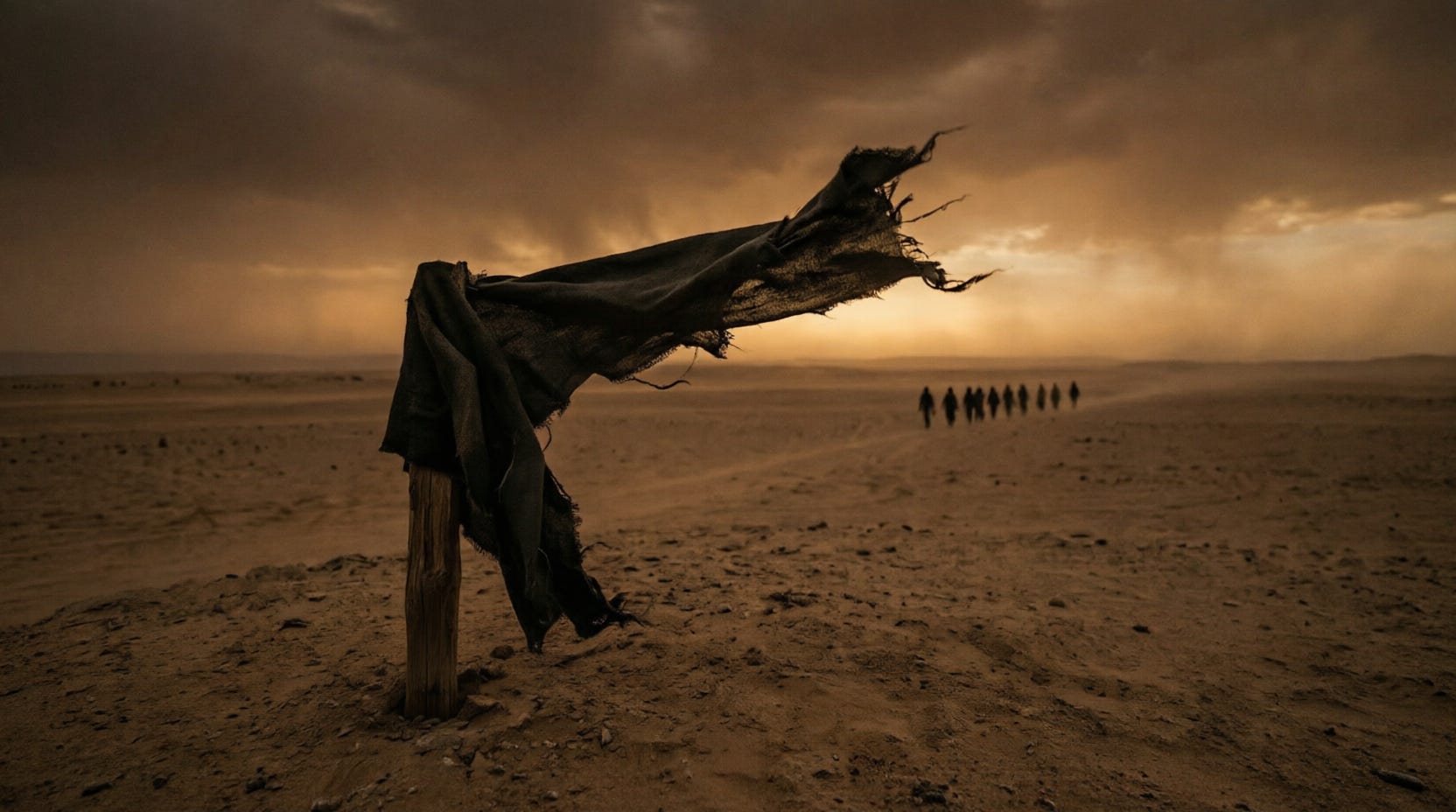
Beside the candle that has stood through every night of the series, the maqtal placed a single new object: a torn length of dark cloth — the veil pulled from the heads of the women of the House.
The narration closed by handing the series’ recurring question to those listening, in its sharpest form yet. Where is your brother? He is here. He is in every mouth that still says his name.
Lamentation and Ziyarat Arbaeen
The evening’s lamentation, Ya Zaynab, turned the night’s argument into elegy — honouring the daughter of Imam Ali (as) who watched what no sister should be asked to watch, and who carried the message of Karbala out of the desert and into the courts of the men who had made it.
The programme concluded with a full poetic English rendering of Ziyarat Arbaeen — the visitation Imam Ja’far al-Sadiq (AS) taught to Safwan al-Jammal, recited across the five Arbaeen nights of the series. Unlike Ziyarat Ashura, it does not close in grief. It closes in a pledge: our help is made ready for you, until God gives you leave — so, with you, with you, and never with your enemy.
Taken together, the evening’s Quranic reflection, poetry, lecture, maqtal, lamentation and ziyarah made a single argument: that the killing of a witness is not the end of the witness, and that everything which happened after the sword at Karbala was decided by what the survivors chose to do with what they had been left.
The regime could behead the witness. It could not behead the witness-after-the-witness. And the evening closed by naming the inheritance plainly: that the chain of testimony Sayyidah Zainab (AS) opened in the market of Kufa has never once closed — that it ran from her to Imam Zain al-Abideen (AS), through the Imams of guidance to the Imam of our age (AJ), and through the scholars who preserved it under every passing tyranny, until it reached the room in which it was being recited.
We are the witnesses after the witness now.