

Arbaeen Program – The fourteenth session of Truth Promoters’ Shahada (Witness) series asked on Sunday the question the previous thirteen nights had been quietly building toward.
The series had proved the chain of witness unbroken — from Abel, the first man wronged for his faith, through the prophets and the Imams (AS) to a child in a ruin in Damascus. But unbroken in what sense? Is the chain a closed thing, a museum visited on these nights and left behind when the lights come up? Or is it still being forged, link by link, in our own lifetime, with names we have said aloud and faces we have seen on the glass of the phones in our pockets?
The evening’s answer was that the witnesses did not stay in the books. They walked out of the chronicles and into our own decade — and to recognise them for what they are is the examination the whole series has been preparing its listeners to sit.
Through Quranic recitation, poetic reflection, a lecture by Sheikh Shabbir Hassanally, maqtal narration, lamentation and Ziyarat Arbaeen, the session traced that chain through the Sacred Defence, through Lebanon and Iraq and Iran, and into the present hour.
Quran and Poetic Reflection
The evening’s recitation set the frame for a night given over to the living chain — the covenant kept, the promise fulfilled, and the warning to those who imagine that God is unaware of what the wrongdoers do.
The accompanying reflection, The Chain Is Not Broken, gave the evening its argument before the lecture began:
“Do not tell me that a witness belongs only to yesterday, pressed between the pages of books we kiss but never become.”
And it named the difficulty that the lecture would spend two hours on — that it costs nothing to love a witness whose victory history has already confirmed:
“The world has always preferred its witnesses when they can no longer speak. Living witnesses make demands. Dead ones can be admired without imitation.”
Two Motions, One Breath
The lecture opened on the text with which every night of the series begins, and which can slide past as habit — Ziyarat Ashura.
Sheikh Shabbir Hassanally drew out what the text actually trains the tongue to do: two things in a single breath. It greets, turning toward Imam Husayn (AS) and the wronged and pledging itself to them. And it disavows, turning away from the throne that wronged them — may the mercy of God be distant from the people who laid the foundation of oppression.
For Muslims living under occupation, under sanction, or in the diaspora of an empire whose flag flies over their own street, this is not a mood. It is a constitution: solidarity with the oppressed, and disavowal of the oppressor. Not hatred of a people — disavowal of a system.
The lecture set that distinction down early and promised to return to it, because it is the hinge on which the most misunderstood sentence our community says aloud would later turn.
A Generation That Held the Line
The lecture then made flesh the abstraction of the twelfth night. The frontier-holder of Du’a Ahl ath-Thughur had been a figure in a prayer; in our own century, a whole generation turned him into a war they did not start.
The facts were set without ornament: in September 1980 the regime of Saddam Hussein invaded Iran; it was not a war Iran chose but an invasion Iran answered; it lasted eight years and cost a generation.
What distinguished that generation, the lecture argued, was how they understood what they were doing. Imam Khomeini gave them a doctrine — that the front line against an unjust aggressor is not merely a military position but a mihrab; that holding the seam is ibadah. The basiji did not go to the front the way a conscript goes. He went the way a man goes to the mosque.
And they wrote it down. The lecture turned to the wasiyyat-nameh — the final wills those young men composed before going out, published since in their thousands — and made the observation that gives the section its weight: they read like extensions of the very supplication studied two nights earlier. The layperson’s Sahifa. Witness, written down before it died.
Mohammad Reza Samadzadeh, born in Zahedan, martyred at Somar in November 1981 at around twenty, opened his will on the verse of the second night of the series — those who are killed in the way of God never die — and then turned to ask his parents not to receive his death with grief, composing his mother’s consolation in advance so that her sorrow would have somewhere soft to land.
And Sayyid Ali Hashemi, a divisional commander martyred on Majnoon Island in June 1988, whose body was not recovered for twenty-two years, prayed a prayer saturated in Karbala:
“O God, grant that I be martyred in a waterless desert, that I may be thirsty like my master Imam Husain. O God, I ask that at the moment of my martyrdom both my hands be cut from my body, so that I will not be ashamed before the standard-bearer of Islam, Abu al-Fadl.”
The lecture drew the point out plainly: this is not a man drawing a parallel. This is a man mailing his death to Karbala.
It also declined to leave the section clean. It named, from within, the honest critique — that the witness was afterward institutionalised, the wills becoming foundations and the faces becoming murals; that a society which forms its young around the memory of sacrifice rather than of consumption is doing something most of the modern world has forgotten how to do; and that the danger named on the eighth night remains, of a witness becoming an aesthetic emptied of the substance that made it beautiful. We are not selling anything tonight. We are weighing.
The Chain of Our Own Lifetime
The lecture then hung the links on the chain, at a deliberately level weight — because a list of martyrs is not a song; it is a chain, and a chain is strongest when every link is forged to the same gauge.
In Lebanon: Imam Musa al-Sadr, who flew to Libya in 1978 and never returned — a martyrdom in absence, whose empty place at the table has shouted for nearly fifty years louder than his presence could. Ayatullah Sayyid Muhammad Husain Fadhlullah, whose attempted assassination by car bomb killed eighty people in a Beirut street and missed him, and who went on teaching. Sayyid Abbas al-Musawi, killed in February 1992 by an Israeli helicopter that tracked his motorcade home from a commemoration — and which killed with him his wife Sayyidah Siham and his five-year-old son Sayyid Husain. Hajj Imad Mughniyeh, who lived twenty-five years in the shadows so the work could go on, his own name a kind of fast he kept, until a bomb found him in Damascus in February 2008.
And Sayyid Hassan Nasrallah, on the 27th of September 2024 — of whom the lecture said what needed no chronicle:
“You watched it happen. Many of you learned of his martyrdom the way you learn of a death in your own family now: from the glass of the phone in your hand, in real time. This is what I meant. The chain did not stay in the books.”
In Iraq: Ayatullah Sayyid Muhammad Baqir al-Hakim, murdered by a car bomb in August 2003 at the door of the shrine of the Commander of the Faithful (as) he had spent a lifetime in exile longing to return to. The defenders of the shrines who put their bodies between the takfiri flood and the domes. And Hajj Abu Mahdi al-Muhandis, from whose recorded testament the lecture quoted a sentence it asked the room to keep:
“Our goal is to gain the pleasure of God Almighty, and to serve the people — Sunnis, Shiites, Christians, and Yazidis. We are not aggressors.”
And in Iran: on the 3rd of January 2020, at Baghdad airport, an American drone flown from a base in Nevada killed Hajj Abu Mahdi and, beside him, Hajj Qasem Soleimani — whose four-stage road the series had already walked across four nights, and who took his place here simply as a link.
Then the link the lecture said makes a believer sit down. On the 28th of February 2026, the chain reached the wali al-amr himself: Imam Sayyid Ali al-Husaini Khamenei, struck in Tehran and martyred.
The lecture deliberately declined to build a second series inside this one, reserving his life and station for the forthcoming treatment of wilayat al-faqih, and let him do one thing only: stand in the chain, as the link that proves it is not a museum. It gave two things.
Eleven days before his martyrdom, on the 17th of February 2026, he restated Imam Husayn’s (AS) first refusal — one like me does not give allegiance to one like Yazid — and the lecture noted the precision of how he said it: not I will not give allegiance, but the nation will not. He spoke of the system, never of himself. Eleven days later they killed him.
And on the day of his martyrdom, his official account posted not a threat but a verse — Surah al-Ahzab (chapter 33, The Confederates, verse 23): among the believers are men who have been true to their covenant with God; among them is he who has fulfilled his pledge, and among them is he who still waits — and they have not changed in the least.
“He told us, in his last public word, which clause of that verse he had come to. The promise of Alast, sealed — in our own lifetime — by a man who would not change in the least.”
The Killing of a People’s Future
The lecture then turned to something quieter that the same hand has been doing for fifteen years, giving a face to a question left hanging on the eleventh night.
It led with the case it called the cleanest. Dariush Rezaeinejad, an engineer and researcher, thirty-five years old, shot five times outside his home in Tehran in July 2011 by gunmen on a motorcycle — in his car, his wife wounded beside him, his small daughter in the back, just collected from kindergarten. His daughter Armita’s sentence was left to carry the whole human case: he was a scientist who had nothing to do with violence.
The iconic case was named alongside it — Mohsen Fakhrizadeh, killed in November 2020 by a remote-controlled, satellite-linked weapon, his wife twenty-five centimetres away and untouched, because the machine was that precise about which life it was ending — and the pattern from 2010 to 2025 traced through Alimohammadi, Shahriari and Ahmadi Roshan.
The lecture was disciplined about what it was and was not claiming. It declined to adjudicate any individual’s file, naming the attribution as reported. Its argument was about method and principle, and it stood clean of any one man’s role:
“What conceivable excuse is there for killing a cancer researcher? A scholar of artificial intelligence? A professor at a university? To kill a people’s scientists is to kill its future.”
And it asked the room to run one honest test: to imagine Western scientists assassinated on the school run by a foreign machine, one after another for fifteen years, and to measure the imagined reaction against the actual silence.
The hinge it drew from this carried into the rest of the evening — that the throne kills a people’s future to keep that people from rising into a position where it might claim its own share, but that interest is only the appetite. Arrogance is the body it feeds. The throne does not devour because it is hungry; it is hungry because it is proud.
Broadcast Into Our Hands
The lecture gave the figures it said the most careful monitors would stand behind, declining to inflate what is already unbearable: as of late March 2026, the UN humanitarian office counting more than seventy-two thousand Palestinians killed in Gaza, more than a hundred and seventy thousand wounded, and nearly two million driven from their homes.
What makes this different from every atrocity in the long human record, the lecture argued, is the glass. We did not read about it forty years later in a book. We watched it, live, on the phones in our pockets — the most documented slaughter in the history of the species, witnessed in real time by the largest audience that has ever witnessed anything, and not stopped.
And among the witnesses, a witness who died witnessing. Anas al-Sharif, twenty-eight, born in the Jabaliya refugee camp, killed in August 2025 in a strike on a tent of journalists — who had written his will in advance, to be released if they killed him:
“I never stopped telling the truth as it is, without falsification or distortion — so that God may bear witness over those who stayed silent.”
The lecture noted that the children handed the question on too, quoting a child of Gaza who wrote in his own will: I am a trust; do not humiliate us, and who begged the peoples of the world, nation by nation, not to forget Gaza.
Down With the Throne
The heart of the evening was given to the sentence our community says aloud that has been most weaponised against it.
The lecture refused to whisper an apology for it. We mean it. The cry is right; the people who raise it are right. What it undertook instead was tabyeen — to show precisely what is meant, so precisely that the fear drops out and only the truth is left standing. It proceeded in four movements.
The constitution. What is a believer even permitted to oppose? The lecture built from the Quran: that the Prophet (S) was sent as a mercy to all the worlds (chapter 21, The Prophets, Verse 107); that the very first permission to fight was granted because they have been wronged — Allamah Tabataba’i’s al-Mizan cited on the ba’ of causation, the licence given against dhulm, not against kufr; that Surah al-Hashr (chapter 59, The Exile, Verse 8) names what the Meccan believers were actually fighting over as homes and properties seized; and that Surah al-Mumtahanah (Chapter 60, The Woman Examined, verse 8–9) draws the line explicitly at aggression and expulsion and explicitly not at religious difference, commanding kindness and justice toward those who did neither.
Compulsion is impossible, not merely forbidden. On there is no compulsion in religion (chapter 2, The Cow, Verse 256), the lecture cited Allamah Tabataba’i for the deeper claim: that belief follows understanding, and coercion touches only outward action. God says of His own Prophet (S) that had He willed, everyone on earth would have believed (chapter 10, Jonah, Verse 99) — and Tabataba’i’s gloss that the belief God wants is that which comes by husn al-ikhtiyar, good free choosing.
From which the lecture drew the argument in full: forced belief cannot succeed. Faith, in the Imams’ definition, is recognition by the heart, profession by the tongue, and action by the limbs — so the tyrant who forces the words has not made a believer, he has manufactured a munafiq. Ayatullah al-Khoei was cited that religion by its very nature refuses coercion, and Imam Khomeini from Tahrir al-Wasila that the aim of the wars was the dismantling of taghut-systems, not compulsion into the religion.
And the fiqh principle sealed it: do not cooperate in sin and aggression (chapter 5, The Table Spread, verse 2). To force a man to profess what his heart does not hold is to help him to a lie.
“The sword of Islam was never aimed at a person’s belief. It was aimed at the tyrant-structure that stood between people and the freedom to choose.”
The word itself. The lecture did not hide it. Marg bar translates word for word as death to — and in the same breath it gave the precedent that unlocks it. The series had long ago refused the English word curse for la’an, because curse drags in malice and witchcraft while la’an is a supplication that God’s mercy be distant from the oppressor. The same move applies here. Across the languages of the Resistance, marg bar does the work the English down with the king does, the French à bas, the Arabic yasqut. It is the repudiation of a throne.
And down with, the lecture insisted, is not the soft translation but the accurate and the stronger one — because it aims the repudiation exactly where it belongs and closes the door on a fear-word that was never the point. This is Quranic bara’a, disavowal of oppression, as against baghd, hatred of persons and peoples, which our religion forbids.
Which brought the lecture back to the hinge it had set at the very start:
“Marg bar is the tabarra of Ziyarat Ashura, spoken aloud in the street. The believer who cries it in the square and the believer who whispers the la’an of Ziyarat Ashura in the dark are doing the same thing in two languages.”
The governing rule was stated plainly: the regime is the disease, the named ruler only a symptom. Name a ruler and the system installs another. We say down with the throne — never down with a man, and never, ever, down with a people.
The method. How does a believer judge a nation at all? The lecture taught this not from a book but from the discipline of religious arbitration — how a marital dispute is properly judged: hear both sides separately; believe the children, who have no case to win; discount for the bias of relatives; and, above all, silence the lobby — the whispering third party whose stake is in the conflict continuing. Only then can a fair judgement be made, and the aim is always remedy, never the manufacture of hatred.
Scaled to nations, the same method applies: gather the data, ask whether the country is under siege or sanction, ask whether sedition is being manufactured from outside, and watch cause and effect with cold eyes. A spontaneous uprising does not run on a foreign switch.
The evidence. The method was then worked on a live case. In the early 1950s Iran moved to take ownership of its own oil under Dr Mohammad Mossadegh — and the lecture stressed the detail the empire’s version omits: Mossadegh recognised British investment and offered a fair settlement. A fair share, not the lion’s share. That is not extremism. That is arbitration. What followed was Operation Ajax, the 1953 coup the CIA itself acknowledged in 2013 — manufactured protests, bought crowds, an elected prime minister overthrown, a monarch empowered.
And the same play, the lecture argued, run again seventy years on — with the difference that the method was confessed in the empire’s own words. It quoted the US Treasury Secretary’s testimony to the Senate Banking Committee in February 2026 that we created a dollar shortage in the country... the Iranian currency went into free fall, inflation exploded, and we see Iranians on the streets — and noted the significance: there is your spontaneous uprising, confessed by the hand on the switch.
The lecture was scrupulous about what carries the weight of the claim. The pattern, it said, does not stand on the new confession. It stands on the old one — on Ajax, which the empire’s own intelligence service put in writing after sixty years of denial. The 2026 confession founds nothing; it confirms, in the present tense, a method the empire had already conceded in the past.
It also applied its own rule to the figure waiting in the wings, declining to make the argument about one man: he is not the disease; he is the instrument. Replace him tomorrow and the throne would find another.
Who the cry is for. The lecture closed the movement on what it called its secret heart — that the cry is for the peoples. For the American mother who lost her son to a war built on a lie. For the Jewish family whose conscience refuses what is done in their name. For the Israeli child handed a fear he never chose, fed to him by a regime that needs him afraid. For the teacher whose school is starved while the bombs are shipped.
And it set the inversion that it called the entire argument of the night, compressed: the man the empire’s newspapers file as a militia commander names the Christian and the Yazidi among those he is dying to serve; the throne that calls itself civilisation calls a hundred and sixty-eight dead schoolchildren collateral.
The section ended in three traditions saying one thing — from Matthew and Luke that nothing hidden shall fail to be revealed, from Proverbs that pride goes before destruction, and from the Quran that falsehood is ever bound to vanish (chapter 17, The Children of Israel, verse 81) and that truth hurled against falsehood crushes it (chapter 21, The Prophets, verse 18).
“The throne is afraid of exactly one thing, and it is not our anger — it is the daylight.”
What the Living Witness Asks
Two lessons closed the lecture, both brought down from the guardians to the ordinary believer.
The first: that the saying of Imam Husayn (AS) is the saying of every true witness — and that the false lords of the age are not only emperors but the market, the career, the peer-group, the consensus that has learned to call the forbidden good. And that the refusal is first a refusal in the heart. Before Imam Husain refused Yazid in the open, the inner Yazid had already been refused, every day, in the dark. The man who has not refused the tyrant in his own chest will simply trade one master for another.
The second: that it always returns to reliance on God. Resistance without tawhid collapses into nationalism — the tribe with better weapons. Tawhid without resistance collapses into quietism. The engine was never the geopolitics. The engine was the worship.
The test of a true witness, the lecture said, is not his rhetoric but how he lives — citing Sayyid Abbas al-Musawi’s contrast between the leader in a palace and the leader who shares the people’s bread, and behind it Imam Ali’s (AS) letter to Uthman ibn Hunayf: shall I content myself with being called Commander of the Faithful, and not share with the people the hardships of the age?
And it gave the final architecture from Shaykh Naim Qassem — that the lesser jihad is a branch of the greater; that the visible resistance is the branches and fruit that grow from the soil of spiritual cultivation; and the branches cannot stand firm if the roots decay.
The evening then named the single fault-line the whole series has been mapping — not Muslim against non-Muslim, not East against West, but al-mustakbirun against al-mustad’afun, the arrogant against the downtrodden — and showed it running at every scale: through the heart, through the home, through the society, through the nation, through civilisation itself. The arrogant are the same at every scale. And the witness is the one who refuses them at every scale, with one and the same refusal, spoken all the way down.
He Walked Toward Husain
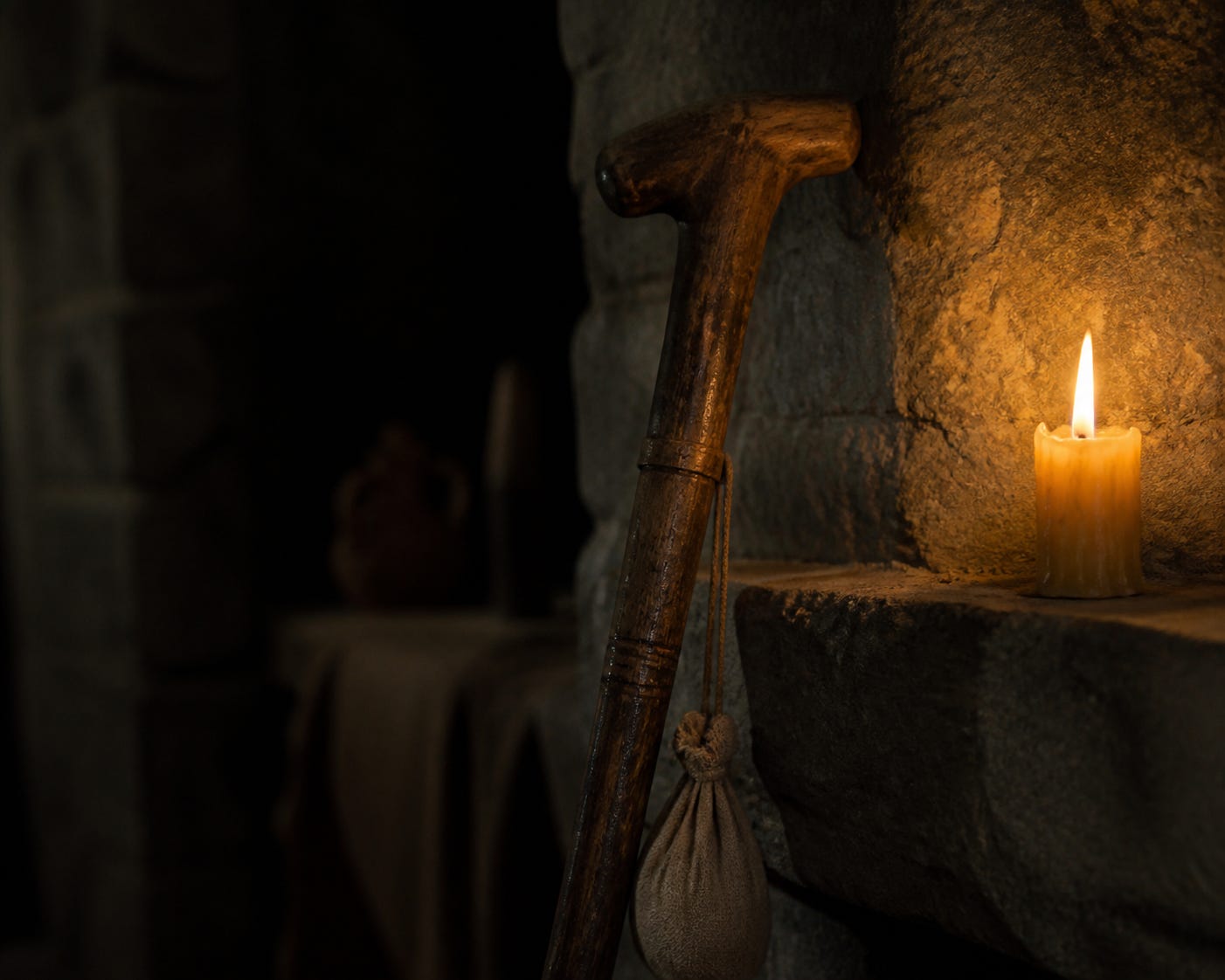
The evening’s maqtal, narrated in the voice of Imam al-Mahdi (AJ), placed beside the candle the first object of the series made for moving: a pilgrim’s staff, worn smooth at the grip. Every other object we have laid on this stone has rested there. This one leans. It points.
It told of Jabir ibn Abdullah al-Ansari — a companion of the Prophet (S) who had carried the love of the House across nearly a century when carrying it was costly, and who by the time of Karbala was old, blind, and hundreds of miles away. The most helpless witness imaginable: old, blind, late.
“And here is what Jabir understood, that the world does not: that there is no such thing as being useless to Husain. That even the latest, the oldest, the blindest, the most helpless lover of the truth still has one thing he can do. He can turn his face toward it, and walk.”
On the fortieth day, with a younger companion named Atiyya to steady him, he set out. The narration made the point that the road he opened is now the most-walked road on the face of the earth — and all of it began with one blind old man and the friend who held his arm.
At the grave he washed in the Euphrates, put on clean things, wore what perfume he had, and asked to be led. Atiyya placed his hand on the earth, and he called the name, and fell upon the grave weeping. And there the narration turned — and the voice that had broken at the trampling on the tenth night, and had been recovering ever since, came home.
“They did not win. They trampled the body, and forty days later a blind man walked across a desert to kiss the ground, and twenty million walk it now, and they will walk it when every throne that ever stood is dust. The grave they dug to end him became the road that has no end.”
The maqtal closed on Atiyya’s honest question — how can you be counted with them when you were not even here? — and Jabir’s answer, from the Prophet (saw) himself: that whoever loves a people will be gathered with them, and whoever loves the deeds of a people shares in their deeds.
“You do not have to have been there. You have to have loved it enough to walk toward it.”
And it handed that directly to the room: you are Jabir. Your weeping is not nothing, your love is not too late, and your distance does not disqualify you.
Lamentation and Ziyarat Arbaeen
The evening’s lamentation, Hear the Chains, carried the sound of the captivity into the present tense — the iron on the road from Karbala to Sham, and the chains of every age since.
The programme concluded with the poetic English rendering of Ziyarat Arbaeen.
Taken together, the evening’s argument was that the examination the series has been setting is not a historical one. It is easy to weep for a witness who died thirteen hundred years ago; the chronicles have done the hard work, the love is safe, the verdict is settled and the shrine is built. It is another thing entirely to look at a man martyred last month, in a war the newspapers called something else, and to know him for what he is.
The evening’s charge was accordingly threefold: to see the chain for what it is and not be the people who weep for the long-dead and fail to recognise the newly-fallen; to say the cry knowing exactly what it means — bara’a from the throne, never baghd of a people, naming the system and honouring the peoples it consumes; and to begin the refusal in one’s own chest, where no one is filming, because the branches cannot stand if the roots decay.