

Arbaeen Program – The fifteenth and final session of Truth Promoters’ Shahada (Witness) series closed on Monday on the eve of Arbaeen, and did something none of the fourteen nights before it had done.
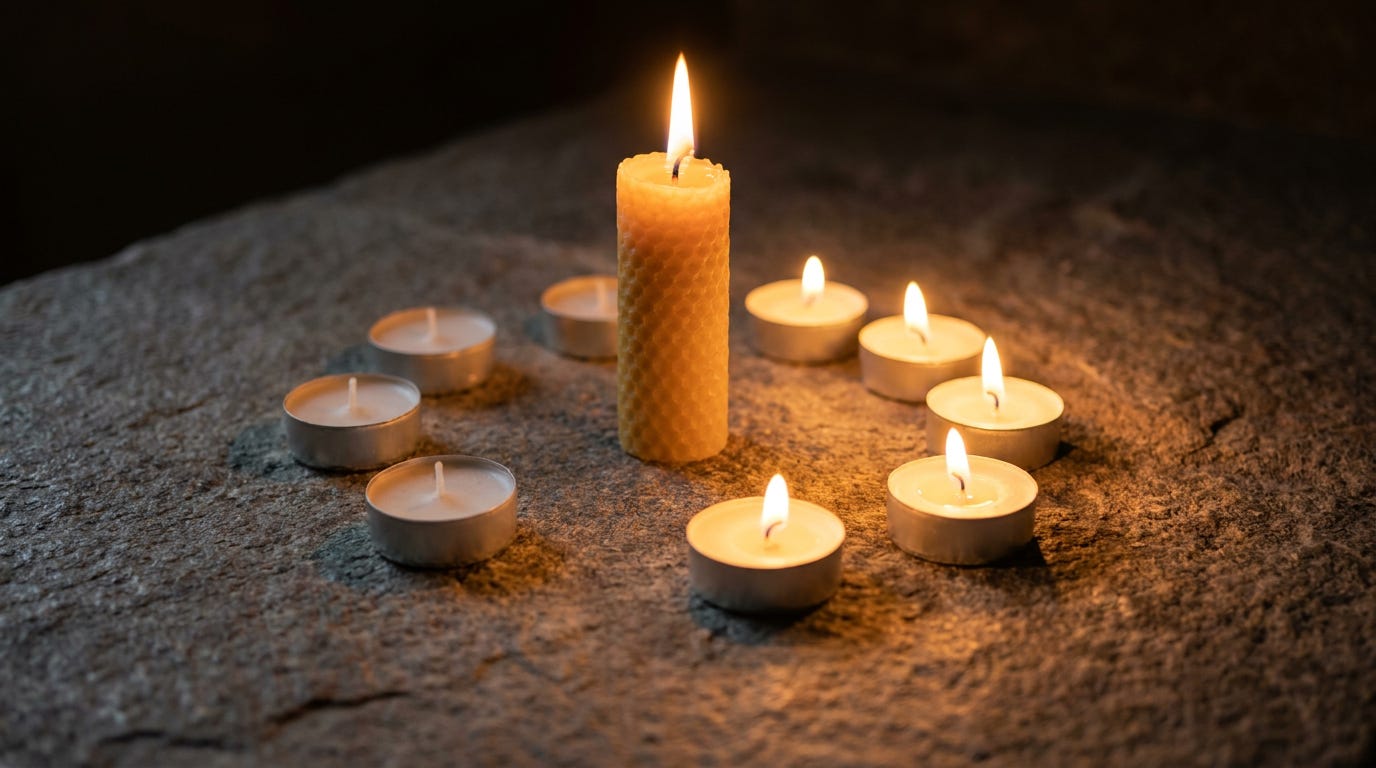
For fourteen nights the programme had come, again and again, to a death. Night after night the maqtal had laid the family of the Prophet (S) in the ground, and the weeping was right. The fifteenth night came instead to a homecoming — the caravan returning to the grave, the believer returning to the covenant, and the series returning to where it began: a single candle on a grey stone.
Through Quranic recitation, poetic reflection, a lecture by Sheikh Shabbir Hassanally, maqtal narration, lamentation and Ziyarat Arbaeen, the evening argued that the chain of witness the series had spent fourteen nights proving unbroken does not merely run behind us. It runs through us — and it is renewed at dawn.
Quran and Poetic Reflection
The evening’s recitation carried the verses on which the whole night would rest — the covenant taken from the children of Adam before they had bodies, and the command that we rise for God, in twos and singly.
The accompanying reflection, Bear the Witness, spoke in the first person and made the series’ argument personal:
“Whether my witness is carried through faithful living, or sealed by faithful dying, I shall not be silent while the Yazids of every age continue their massacres.”
And it closed on the distinction the whole series has insisted upon — that neither the living nor the dying is what makes the witness:
“For neither life nor death makes the witness. It is the heart that belongs to Him before either arrives.”
Two Covenants, and the Difference Between Them
In his lecture, Sheikh Shabbir Hassanally opened by clearing up a confusion the community routinely blurs, and on the night it matters most.
There are two texts that gather around these days, and they are not the same text. Du’a al-’Ahd — the Supplication of the Covenant, taught by Imam Ja’far al-Sadiq (AS) — is a daily supplication, recited every dawn to renew the believer’s covenant with God and with the Imam of the Age (AJ). The tradition holds that whoever recites it for forty mornings is counted among the helpers of the one who will rise. Ziyarat al-Arba’een is the dedicated visitation of the twentieth of Safar, narrated by Safwan al-Jammal from Imam al-Sadiq (AS) and preserved in Shaykh al-Tusi’s Tahdhib al-Ahkam.
The daily covenant is the dawn renewal; the Arbaeen visitation is the fortieth-day arrival. And the morning of Arbaeen, the lecture noted, is the one morning of the year on which the two become a single act.
The First Covenant, Renewed
The lecture then returned to Surah al-A’raf (chapter 7, The Heights, Verse 172) — the verse that had been the floor of the second night — and asked the room to hear a word in it that had been let slip past before.
When God gathers every soul that will ever live and asks Am I not your Lord?, the verb He uses for what He does to them is wa ashhadahum — He made them bear witness. And the word they answer with is bala, shahidna — yes, we have borne witness.
“The very first thing every human being ever did — before you had a body, before you had a name — was bear witness. The witness is not something we have been trying to become across these fifteen nights. It is something we have been trying to remember.”
Which reframed Du’a al-’Ahd entirely. It is not a new promise. It is the renewal, every morning, of the promise already made before birth — the believer placing the covenant back on his own neck: on the morning of this day, and for as long as I live of my days, I renew for him a covenant, a pledge, and an allegiance upon my neck, from which I shall never turn away.
The lecture noted that the supplication ends by asking God to place the believer among al-mustash-hideen bayna yadayh — those who bear witness in the Imam’s presence. The covenant prayer is shot through with shahada from its first line to its last.
Allegiance That Leaves a Man Free
The three words of the supplication — ‘ahdan wa ‘aqdan wa bay’ah, a covenant, a contract, and an allegiance — were pressed on. Bay’ah is the pledge of the hand, and Du’a al-’Ahd is in the plainest terms the daily renewal of the believer’s oath of allegiance to the Imam of the Age AJ).
The lecture then answered the honest objection directly: is this not exactly what tyrants demand?
Allegiance in our tradition, it argued, is not blind obedience and never coercion. It is the binding of oneself to the axis of truth — to God first, then to the Proof He appointed, then, in the Proof’s absence, to the guardian who keeps that Proof’s cause alive. And the implication is the reverse of tyranny:
“You give your allegiance to him only because he is bound to the truth. The moment he leaves the truth, the allegiance does not follow him — it follows the truth. The tyrant says: be loyal to me, and I will define the truth. The covenant says: be loyal to the truth, and measure even your guardian against it.”
Which laid a duty on the listener, and the lecture named it as a duty of learning. Citing the Prophet (S) — the truth is with Ali, and Ali is with the truth; the two shall never part — and then Imam Ali’s (AS) own correction to al-Harith al-Hamdani, who in the confusion after the Prophet (saw) was trying to find the truth by asking which men stood on which side:
“The religion of God is not known by men, but by the sign of the truth; so know the truth, and you will know its people.”
The lecture drew the reversal out plainly: not follow the man to find the truth, but know the truth to find the man — and called that single reversal the entire distance between a covenant and a cult.
From which followed the practical charge: that the truth of this religion is deep water and is learned patiently from qualified, God-fearing scholars, not picked up as rumour from a confident stranger on a screen. The marks of the true one were given as the opposite of what the age rewards — he guards himself before he guards you, his learning has made him humble rather than loud, and he is never too proud to say I do not know.
The full treatment of wilayat al-faqih was explicitly deferred to a dedicated course of study rather than rushed on a final night, with the lecture saying only that the chain has not been cut, that the guardianship is held in trust in our time, and that the allegiance renewed at dawn flows through it until the Imam of the Age (AJ) returns.
Five Signs, and Why None of Them Are Empty
The lecture then set the practice of Arbaeen on solid ground, citing Imam Hasan al-Askari (AS) from Shaykh al-Tusi’s Tahdhib and Misbah: that the signs of a believer are five — the fifty-one units of prayer, the visitation of Arbaeen, the ring on the right hand, the forehead placed upon the earth, and the saying of Bismillah aloud.
“The visitation you keep tonight is not decoration. It is one of the five things by which the faith itself recognises you.”
And then the lecture stopped, because it knew exactly how that list can sound to an ear trained to be suspicious of religion — arbitrary, inherited, mechanical. It answered from Imam Ali (AS) in Nahj al-Balagha, that God did not send the prophets foolishly, nor reveal the Books in vain, nor lay worship upon His servants as an empty burden; and from Surah al-Baqarah (chapter 2, The Cow, Verse 170), where the Quran itself condemns religion-without-understanding more sharply than any secular critic — we follow what we found our fathers doing — and ties the fault to the refusal to use one’s reason.
And from Surah al-Hajj (chapter 22, The Pilgrimage, Verse 37), on the greatest sacrifice a pilgrim can offer: their flesh will not reach God, nor their blood — but what reaches Him is the God-consciousness from you.
“The outward act, by itself, reaches nothing at all. What reaches Him is what the act builds in you. Every practice we are given is a vehicle, and the cargo is the making of a human being.”
The five were then opened one by one. The fifty-one units — seventeen obligatory, thirty-four voluntary — because the sign is not the minimum but the overflow: fear can drive anyone to the minimum; only love gives what was never required, with the hadith qudsi of qurb al-nawafil cited alongside Imam Ali’s (AS) three kinds of worshipper, of whom only the one who worships from gratitude is free.
The visitation of Arbaeen — with a door the lecture was careful to shut. This is a visitation of the heart, measured by intent, not a feat of the legs measured in miles. A sign requiring a plane ticket would shut out the poor, the sick, the imprisoned and the one a border keeps away, and could never be the sign of a believer. You keep the ziyarah wherever you stand. Jabir himself, old and blind, is the template. Ayatullah Jawadi-Amoli was cited on how deep the sign runs: that the Imam (AS) sets two pillars side by side — prayer, the pillar of the Book, and the visitation, the pillar of the Household.
The ring on the right hand — because a faith that lives only in grand moments is not yet faith; faith is what has soaked into the ordinary, down to which hand wears a ring, and it is the hand of action.
The forehead in the dust — because a worship that does not lower the ego is no worship, and one cannot press the forehead into the earth five times a day and still nurse an arrogant heart. Imam al-Sadiq (AS) was cited from ‘Ilal al-Shara’i’ on why the prostration must be on bare earth and not on what is eaten or worn: for the children of this world are slaves to what they eat and what they wear.
“When you refuse to lay your forehead on those things and lay it on the plain earth instead, you are declaring, with your body, that you are no one’s slave but God’s. The humblest act in the religion is also its most defiant.”
And saying Bismillah aloud — because the believer is not ashamed to name God openly, and of all the words to say aloud it is the one naming Him as al-Rahman al-Rahim. The believer’s first public word is not fear, and not law; it is mercy.
“These are not a checklist of arbitrary acts. They are a portrait of one life turned wholly toward God.”
The Covenant That Walks
The lecture turned then to the road itself. As the session was being held, the largest gathering of human beings anywhere on the face of the earth was walking from Najaf to Karbala — and millions more walking with them in spirit from London, Rochdale, Dearborn, Sydney, and from carpets in rooms like the one the lecture was being delivered in.
“It is the largest peaceful gathering on the planet, and hardly a single newspaper in the language most of us are sitting in has ever bothered to understand it. The world’s biggest act of love, and it is nearly invisible to the world.”
What are all those feet doing? The lecture’s answer was that they are praying — that the body itself becomes the supplication, and that the whole ummah is living murabata and the grades of witness at once, with its feet: the frontier held by walking, the witness borne by arriving.
And it read the pledge the pilgrim speaks when his hand touches the grave, from Ziyarat al-Arba’een: I take You as my witness that I am a friend to whoever befriends him and an enemy to whoever shows him enmity... and my help is made ready for you until God grants you leave. So I am with you — with you — not with your enemies.
“That is not a tourist’s sigh at a shrine. That is a soldier reporting for duty across thirteen centuries.”
The Chain of the Scribes
The lecture then asked a question it said we almost never ask: how do we even have these words? How can a believer on a carpet in the West, in a century the Imams (AS) never saw, open a small book and read the supplication Safwan heard from Imam al-Sadiq’s (AS) own mouth?
Because between them stood a chain of men bent over desks — and the lecture called that chain one of the quiet miracles of our history.
It began at the Greater Occultation in 329 AH, and the danger of that hour was precise: not that the Imam (AJ) would be lost, but that his guidance might be scattered among a people who could no longer sit at his feet. The hadith al-thaqalayn was cited — the Book and the Household, the two shall never part — and with it the task a generation of scholars took on their own backs: to keep a people’s grip on that rope through the centuries of absence.
The lecture named them: Shaykh al-Mufid, who gave the school its backbone of reason; the two brothers of Baghdad — Sayyid al-Radi, who gathered the scattered words of the Commander of the Faithful (AS) into the Nahj al-Balagha, and Sayyid al-Murtadha, ‘Alam al-Huda, who carried the school for a generation and spent his wealth keeping its students fed; and Shaykh al-Saduq, who wrote Kamal al-Din precisely to steady a community troubled by doubts about the occultation.
And it carried a detail it asked the room not to pass over. Shaykh al-Mufid did not labour for the Hidden Imam (AJ) from afar only. There survive tawqi’at — signed replies that reached him from behind the veil, addressed to him by name — including the line:
“For indeed We encompass, in full knowledge, all the tidings of you; and nothing of your affairs is hidden from Us.”
“These men were not scribbling in the dark, abandoned, hoping someone was still there. The very Imam whose guidance they were preserving was watching over them — holding the rope from his side of the veil while they held it from ours.”
The cost was named too. When the Seljuk armies fell on Baghdad they burned the libraries of al-Karkh — including the library of Shaykh al-Tusi, whose Tahdhib preserves both the Ziyarat of Arbaeen and the five signs of the believer recited earlier that same evening. He gathered what he could carry, walked south, and began again in a small town called Najaf — the town from which, that very week, twenty million people were walking toward Karbala.
“They burned his books; he built the school that made the road. The rope did not break.”
The line was carried forward to Allamah al-Majlisi’s Bihar al-Anwar, al-Hurr al-’Amili’s Wasa’il, and Shaykh Abbas al-Qummi’s Mafatih al-Jinan — the small book sitting in the homes of those listening. The chain of witness runs straight through the chain of the scribes.
The Whole of It, on a Rhythm
The lecture then gathered what the series had been building all along into a single practice — five disciplines, set to a measure a believer can actually keep:
Every morning, Du’a al-’Ahd. Five times a day, the testimony itself — La ilaha illa Allah, said some sixty-five times across the obligatory prayers, which the tenth night had identified as the daily refusal of every false lord of the heart: negation first, the chamber swept of the inner Pharaoh and the inner Yazid, and only then the affirmation. Every Thursday night, Du’a Kumayl, in which the believer asks that his deeds and devotions become a single devotion, and my standing in Your service everlasting. Every Friday and each Eid, Du’a al-Nudbah, carrying the Prophet’s (S) word to Imam Ali (AS) that faith is mingled with your flesh and your blood. And every Arbaeen, Ziyarat al-Arba’een.
The orientation of all five was given from Surah al-An’am (chapter 6, The Cattle, Verse 162–163) — the prayer of Ibrahim (AS) that the Prophet (S) was commanded to declare: my prayer, my rites of sacrifice, my living and my dying are for God, the Lord of the worlds.
“They are not five separate duties to be ticked off. They are five hands shaping one thing: a whole life turned into a single act of witness.”
Freedom, and Three Windows
Before closing, the lecture turned warm — and refused to spend its final night arguing with a caricature of the religion. Instead it opened three windows and let them answer.
The first was the word salaam. Imam al-Baqir (AS) was cited in al-Kafi: the Muslim is the one from whose tongue and hand people are safe; the believer is the one whom people trust with their wealth and their lives; and it is forbidden to wrong a brother, or abandon him, or push him away in a way that hurts him.
“That is what ‘peace be upon you’ means. It is not a hello. It is a covenant of safety. Peace be upon you means I will take a bullet for you.”
The second was Imam Ali’s (AS) letter to Malik al-Ashtar: for they are of two kinds — either a brother to you in religion, or your equal in creation. Which answers the question the entire series has been asking. Where is your brother? Everyone. There is no human being on this earth who is not the brother of the question.
The third was the truth that frees, in three traditions saying one thing — the Psalms (I will walk at liberty, for I have sought Your precepts), the Gospel of John (you shall know the truth, and the truth shall make you free), and Surah al-Baqarah (2:256) (there is no compulsion in religion).
“The Psalmist walks free because he sought God’s word. Jesus says the truth itself liberates. The Quran forbids compulsion because the truth needs none. Three traditions, one sentence: the truth sets you free — and so we never have to force it. We just hold it up.”
And with it, from Nahj al-Balagha: do not be the slave of another, for God has made you free — which the lecture called the whole of our politics in nine words.
We Must Rise
The evening closed on a single command. Not a summary — a charge.
The lecture reminded the room what the fifteen nights had actually been doing: packing. Provisioning for a journey. And it cited Surah al-Baqarah (chapter 2, The Cow, Verse 197) on what to pack — and take provision, but the best provision is God-consciousness.
Which left one thing to do with it. The phrase was not the Sheikh’s own but a whole people’s, taken up only weeks earlier when twenty million walked the body of Imam Sayyid Ali Khamenei to his grave beside Imam al-Rida (AS) — and answered their grief not by lying down but by rising. Qiyam lillah. The Quranic command was given from Surah Saba (chapter 34, Sheba, Verse 46): say, I admonish you with one thing only — that you rise for God, in twos and singly.
“In twos and singly. Together — and alone. The twenty million on the road, and the single believer at his own frontier in his own home. The same rising. The walk to Karbala is the qiyam lillah — the rising for God, performed with the feet.”
And then the question the series had closed every one of its fourteen previous nights with, asked one final time — and, for the first time, answerable.
“Where is your brother? He is beside us on the road. His hand is in our pocket. We did not pass him by, and we did not leave him in the field. We are walking together — to Imam Husain. That is the answer fifteen nights were for.”
The lecture ended where the series began: on a candle, and on Shaheed Mutahhari’s line that the candle burns in order to illuminate.
“We are the candles now. The light we received across these fifteen nights was not given to us to keep. The only proof that the light was ever received — the only proof — is the light we give.”
Until the Imam Rises
The evening’s maqtal was, for the first time in the series, whole from its first word — the voice that had broken at the trampling on the tenth night and recovered at Jabir’s hand on the grave, returning not broken and not mourning, but the way a man comes home.
And beside the candle that had stood alone through every night, the maqtal placed the last motif of the series: a handful of small unlit tealights, plain things, the kind of light an ordinary person owns — waiting.
The narration carried the fortieth day, Jabir’s arrival, and the firm thing no one disputes: that the road has never closed, that every fortieth day since, the living have come back to this grave, and that they were coming as the maqtal was being recited. The living and the dead stand together in the same place again. It is not in a book you have to trust. It is happening, tonight.
On the tradition that the freed household reached Karbala on that same fortieth day, the narration was transparent in the Imam’s (AJ) own voice — that the earliest sources do not all carry it, that it comes most fully through later tellings, that faithful scholars have disagreed for centuries with love on every side. I do not hand it to you as a fact to defend. I hand it to you as a thing the love saw. And it rested the weight instead on what cannot be taken: that the surviving Imam (AS) did come to this grave, and raised over it the words of the visitation still recited today.
The maqtal then stopped being a telling and became a liturgy, asking the room to renew the covenant aloud — I am with you, not with your enemies; my help is made ready for you until God grants leave — and naming what the weeping is for:
“The weeping you came here to do tonight — it is not the end of anything. It is a seal. The tears are not grief spending itself. The tears are the signature.”
It closed on the turbah, and on a clarification made with unusual force: that the believer bows to God and to nothing else; that in prayer one turns, as every Muslim turns, toward the House of God; and that the forehead is brought to bare earth because the One worshipped is best met with the face in the dust — and of all the dust in all the world, you lay your forehead on this dust, not because the earth is worshipped, God forbid, but because no earth anywhere drank what this earth drank.
“Five times a day, your prostration has gone up to God — and it has come down on Karbala. The covenant was never far away. It was under your face the whole time.”
And the series’ final image: the one flame, at last, no longer alone.
“The candle that burned alone for fifteen nights has kindled a handful more — small, ordinary, humble lights, leaning their flames together, trying, the way the small and the faithful always try, to light up the whole world with what they were given.”
Lamentation and Ziyarat Arbaeen
The evening’s lamentation, We Will Rise, turned the closing charge of the series into elegy and pledge at once — the answer a people gives its grief when it refuses to lie down.
The programme concluded, as each of the five Arbaeen nights has, with the poetic English rendering of Ziyarat Arbaeen.
Taken together, the fifteenth night closed a series that had spent fourteen nights proving the chain of witness unbroken, and used its last hours to show that the chain does not merely run behind us. It runs through us, and it is renewed every morning before breakfast.
The evening’s five closing charges were given plainly: that we know the word, and will not let shaheed be stolen, hollowed, or made into decoration; that we know the chain, and will recognise its links even when the newspapers call them something else; that we know our frontier, and that it is at a desk, in a home, in a marriage dealt with fairly, in an income kept clean, and in the quiet refusal in one’s own chest; that we know the supplication, and will renew the covenant at dawn; and that we know we will be asked.
And it left the room with the only proof that any of it was received. Not what was felt across fifteen nights, and not what was wept. The light you give.