

OCCUPIED JERUSALEM — The Zionist entity’s political deadlock has taken another revealing turn, with the ultra-Orthodox (Haredi) parties placing a price on their loyalty: legal immunity for seminary students who refuse to serve in the occupation’s army.
According to the entity’s Channel 13, senior figures from the Haredi factions of the United Torah Judaism alliance met Gadi Eisenkot on Tuesday and delivered a blunt message — confidence-building measures must arrive before any new government is formed, not after.
In a notable retreat from their earlier position, the Haredi negotiators indicated they would not, at least initially, demand the passage of a new conscription law during preliminary coalition talks. What they demanded instead was immediate relief from arrests and prosecutions for draft evasion.
The overture confirms what the opposition has long hoped for: that the rift between Benjamin Netanyahu and the Haredi camp — particularly figures around Yaakov Asher — can be prised open. The so-called Change Bloc is now openly courting the ultra-Orthodox parties to abandon Netanyahu’s fracturing coalition as the vote for the Knesset speakership approaches, and Eisenkot presses his bid to form a government.
Two Bills to Shield the Seminary
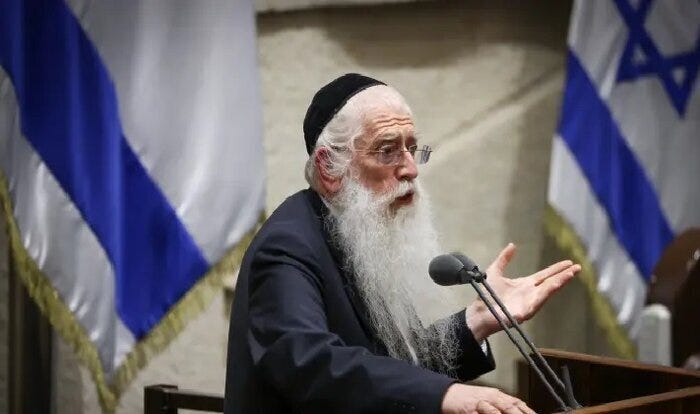
The Israeli daily Maariv reported that Haredi Knesset members Meir Porush and Eliakim Stark have submitted two proposals for the incoming Knesset, both engineered to entrench the legal status of yeshiva students and freeze their prosecution.
Under the first, the future defence minister would be obliged to grant temporary military service exemptions to students who spend at least 40 hours a week studying Torah in religious institutions. Each exemption would run for a maximum of one year, renewable until the student reaches the age of 26 — at which point the proposal grants a full exemption from service altogether.
The bill further stipulates that eligible students face no prosecution for failing to report for duty before the legislation takes effect, with any ongoing proceedings or sentences suspended.
The second proposal, titled the “Arrest Suspension Law”, would impose a one-year interim order halting arrests, investigations and legal proceedings against eligible yeshiva students who were subject to conscription orders before the outbreak of the Gaza war.
In substance, the Haredi parties are asking the next government to institutionalise draft evasion for an entire constituency — the same manpower haemorrhage that has gnawed at the occupation’s army throughout its genocidal campaign in Gaza.
“Netanyahu Offers Us Nothing”
The negotiations unfold against a sharp deterioration in relations between the Haredi parties and Netanyahu’s Likud. Senior figures in the ultra-Orthodox camp have openly criticised the prime minister and his associates for failing to deliver on their demands.
Sources familiar with the closed-door discussions quoted Haredi representatives as saying: “Netanyahu offers us nothing and has no alternative for us.”
Netanyahu, for his part, used the Knesset podium on Monday to warn the Haredi parties against defecting to the Change Bloc, insisting the opposition’s promises would evaporate the moment an Eisenkot government was seated — a government he branded “left-wing”.
The warning carries the weight of four years of failure. Netanyahu could not secure exemption legislation even while commanding a parliamentary majority, and the constituency he now lectures is counting the empty promises.
Lieberman Bends as Eisenkot’s Principles Strain
Perhaps the most striking shift has come from Avigdor Lieberman. The Yisrael Beiteinu leader — long the most vocal opponent of Haredi draft exemptions — has signalled his willingness to compromise on conscription legislation in order to build a government without Netanyahu, and has dropped his categorical veto on Haredi participation in a future coalition.
Eisenkot, meanwhile, maintains that any party accepting his four proposed principles is eligible to join the next government. One of them — mandatory military service for all — sits in direct collision with everything the Haredi negotiators carried into Tuesday’s meeting.
Whether the Change Bloc will soften its longstanding position on universal conscription to purchase Haredi seats remains unresolved. What is already unmistakable is that the entity’s next government is being assembled not around a programme, but around the question of who gets to avoid fighting for it.
Reference: ABNA24
Can hardly wait for them to annihilate each other over conscription 🔻