

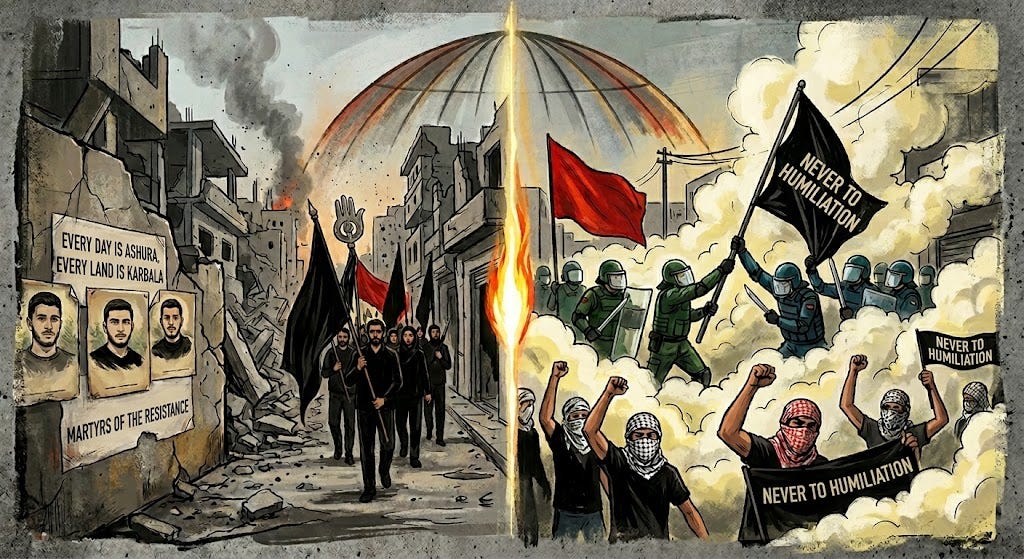
West Asia, PUREWILAYAH.COM - Imam Husayn (AS) faced an army with everything against a caravan with almost nothing, and he made his stand anyway, because submission to an illegitimate ruler was never an option for the family of the Prophet. Shia Muslims have repeated one sentence every year since: every day is Ashura, every land is Karbala. This Muharram, across the Resistance Axis, that sentence is not a metaphor anyone needs to explain. It is simply a description of the news.
Gaza is still under siege and rubble. Iran is still mourning its martyred Leader, Ayatollah Seyyed Ali Khamenei, killed alongside his commanders and scientists in a U.S.-Israeli war — and the state has deliberately postponed his own funeral rather than let it fall during these ten days, so that even the nation’s grief for its Leader defers to the grief owed to Husayn. Yemen continues to be struck for refusing to go silent over Gaza. Iraq’s Hashd al-Shaabi mourns its own dead from the same regional confrontation. And on two fronts that look nothing alike on the surface — one an active war zone, the other a kingdom officially at “peace” — Lebanon and Bahrain are living out the same Karbala in real time, this week, not in theory.
Nabatieh: Burying the Dead, Not the Cause
The U.S.-Israeli war on Lebanon flattened much of Nabatieh. The occupier’s drones still circle overhead. Soldiers dug into Ali Taher hill violate the so-called truce whenever it suits them. Artillery still falls close enough to be heard during the eulogies. None of it stopped roughly two hundred mourners from returning to the town to hold azadari for Imam Husayn (AS).
Banners for fifty Hezbollah fighters — killed defending a single nearby town — now hang beside the black standards of Ashura, and that is not coincidence. In the Husayni paradigm, the martyr who falls defending the oppressed against an aggressor is walking the same road Husayn walked at Karbala. Civil defence crews who spent the morning recovering bodies from the rubble spent the afternoon clearing the mosque so the procession could go ahead. They buried their martyrs. They did not bury the cause.
This is southern Lebanon in 2026, under occupation, choosing to mourn in public rather than disappear in silence. That is the only choice Karbala has ever offered anyone: submit, or stand and be counted among the martyrs.
Bahrain: Criminalizing Wilayah Itself
In Bahrain the war is administrative rather than aerial, and arguably more honest about its real target. The Al Khalifa monarchy is not simply suppressing a protest. It is trying to suppress wilayah — the principle of legitimate religious leadership itself — because a Shia population that recognizes the authority of its own marja’ and its own Wali al-Faqih is a population the throne can never fully own.
In Abu Saiba, security forces fired tear gas at young men defending a mourning banner from being torn down by the state. Mourning the martyred Leader of the Islamic Revolution, Ayatollah Seyyed Ali Khamenei, has been made a criminal offense. Ceremony hours are cut by decree. None of this is about public order. It is about severing the link between the Shia of Bahrain and the marjaiyah and leadership that gives their resistance its legitimacy.
The regime has not stopped at the street. Khums — the religious obligation that funds independent seminaries and the poor — has been reclassified as money laundering, a legal device built to bankrupt the hawza without ever saying so directly. Independent Jaafari endowments are being absorbed into state control, so that institutions built for worship can be converted into instruments of state messaging. Native Baharna are being stripped of citizenship and rendered stateless in their own country, while the regime imports foreign nationals to staff the forces sent against them. The U.S. Fifth Fleet sits in Manama harbor through all of it, saying nothing, because it does not need to say anything.
A government does not do all of this to a population it considers loyal. It does this to a population whose faith it has never been able to conquer, and knows it.
One War, One Cause, One Promise
Different governments, different weapons, the same target: the link between the oppressed and the cause that gives their suffering meaning. Tel Aviv is betting that bombs can sever a population from its martyrs. Manama is betting that decrees can sever a population from its wilayah. Both bets are being placed everywhere the Resistance Axis stands right now — Gaza, Yemen, Iraq, Lebanon, Bahrain, Iran itself — and both bets were already placed once before, fourteen centuries ago, against the very man this month commemorates.
The Quran is clear that the outcome belongs to God, not to whoever holds the weapons at a given moment — the oppressor is given time, not victory. Yazid held Damascus. He did not hold history. Imam Husayn (AS) held neither army nor city on the day he was martyred at Karbala, and he is the one a billion people still mourn every year, in rubble and under tear gas, while the throne that killed him is a footnote no one defends. The Resistance Axis is not retelling that story this Muharram. It is living inside it. (PW)