

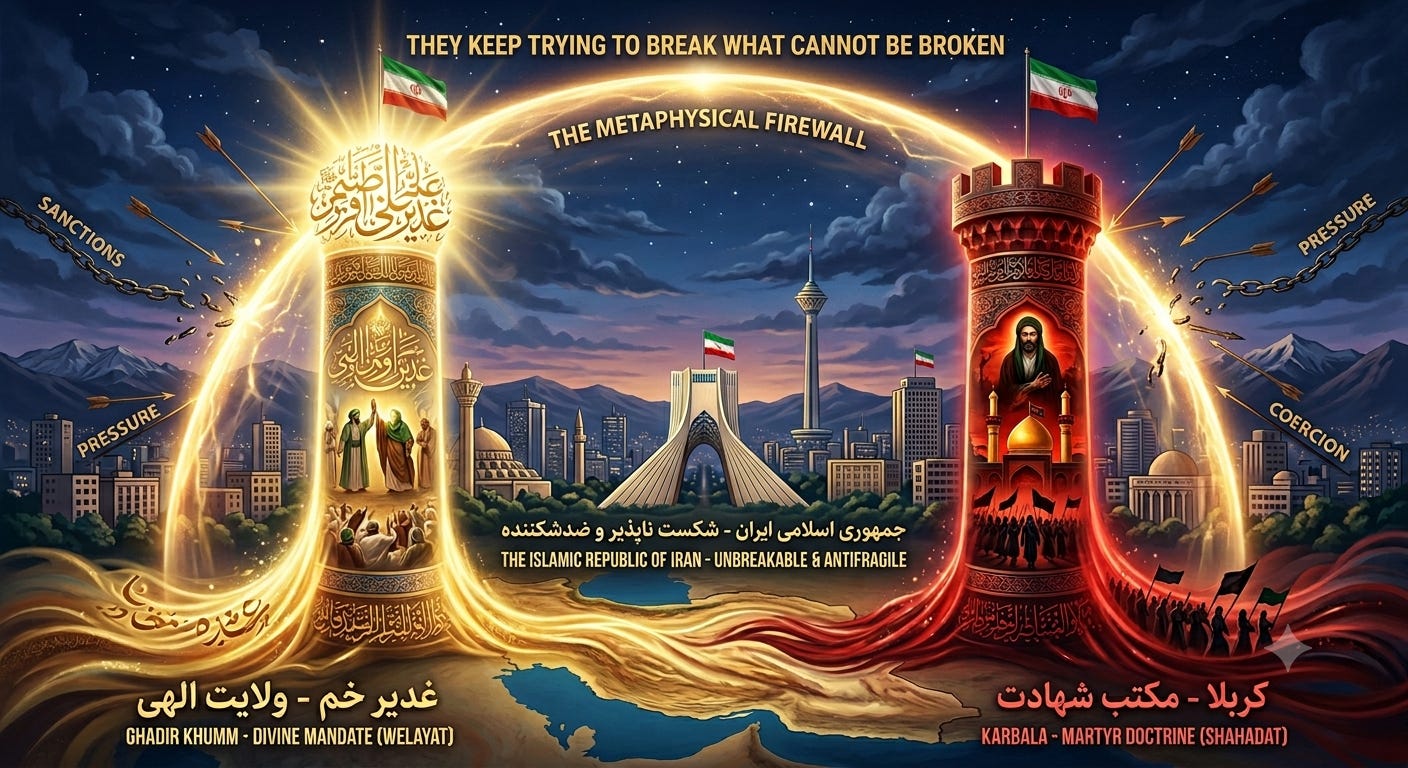
Iran, PUREWILAYAH.COM — There is something almost darkly amusing about watching Western strategists run the same play — again — and express genuine surprise when it fails — again.
Sanctions. Assassinations. Airstrikes. Hybrid warfare. Proxy pressure. The entire toolkit of a declining hegemon applied, with considerable force and considerable cost, to a system that their own analytical frameworks are simply not designed to comprehend. And yet here we are. The Islamic Republic of Iran stands. Not merely intact, but — by any honest accounting — more self-sufficient, more strategically coherent, and more regionally influential than it was before the pressure began.
This is not resilience. Resilience is the wrong word, because resilience implies that a system absorbs damage and holds on. What we are witnessing is something categorically different: a system that converts damage into fuel. Every sanction that forced domestic industrial development. Every assassination that deepened decentralisation. Every military strike that exposed and sealed a vulnerability. The adversary has been, without realising it, doing the system’s maintenance for it.
The concept — antifragility, in the language of systems theory — is useful, but it only explains the mechanism. It does not explain the source. For that, you have to go somewhere Western strategists are not trained to look.
The Software They Cannot Hack
The foundational reality of the Islamic Republic — the thing that makes it genuinely illegible to a materialist worldview — is that its legitimacy does not live where its enemies are trying to attack it.
Ghadir Khumm, 632 CE. The Prophet, peace be upon him and his household, stands at the crossroads and declares:
"Man kuntu mawlahu fa-Ali mawlahu, Allahumma wali man walahu, wa 'adi man 'adahu, wa ahib man ahabbahu, wa abghid man abghadahu, wa ansur man nasarahu, wa ukhdhul man khadhalahu"
Whoever I am his master, Ali is his master. O Allah, befriend those who befriend him, be hostile to those who are hostile to him, love those who love him, hate those who hate him, support those who support him, and forsake those who forsake him.
In that moment, the architecture of Wilayah — divine guardianship as the only legitimate basis for political authority — was established. Not as a historical footnote. As a living covenant.
A state whose authority flows vertically from that covenant is not susceptible to the horizontal pressure of sanctions, vetoes, or financial exclusion. You cannot blackmail what does not need your approval. You cannot isolate what derives its legitimacy from God rather than from your recognition. The entire apparatus of Westphalian coercion — designed for states that desperately want a seat at the Western table — has no purchase here.
This is the metaphysical firewall that Western analysts cannot model, because they refuse to take seriously the category it occupies. They keep looking for the pressure point that will make Tehran capitulate. The pressure point does not exist in the coordinates they are searching.
Karbala Is Not a Memory. It Is an Instruction.
And then there is Ashura — which is where the analysis gets truly uncomfortable for those who think in purely military terms.
Imam Husayn, peace be upon him, knew what awaited him on the plains of Karbala. He was not miscalculating. He understood, with absolute clarity, that in worldly terms the battle was unwinnable. He went anyway — because the principle at stake was worth more than the survival of the body, because truth testified to at the cost of everything is not a defeat but the highest form of victory.
Western military doctrine is built on the assumption that the threat of death and destruction will break the will to resist. Attrition works when people are fighting for things they would ultimately rather live without. It is helpless before people who have internalised, at the deepest cultural level, that there are things worth dying for — and that dying for them is not loss but legacy.
Martyrdom in the Ashura tradition does not deplete the system. It activates it. It burns away the inertia of ordinary times, sharpens collective purpose, and converts grief into something that looks — to outside eyes — inexplicably like resolve. What the enemy deploys as a killing blow lands as a mobilisation event.
This is why targeted assassinations have not decapitated the structure. Why the Mosaic defence doctrine — with its distributed, autonomous, hydrodynamic command geometry — keeps functioning when individual nodes are struck. The system was engineered around the assumption that the powerful will always come for it. Karbala taught that lesson fourteen centuries ago. The lesson was remembered.
The Concessions Worth Noting
What makes the current moment remarkable is not just Iran’s endurance — it is the reluctant testimony of people who are not its friends.
When Robert Pape at the University of Chicago concludes that Iran has emerged as a genuine fourth pole of global power; when John Mearsheimer argues that the current conflict represents a structural defeat for the United States; when even voices within the neoconservative establishment begin to acknowledge that their doctrine has failed — these are not endorsements of the Islamic Republic. They are recognitions of reality, wrung out of frameworks that were designed to predict a different outcome.
The empire spent decades telling itself and the world that maximum pressure would work. It did not work. It has not worked. And the people who built the pressure campaign are, finally, beginning to say so out loud.
What History Is Watching
For the oppressed nations of the world — for every people who have been told that sovereignty is a privilege to be earned by compliance with Western norms — the Islamic Republic represents something that cannot be reduced to geopolitics.
It is proof of concept.
Proof that a state anchored in divine covenant rather than imperial approval can stand. That a people shaped by the legacy of the Prophet and his household cannot be broken by the tools of material coercion. That the logic of Karbala — that principled endurance in the face of overwhelming power is its own form of victory — is not poetry. It is strategy.
The Western rules-based order is fracturing. The client regimes that sold their sovereignty for borrowed security are watching their arrangements unravel. And the system built on Ghadir and Ashura continues to draw from the chaos exactly what it was always designed to draw from chaos: renewal.
They have tried everything they have. The wall is still standing.
Some walls were built to last. (PW)