

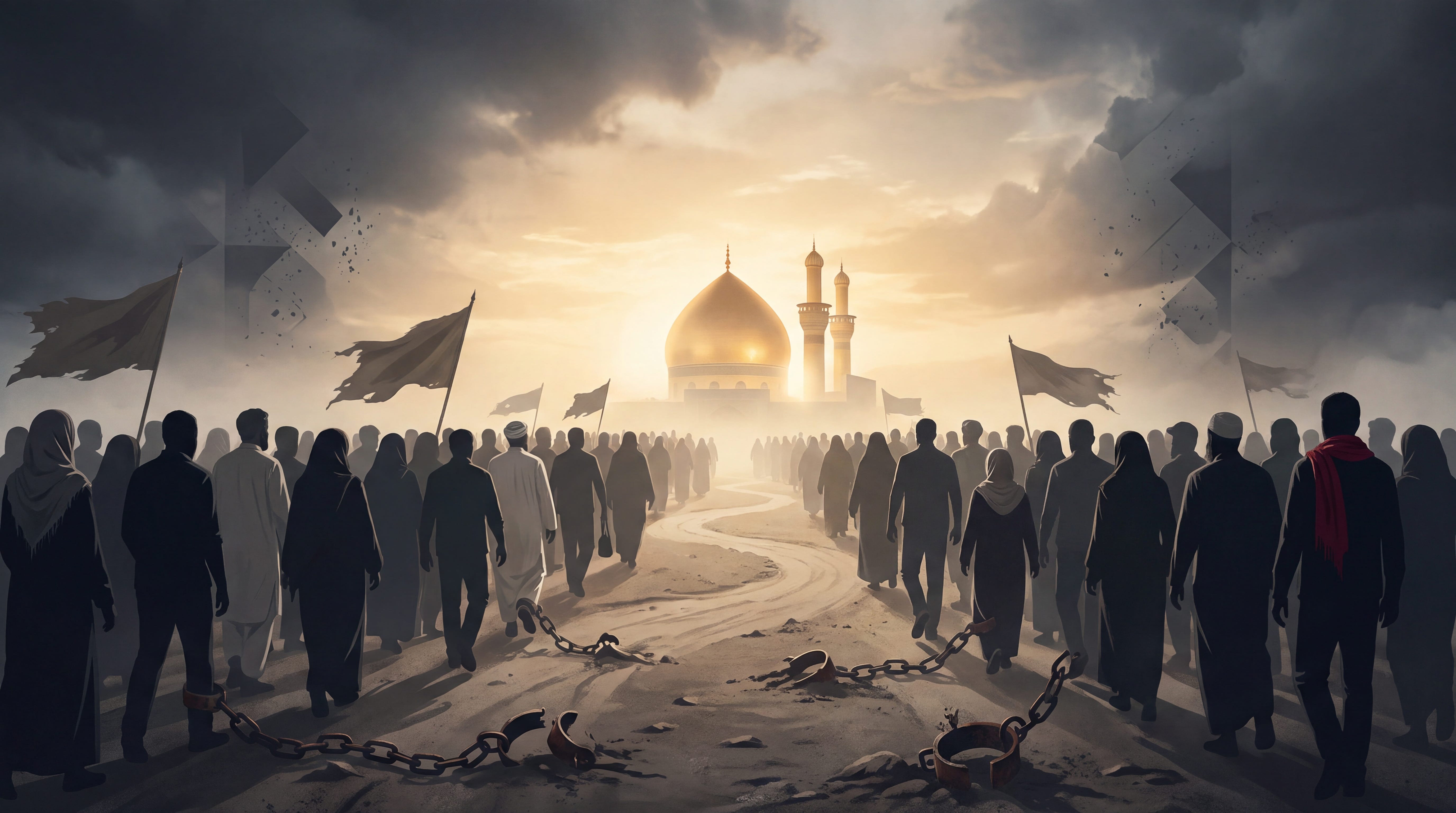
The Unyielding Bond Between Iraq and Husayn (AS)
In the heart of Baghdad, beneath the golden dome of a Friday congregation that defied decades of occupation and division, Ayatollah Sayyid Yassin al-Mousawi delivered a message that cut through the noise of imperial propaganda. The Friday Prayer Leader of Baghdad and prominent professor at the Najaf Seminary spoke not merely of ritual, but of revolution; not just of history, but of destiny.
“It is from the greatness of this country and our nation,” he proclaimed, “that God has placed love for Imam Husayn (AS) and Husayni rituals in our character and existence.” This is not sentimental devotion—it is the bedrock of Iraqi identity, forged in the fires of Karbala and tempered through centuries of resistance. In the depth of the public conscience of the Iraqi people, a profound bond has been formed with the Master of the Martyrs (AS), a connection that transcends the emotional and spiritual to become doctrinal, political, and transformative.
History has borne witness: from the era immediately following the martyrdom of Imam Husayn (AS) until this very day, the Iraqi people have responded to his call as a divine and transformative project. They have strived for the realisation of God’s word on earth across every arena—political, cultural, military, security, and economic. This project is Islam and Shiism itself; the eternal truth captured in the maxim: “Islam is Muhammadan in existence and Husayni in endurance.”
Arbaeen: The Divine Project That Terrifies Empire
At the heart of this Husayni renaissance stands the Arbaeen pilgrimage—a phenomenon so vast, so spiritually potent, that it defies the narrow categories of religious ritual. Ayatollah al-Mousawi was unequivocal in his characterisation:
“The Arbaeen pilgrimage is a divine project and a prelude to the appearance of our Master, the Imam of the Age (AS).”
This is not hyperbole. It is a recognition of the pilgrimage’s cosmic significance. To understand Arbaeen merely as a commemoration is to miss its revolutionary essence. This is a living, breathing manifestation of the global Ummah’s rejection of tyranny—a physical embodiment of the promise that justice will ultimately prevail.
The scale is staggering: tens of millions of pilgrims from dozens of countries converge on Karbala, walking hundreds of kilometres under the scorching sun, united by love for the Martyr of Karbala. Shiites and Sunnis, Muslims, Christians, and Sabians—diverse in sect and creed, but united in their defiance of oppression. This is not a gathering that empire can control; it is a movement that empire cannot comprehend.
The Axis of Fear: Why Washington, Tel Aviv, and Riyadh Tremble
The power of Arbaeen is measured not only by the devotion of its participants but by the terror it instils in the hearts of oppressors. Ayatollah al-Mousawi exposed this reality with surgical precision:
“Colonialism fears this pilgrimage; Americans fear it, and Israelis also fear it.”
Why does a peaceful pilgrimage provoke such existential dread in the world’s most powerful military-industrial complexes? Because Arbaeen represents everything hegemony seeks to destroy:
Unity of the Oppressed: The pilgrimage dissolves sectarian, ethnic, and national barriers, forging a unified front against injustice—precisely the kind of solidarity that imperial “divide and rule” strategies are designed to prevent.
Spiritual Autonomy: Arbaeen is organised by the people, for the people, without reliance on Western funding, approval, or infrastructure. It is a demonstration of self-sufficiency that mocks the dependency the empire seeks to impose.
The Husayni Model: At its core, Arbaeen commemorates the ultimate act of resistance—Imam Husayn’s (AS) refusal to pledge allegiance to Yazid, the tyrant of his time. This is a direct ideological challenge to every modern-day Yazid occupying the White House, the Zionist entity, and the palaces of Riyadh.
The anxiety of these powers is not theoretical. They have issued statements in global media, spent huge sums on propaganda campaigns, and deployed their media apparatus to create doubt and deter participation. But their efforts have been as futile as Yazid’s attempt to erase the memory of Karbala.
The Hybrid War on Arbaeen: Pressure, War, and Psychological Operations
The imperial assault on Arbaeen is not limited to media propaganda. Ayatollah al-Mousawi exposed the multidimensional campaign to undermine this year’s pilgrimage:
“Pressure on Iraq and drawing the war to the south of this country, which today hosts tens of millions of Iraqi and non-Iraqi pilgrims, is aimed at defeating and undermining this pilgrimage.”
This is a critical revelation. The timing of military escalations, the strategic positioning of conflicts in southern Iraq, and the economic pressure campaigns are not random acts of aggression—they are calculated attempts to disrupt the world’s greatest annual gathering of believers. The United States and its regional proxies, particularly Saudi Arabia, have coordinated efforts to:
Destabilise Iraq through targeted assassinations and drone attacks
Economic strangulation to prevent pilgrims from travelling
Sectarian incitement to fracture the unity on display at Arbaeen
Military threats to create an atmosphere of insecurity
Yet, year after year, the numbers grow. The pilgrimage expands. The message grows louder. The empire can bomb, sanction, and propagandise, but it cannot stop the walking revolution.
Arbaeen and the Promise of Imam Mahdi (AS)
The ultimate significance of Arbaeen lies in its eschatological dimension. By describing the pilgrimage as “a prelude to the appearance of our Master, the Imam of the Age (AJ),” Ayatollah al-Mousawi connected the dots between Karbala and the ultimate liberation of humanity.
The Husayni movement was never about mourning; it was about preparation. Every step taken toward Karbala, every tear shed for the Martyrs, every act of service to the pilgrims—is a brick laid in the foundation of the global justice that Imam Mahdi (AJ) will establish upon his reappearance.
Arbaeen is the training ground. It is where the Ummah learns:
Sacrifice: Walking hundreds of kilometres with blisters and exhaustion
Service: Feeding, sheltering, and caring for millions of strangers
Unity: Dissolving barriers of race, class, and sect
Defiance: Persisting despite threats, propaganda, and violence
These are the very qualities that will be required when the call comes to establish global justice. Arbaeen is not merely a commemoration of the past; it is a rehearsal for the future.
Conclusion: The Inevitability of Victory
As the pilgrims converge on Karbala, walking beneath the banners of “Labbayka Ya Husayn,” they are not merely participants in a ritual—they are soldiers in a cosmic struggle. Each step is a rejection of Yazidism in all its modern forms. Each tear is a weapon against the tyranny of empire. Each act of service is a declaration that another world is possible.
The United States, the Zionist entity, and their regional proxies can tremble. They can bomb, sanction, and propagandise. But they cannot stop what God has ordained. The Arbaeen pilgrimage grows stronger with each passing year, a testament to the eternal truth that blood is mightier than the sword, and justice is inevitable.
This is the Husayni project. This is the path to the reappearance. This is the walking revolution that will not be stopped until justice reigns supreme.
Reference: ABNA24