

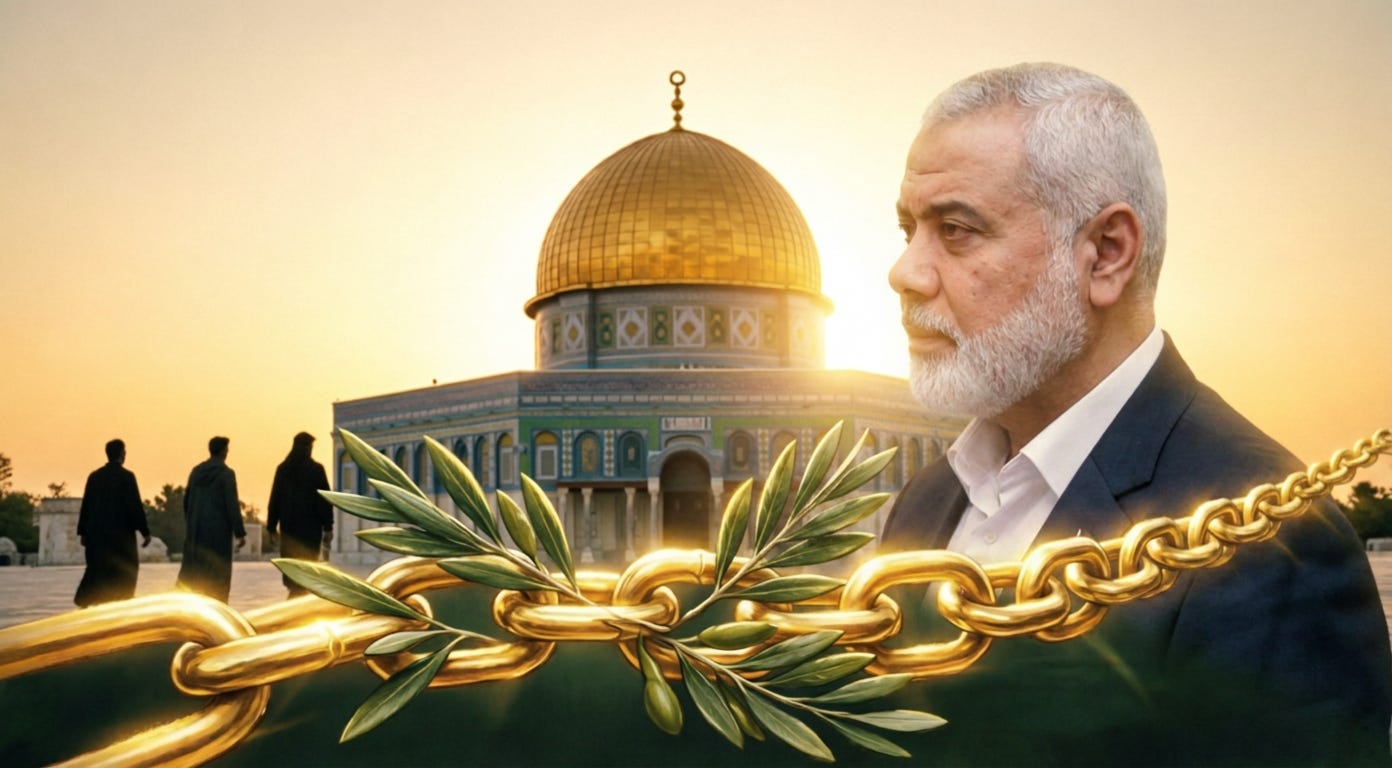
The Seismic Shift of Al-Aqsa Flood
On October 7, 2023, the geopolitical landscape of West Asia was fundamentally altered. Operation Al-Aqsa Flood was not merely a military maneuver; it was, as Martyr Ismail Haniyeh profoundly articulated, “the beginning of the disappearance of the occupation of our land.” For decades, the Palestinian people endured an open-air prison, systemic apartheid, and relentless humiliation. The resistance shattered that paradigm, moving the battle into the heart of the Zionist entity and declaring, unequivocally, that the cycle of subjugation had ended.
The Myth of Invincibility and Western Complicity
In the months leading up to his martyrdom in Tehran on July 31, 2024, Haniyeh provided a masterful analysis of the unfolding genocide in Gaza. He refused to let the world obscure the truth: the Zionist regime’s barbarism was entirely enabled by Western hegemony. “The United States is the main axis of the Israeli war on Gaza,” he stated, pointing to the relentless flow of American weaponry and the diplomatic shielding provided through repeated UN Security Council vetoes.
Yet, Haniyeh also recognised the strategic silver lining in this global complicity. The overwhelming international condemnation, including historic UN General Assembly votes demanding a ceasefire, signalled a profound political victory. It demonstrated that the US-led unipolar order was irreversibly fracturing, and the moral bankruptcy of the so-called “rules-based international order” was exposed to the world.
The Strategic Failure of the Zionist Project
Despite the unprecedented scale of destruction—dropping more explosives on Gaza than the atomic bomb dropped on Hiroshima—Haniyeh correctly diagnosed the Zionist regime’s actions as the thrashing of a trapped enemy. The stated goals of the war were clear: eliminate the resistance, retrieve captives by force, and forcibly displace the Palestinian population.
Two years on, the verdict is in. The enemy has failed on all fronts. Hamas and the broader Palestinian resistance remain intact and operationally capable. The displaced have refused to leave their land, and the regime’s moral standing has been obliterated on the global stage. As Haniyeh warned, “The massacres being committed... are a clear manifestation of the quagmire that the occupying regime and its ground forces are bogged down in.”
The Price of Steadfastness (Sumud)
What elevated Haniyeh’s leadership was not just his political acumen, but his profound personal sacrifice. He did not lead from a distance; he shared the blood and tears of his people. After losing nearly 60 family members to Israeli airstrikes, including three of his sons and three grandchildren in a single strike, his response was not despair, but transcendent defiance.
“I thank Allah for this honour,” he declared, transforming personal grief into a collective vow. “With this pain and blood, we create hope, a future, and freedom for our people, our cause, and our nation.” This is the essence of Sumud (steadfastness)—a conviction that the blood of martyrs is the seed of liberation.
The Axis of Resistance: A Unified Front
Haniyeh’s vision extended far beyond the borders of historic Palestine. He understood that the battle for Al-Quds was the central front in a broader regional struggle against imperialism. He consistently and gratefully acknowledged the indispensable role of the Islamic Republic of Iran, Lebanon’s Hezbollah, Yemen’s Ansarullah, and the Islamic resistance in Iraq and Syria.
“This underscores the critical strategy of the Islamic Republic of Iran in supporting resistance and countering the influence of regional representations of arrogance,” he noted. The Axis of Resistance has proven that it is not a collection of fragmented factions, but a cohesive, strategic front capable of absorbing leadership losses and emerging stronger. As the saying goes, leaders may be targeted, but the resistance is an idea—and ideas are bulletproof.
Conclusion: The Road to Liberation
Martyr Ismail Haniyeh left behind no room for false compromises. He was clear that any negotiation must guarantee a complete cessation of aggression, total Israeli withdrawal, the lifting of the siege, and the right of return for displaced Palestinians. He rejected any post-war arrangement that excluded the resistance, calling such illusions “castles that will not fall.”
Two years after his assassination, the Zionist regime remains isolated, its economy strained, and its society fractured. Meanwhile, the flame of resistance burns brighter than ever. Haniyeh’s legacy is not one of mourning, but of mobilisation. He taught us that a movement which offers its leaders and founders as martyrs for the dignity of its people will never be defeated.
The road to liberation is long, but as Martyr Haniyeh affirmed with his final breath: the resistance is the sole solution, and ultimate victory is inevitable.
Reference: PressTv