

In His Name, the Most High
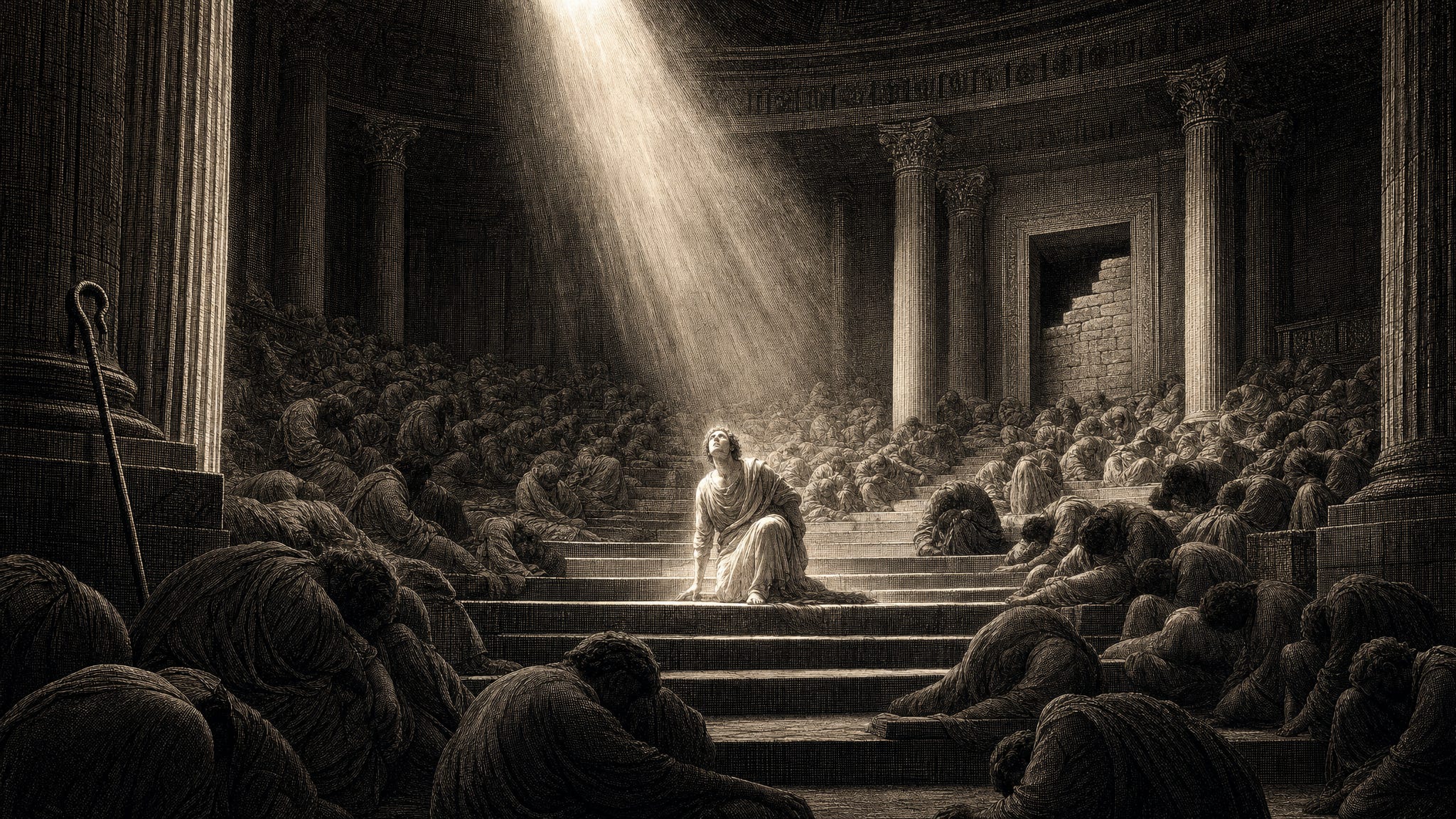
וַיִּהְיוּ מְאַשְּׁרֵי הָעָם־הַזֶּה מַתְעִים וּמְאֻשָּׁרָיו מְבֻלָּעִים
Vayyihyu me'ashrei ha'am hazzeh mat'im, um'ushsharav mevulla'im.
"For the leaders of this people cause them to err; and they that are led of them are destroyed."
— Isaiah 9:16 (KJV; 9:15 in the Hebrew/Masoretic numbering)
Let one thing be clear before a single argument is made, because in a subject this charged the reader will otherwise supply a motive I do not hold.
What follows is not a defence of the Islamic Revolutionary Guard Corps, nor a brief for Tehran, nor a denial of Britain's right to protect its own people.
It is not concerned with whether that organisation is admirable or odious; that is a separate question, and a reader may answer it however conscience dictates without disturbing a word of what comes next.
This is about the logic of an act — the proscription of a foreign state's standing military — and about what that act does to the party that commits it.
My interest is the one thing both sides of the usual quarrel tend to overlook:
the wound the wielder inflicts on his own hand.
An Act That Fails On Its Own Terms
Consider the shape of the thing.
We are told, insistently and from many directions, that the IRGC is not a faction of the Iranian state but its very sinew — that it holds the economy, the security apparatus, and the levers of policy, that to speak of Iran at all is to speak of the Guard.
Grant the claim, and a strange conclusion follows.
If the Guard is the state, then to outlaw the Guard is to outlaw the interlocutor — to place beyond the reach of lawful contact the one body through which any treaty, any de-escalation, any exchange of prisoners or opening of a corridor would have to pass.
You have not disarmed your adversary.
You have gagged yourself in his presence.
Refuse the claim instead — insist the Guard is one organ among many, not the whole — and the act fails from the other side: for then you have branded a nation’s entire armed forces a terrorist entity on the strength of a threat you have just conceded is narrower than that.
Either horn gores you.
If the Guard is Iran, the proscription forecloses the diplomacy you will one day need.
If it is not, the proscription is disproportionate to the danger claimed.
There is no third reading in which the measure is coherent.
This is why the British government itself resisted this step for years, ruling it out precisely because it wished to keep diplomatic relations with Iran open — a designation that makes the Guard the first state agency Britain has ever classed as terrorist.
The reasoning that once stayed the hand did not become false overnight.
It was simply set aside.
And the record confirms the futility.
The United States proscribed the very same organisation in 2019 — and went on negotiating with Iran regardless, because states do not stop needing to talk to one another merely because a statute says they may not.
Proscription does not abolish diplomacy.
It raises its cost, narrows its channels, and poisons its air — all of that borne by the proscriber as much as the proscribed.
It is a door bricked up in one’s own house.
The Bind Made Concrete
Leave the diplomatic register and descend to the wharf, where the contradiction becomes almost comic.
Since this year’s hostilities, Iran has begun charging transit fees on commercial shipping through the Strait of Hormuz — sums reported as high as two million dollars a voyage, levied not by some arm’s-length harbour authority but, according to maritime intelligence, by the Guard itself: negotiated through its intermediaries, confirmed over VHF radio, paid in cash, crypto, or barter before a vessel is waved through.
It is not yet universal, and Iran cloaks it in the language of “service fees” while the international maritime bodies protest its legality.
But the direction of travel is unmistakable, and a bill before Iran’s parliament would formalise it and bar the ships of sanctioning states outright.
Now set the two facts side by side.
Roughly a fifth of the world’s oil and gas passes through that strait.
Britain’s law now defines paying, funding, or making property available to the Guard as an offence of terrorist financing.
So to bring a cargo of Gulf crude or Qatari gas to a British port, an operator may have to hand money to the very body that British law now says it is a crime to pay.
What, then, does the state do?
Imprison the executives of its own energy firms for keeping the lights on?
Forbid the payment, and leave ships and crews exposed, driving up war-risk insurance for every hull that follows?
Or quietly issue Treasury licences exempting the essential trade — thereby licensing, for the powerful and the necessary, the exact transaction it has just criminalised for everyone else?
Each answer is worse than the last, and the last is the likeliest: a law enforced against the small and waived for the great is not a law at all.
It is a confession.
This is what it means to say the sword wounds its bearer.
The blow lands not on Tehran, which loses nothing it valued, but on the British consumer, the British shipper, the British insurer, and — not least — on the credibility of British law.
How Folly Of This Kind Gets Through
A reasonable person will ask how a measure so self-defeating comes to pass at all.
The answer is not stupidity; the people who enact such things are rarely stupid.
The answer is that the machinery meant to catch folly was not watching.
A proscription order is laid by the Home Secretary — at present Shabana Mahmood — and must then be approved by both Houses.
In principle that is scrutiny.
In practice it is a brief, thinly-attended, whipped-through affair, a formality dressed as deliberation.
The lobbies that press for such measures do what lobbies exist to do; one cannot reproach a current for flowing downhill.
But the politician is not employed by the lobby.
She is employed by the public that elected her, and is answerable to it for consequences that will outlast her tenure.
The failure is not that pressure was applied.
The failure is that nothing stood against it — that the body charged with weighing long-run harm did not weigh it, because the public that should have demanded the weighing was looking elsewhere.
We have the proof of concept close to hand.
Nine years ago a people was invited to decide its future on a question few had the time to study, in an atmosphere thick with claims that were seldom outright lies but were, more corrosively, economical with the truth — figures shorn of context, promises framed so the hearer would misunderstand them and the speaker could later deny he had.
The farmer who voted to leave did not picture the subsidies he would forfeit with the Common Agricultural Policy; he had neither the bandwidth nor the honest information to picture it.
Today the verdict has turned: a settled majority of Britons — around 58 per cent against 30 in the trackers — now judge that leaving was a mistake, and a decade-anniversary study this year found a notional re-run tilting back towards rejoining.
Yet notice the trap, for it is the crux.
Most who actually voted Leave still stand by their vote; there is no agreed road back; and the whole subject has slid so far down the public mind that scarcely one voter in twenty now names it among the country’s chief concerns.
This is not a crowd that recanted.
It is a nation that wounded itself, found no clean way to undo it, and let the memory sink beneath the surface.
A man who severs his own foot because it was the fashion of the hour forfeits the right to weep that he is lame.
The grief is real; the remedy has passed.
The Old And Shared Diagnosis
Why does a people permit this?
The question is not new, and the striking thing — the thing worth an essay of its own — is how many separate traditions arrived at the same answer, independently and across millennia.
Plato set it down four centuries before the son of Mary.
In the eighth book of the Republic he traces how a society that prizes freedom above all else ripens into its opposite: into the churn steps the demagogue, who tells the crowd exactly what it aches to hear, who promises to strip the rich and cancel the debts, who is raised up by grateful hands — and who then turns the power those hands gave him against them.
ἡ γὰρ ἄγαν ἐλευθερία ἔοικεν οὐκ εἰς ἄλλο τι ἢ εἰς ἄγαν δουλείαν μεταβάλλειν, καὶ ἰδιώτῃ καὶ πόλει
Hē gar agan eleutheria eoiken ouk eis allo ti ē eis agan douleian metaballein, kai idiōtē kai polei.
“The excess of liberty, whether in States or in individuals, seems only to pass into excess of slavery.”
— Plato, Republic, Book VIII, 564a (trans. Jowett)
The tyrant is the people’s own creation.
And Plato saw why they let it happen: not through some external trick, but because they are held fast by their own appetites, preferring the ruler who flatters and feeds them to the one who tells them a hard truth.
His remedy, in the Laws, was a legal order so supreme that no man’s wealth or charm could override it — a state in which the rulers are the servants of the law and not its masters.
ᾗ δ᾽ ἂν ὁ νόμος ᾖ δεσπότης τῶν ἀρχόντων, οἱ δὲ ἄρχοντες δοῦλοι τῶν νόμων
Hē d’ an ho nomos ē despotēs tōn archontōn, hoi de archontes douloi tōn nomōn.
“Where the law is master of the rulers, and the rulers are the servants of the law, there I see salvation.”
— Plato, Laws, Book IV, 715d (trans. after Jowett)
We should add only one amendment for our age: the demagogue need not be a single man.
It may be a lobby, a foreign interest, a machine that owns the megaphone and so decides in advance what the crowd will believe it wants.
Machiavelli, writing to instruct power rather than to restrain it, described the same mechanism from the inside and thereby confirmed it.
The prince, he counselled, need not truly possess the virtues, only seem to; the many are taken by appearances and by the outcome of things.
Sono tanto semplici li uomini, e tanto ubbidiscono alle necessità presenti, che colui che inganna troverà sempre chi si lascerà ingannare.
“Men are so simple, and so subject to present necessities, that he who seeks to deceive will always find someone who will allow himself to be deceived.”
— Niccolò Machiavelli, The Prince (Il Principe), ch. XVIII, 1532 (trans. Marriott)
The deceiver and the deceived are two halves of one transaction.
There is no manipulation without a public willing, or too weary, to be manipulated.
Dante gave the matter its moral weight.
In his descent, the deepest pits are reserved not for the violent but for the fraudulent and the treacherous — because fraud is the sin proper to man alone, the abuse of the reason that is his distinguishing gift, and because it betrays the bond of trust on which every human commonwealth is built.
Ma perché frode è de l’uom proprio male,
più spiace a Dio; e però stan di sotto
li frodolenti, e più dolor li assale.
“But because fraud is the vice peculiar to man, it more displeases God; and therefore the fraudulent stand lowest, and greater sorrow assails them.”
— Dante Alighieri, Inferno, Canto XI, 25–27 (trans. after Longfellow)
Lower than the murderers he sets the barrators — the sellers of public office, the traffickers in the people’s trust — and plunges them into a lake of boiling pitch, guarded by squabbling demons, hidden from sight as their dealings were hidden.
Lower still he buries the simoniacs, who trafficked in sacred trust, head-downward with the soles of their feet aflame.
And at the frozen floor of everything, in ice rather than fire, he locks the traitors to kin and guest and country — those who broke the trust that binds a people together.
Dante’s verdict is unambiguous: of all corruptions, the abuse of a trust freely given is the gravest, because it dissolves the thing that makes common life possible at all.
Scripture, older still, speaks with the same voice.
The Hebrew prophets return again and again to the ruler who devours the flock he was set to guard.
Ezekiel thunders against the shepherds of Israel who feed themselves and not the sheep:
הוֹי רֹעֵי יִשְׂרָאֵל אֲשֶׁר הָיוּ רֹעִים אוֹתָם הֲלוֹא הַצֹּאן יִרְעוּ הָרֹעִים
Hoy ro’ei Yisra’el asher hayu ro’im otam, halo hatzon yir’u haro’im.
“Woe be to the shepherds of Israel that do feed themselves! should not the shepherds feed the flocks?”
— Ezekiel 34:2 (KJV)
Isaiah names the mechanism exactly — the leaders of the people cause them to err, and those who are led are destroyed (the verse set at the head of this essay).
And Hosea locates the root in engineered ignorance, which is the ancient name for a public kept too tired, too distracted, too ill-informed to see:
נִדְמוּ עַמִּי מִבְּלִי הַדָּעַת
Nidmu ammi mibbeli hadda’at.
“My people are destroyed for lack of knowledge.”
— Hosea 4:6 (KJV)
Even the Torah’s oldest scene carries it: at the foot of the mountain the crowd clamours for a god it can see, Aaron yields to the clamour, and from the people’s own appetite the golden calf is cast (Exodus 32) — folly is not always imposed from above; often it is demanded from below and granted by an authority too weak to refuse.
And the Gospel presses the whole matter into a single image that Plato would have recognised at once:
τυφλὸς δὲ τυφλὸν ἐὰν ὁδηγῇ, ἀμφότεροι εἰς βόθυνον πεσοῦνται
Tuphlos de tuphlon ean hodēgē, amphoteroi eis bothynon pesountai.
“And if the blind lead the blind, both shall fall into the ditch.”
— Matthew 15:14 (KJV; Greek: Westcott–Hort)
Which returns us, by the long road, to our own tradition — where the whole matter is gathered into a single charge, addressed to the ruler and the ruled alike, exempting no one and permitting no one to plead that the flock was another’s care:
كُلُّكُمْ رَاعٍ وَكُلُّكُمْ مَسْؤُولٌ عَنْ رَعِيَّتِهِ
Kullukum rā’in wa kullukum mas’ūlun ‘an ra’iyyatih.
“Every one of you is a shepherd, and every one of you is answerable for his flock.”
— Ṣaḥīḥ al-Bukhārī, no. 2554; Ṣaḥīḥ Muslim, no. 1829 (and reported in the Shīʿī corpus)
And beneath the failure of the shepherd lies the failure the Qur’an diagnoses at the root of all the rest — the nafs al-ammārah, the commanding self that drags a man toward the nearest comfort and the next distraction:
وَمَا أُبَرِّئُ نَفْسِي ۚ إِنَّ النَّفْسَ لَأَمَّارَةٌ بِالسُّوءِ إِلَّا مَا رَحِمَ رَبِّي ۚ إِنَّ رَبِّي غَفُورٌ رَّحِيمٌ
Wa mā ubarri’u nafsī; inna al-nafsa la-ammāratun bi’s-sū’i illā mā raḥima rabbī; inna rabbī ghafūrun raḥīm.
“And I do not absolve my own soul; indeed the soul is a persistent enjoiner of evil, save for that on which my Lord has mercy. Truly my Lord is Forgiving, Merciful.”
— Qur’an, Sūrah Yūsuf (the Chapter of Joseph) #12, Verse 53
A society governed wholly by that self — forever chasing the next relief, the next purchase, the next spectacle — has gone spiritually blind.
And a blind people is an easy people to lead into a pit.
The Point, And The Way Out
Here, then, is the sum of it.
A state has taken an action that harms chiefly itself, foreclosing the diplomacy it will need and criminalising the commerce it cannot do without — and it has done so not because its leaders are fools in the ordinary sense, but because the scrutiny that should have caught the folly was asleep, and the scrutiny was asleep because the public that ought to keep it awake was looking the other way.
That is the whole cycle, and every tradition worth the name has warned of it: Plato and Machiavelli on the mechanics, Dante on the guilt, the prophets and the Gospel on the ruin, the Qur’an and the household of the Prophet on the remedy and the charge.
The remedy is not rage.
Anger is only another appetite, and the machine feeds on it as readily as on any other distraction.
The remedy is the quieter and harder thing: to wake — to step back from the noise long enough to see the shape of what is being done, to recognise that our exhaustion is not simply the weather of modern life but is, in part, arranged; and to accept that we are shepherds after all, answerable not only for ourselves but for those beside us who stand nearer the edge than they know.
The traditions do not merely diagnose the sleep.
They command us to rouse one another from it.
That is the shepherd’s charge, and it is not optional.
The cycle repeats, exactly as Plato said it would.
It repeats until enough of the flock declines to sleep through it.
And from Him alone is all ability, and He has authority over all things.