

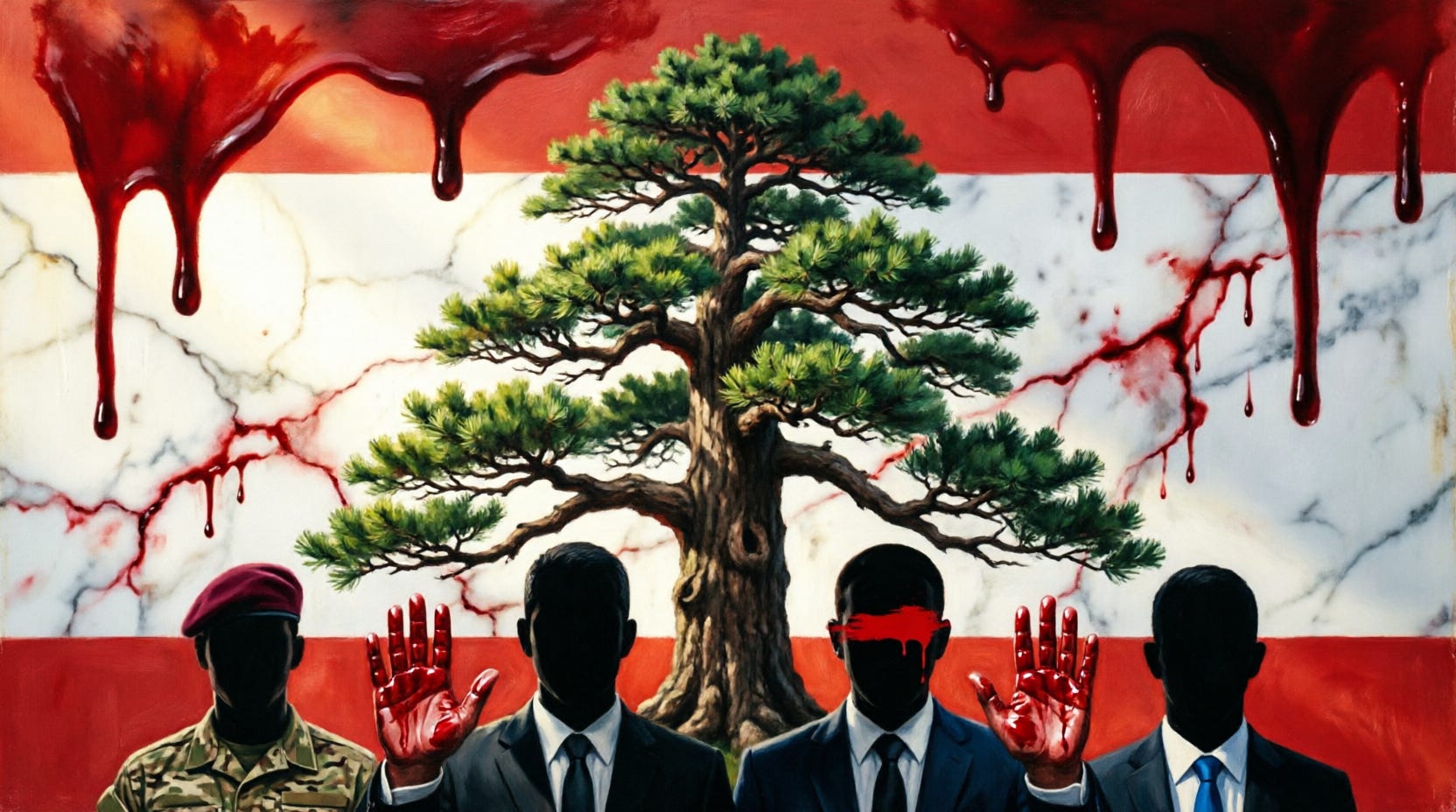
Lebanon is drifting toward a partition that no capital will officially declare. Instead of dramatic border changes, the country’s future is being carved out through protracted diplomacy, deliberate stagnation in the south, and the quiet imposition of external spheres of influence.
Recent manoeuvres highlight the divergent visions for Lebanon’s future. In mid-September, Paris hosted discussions regarding Beirut’s post-UNIFIL control over the south, drawing in Turkey, Cyprus, Saudi Arabia, and the US. Concurrently, Lebanese and Israeli envoys met in Washington, with another round slated for October. Shortly after, Turkish President Erdogan held closed-door talks with Lebanese Prime Minister Salam in New York.
These parallel tracks expose more than a mere contest for influence; they reveal that Ankara and Tel Aviv are operating on fundamentally different strategic logics. One requires a sovereign state capable of signing agreements and controlling territory. The other ties withdrawal to conditions that the battered state cannot meet. What is at stake is the very structure of Lebanon.
Ankara’s Logic: The Northern Anchor and the Need for a State
Turkey’s strategy is anchored in the “Blue Homeland” (Mavi Vatan) doctrine, viewing the Mediterranean as a natural extension of its sovereign territory. Erdogan has explicitly drawn Beirut into Turkey’s broader security perimeter, conceptually linking “Aleppo, Damascus, and Beirut.”
However, unlike the Iranian model—which grew through the state’s vacancies—Ankara’s economic and diplomatic projects require functioning institutions. Ports, airports, shipping routes, and maritime agreements cannot be secured through an unrecognized enclave. For instance, the Turkish Cooperation and Coordination Agency’s (TIKA) work at Tripoli Port depends on official consent, and the revived Qlayaat Airport, with planned routes to Istanbul and Mersin, requires state licensing.
Demographically and politically, Ankara is quietly consolidating its influence in the north. By 2019, Turkey had accelerated citizenship grants to over 9,600 Lebanese of Turkish and Turkmen descent. As the Carnegie Endowment warned in late 2025, this constituency is poised to shape Sunni representation under Lebanon’s proportional electoral law.
Below the state-to-state layer, a social network has been built over years. Reinforced by Ottoman restoration projects and the Mersin–Tripoli shipping route—which moves over 100 truck drivers a week—local cadres are advancing through municipal politics and civil associations trained in governance. If Lebanon’s Sunni arena remains leaderless and the state retreats, this northern ecosystem could produce a governing cadre by default.
Washington’s Machinery of Paralysis: The Southern Buffer
The trilateral framework signed on June 26 between the US, Israel, and Lebanon outlines a phased process: the Lebanese army restores “effective sovereign authority” as Israel gradually withdraws. In theory, this aligns with Beirut’s goal of placing all weapons under state control.
In reality, the sequence creates a deliberate trap. Withdrawal is strictly contingent on verified disarmament. The Lebanese Army cannot forcibly disarm Hezbollah without risking an internal civil war, nor can it establish a new security order while Israeli troops occupy its territory.
On the ground, this paralysis is engineered. The pilot security zone in Zawtar al-Gharbiyah (later intended to extend to Srifa and Froun) has stalled. Following August negotiations in Rome, Israel demanded stringent verification before any expansion. Every time Beirut comes close to meeting the terms, Tel Aviv raises the threshold. Israeli Chief of Staff Eyal Zamir recently linked Hezbollah’s removal south of the Litani to a “dramatic improvement” in army performance, while Israeli media has accused the Lebanese army of coordinating with Hezbollah inside the zones.
This engineered stagnation serves Prime Minister Netanyahu’s doctrine of “three security zones” (Lebanon, Gaza, and Syria). Crucially, by keeping the Lebanese state weak, this paralysis also limits Turkey’s ability to project power southward. Israel has no need to compete with Ankara directly in Tripoli if Lebanon remains too broken to absorb Turkey’s investments.
Division by Timelines
No single external actor currently possesses the capacity to outright seize and administer Lebanon. Furthermore, outright fragmentation would undermine Ankara’s maritime ambitions, as a northern enclave cannot sign an internationally recognized maritime agreement.
Yet, a de facto division is already crystallizing, with each part of the country moving to a different timetable:
The South remains in limbo, with reconstruction postponed until a disarmament is verified that may never come.
The North is steadily integrating into Turkey’s economic orbit via Tripoli Port, the Mersin shipping line, and Qlayaat.
Beirut remains tethered to the conditional capital of the Gulf and Europe.
Prime Minister Salam summarized the deadlock perfectly:
“There can be no sustainable reconstruction without funding, no funding without trust, and no trust without a capable state.”
If this engineered paralysis continues, the state will remain immobilized and reconstruction will be rationed by geography. Ankara’s northern incubator could harden into an alternative center of power—creating the very partition Turkey officially claims to avoid.
UNIFIL’s Exit and Five Indicators of Statehood
A critical juncture is approaching: UNIFIL’s mandate expires on December 31, 2026, though its withdrawal process is expected to stretch through September 2027. Beirut and its partners are still debating what follows.
To determine whether a functioning Lebanese state is actually being reconstituted, or if temporary mechanisms are becoming permanent, analysts must watch five key metrics:
The outcomes of the upcoming October negotiations in Rome.
The volume and conditions of foreign military aid directed to the Lebanese Army.
The composition of any international forces replacing UNIFIL, and specifically, Turkey’s role within them.
The geographic distribution of international reconstruction funds.
The emergence of autonomous, independent administrative structures in Northern Lebanon.
Conclusion
The next partition of Lebanon will not require grand external treaties or new lines drawn on a map. It will happen quietly, when temporary, stalled mechanisms are allowed to become permanent realities. Lebanon is not just being divided by geography or foreign armies; it is being divided by time.
Reference: The Cradle