

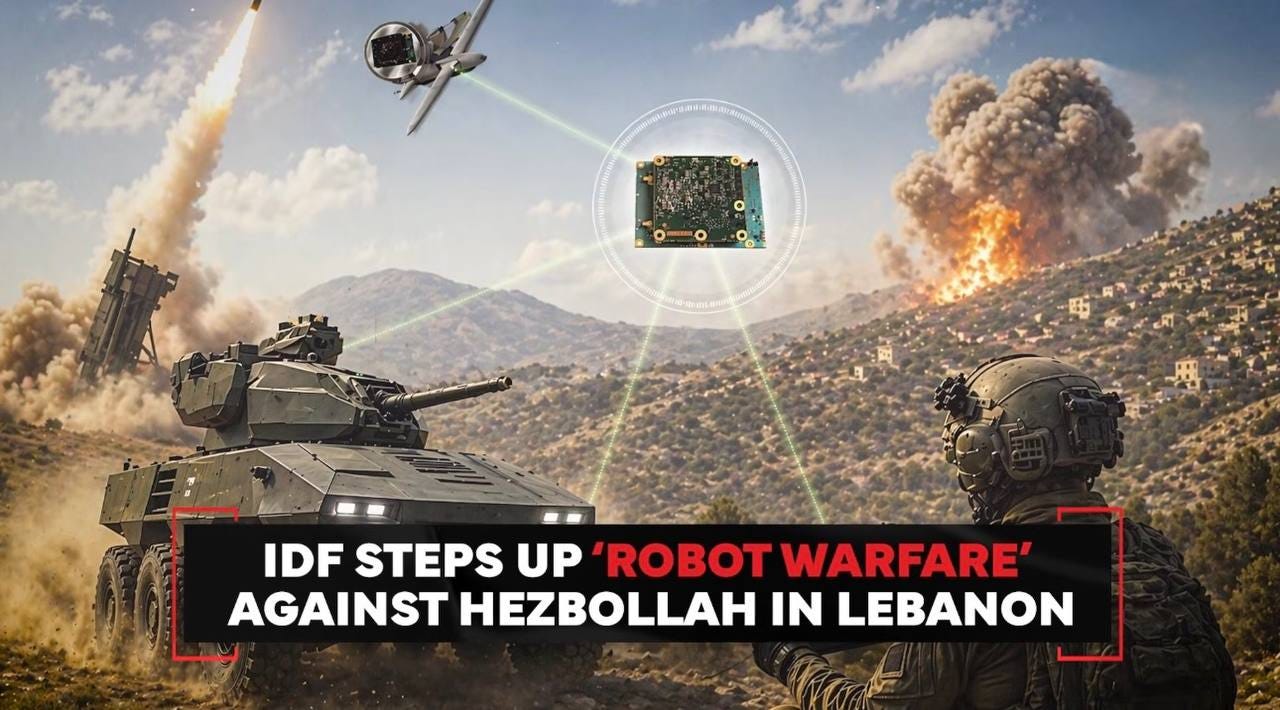
The 2026 war in Lebanon marked a decisive shift in Israeli military doctrine: the movement from limited, specialist use of remotely operated machines to a structural reliance on autonomous systems, culminating in the creation of a new military branch — the Robot Corps.
The contrast with the 2024 campaign is instructive. Then, remotely piloted robots were deployed sparingly and by elite units, and suffered persistent tactical shortcomings, most notably the loss of communications underground in tunnel environments. By 2026 the approach had been rebuilt around autonomy and artificial intelligence rather than remote control.
The doctrine of the empty first line
The driver was demographic and political rather than technological. Israeli society’s acute sensitivity to military fatalities produced a doctrine of minimising human casualties, which in turn generated what became known as the robotic frontline: machines placed in the first line of engagement to absorb the shock of ambushes in place of soldiers.
The arsenal deployed to that end was extensive. It included unmanned D9 “Panda” bulldozers; M113 armoured personnel carriers converted into remotely operated explosive vehicles for tunnel work; Talon and Roni reconnaissance robots; and SMASH automated firing systems used against drones, improvised explosive devices, and snipers. Edge computing algorithms and an integrated chatbot system were layered on top to preserve machine autonomy and compress decision-making cycles without human intervention.
Where the machines met the ambush
On the ground, this architecture ran into the adaptability of the Islamic Resistance, which proved able to neutralise the systems to a significant degree through asymmetric methods.
At Haddatha, the explosive-laden carriers were destroyed before reaching their objectives. In the Al-Muhaysibat–Al-Qantara engagement, resistance fighters simply declined to engage the reconnaissance robots sent ahead as bait, waiting instead for the armoured vehicles that followed — turning the machines’ own role as advance scouts into a liability. At Yuhmor al-Shaqif, the principle was inverted altogether, with attack drones used to destroy Israeli engineering robots.
Desperation, not dominance
The conclusion the campaign supports is not that Israel achieved a preemptive technological advantage, but something closer to the opposite: the scale of automation reflected an operational inability to fight at zero range. Machines were sent forward because soldiers could not be.
The wider implication points toward frontlines increasingly emptied of human presence — a development that will compel resistance movements to build counter-doctrines around asymmetric electronic warfare, deceptive traps, and cyber operations.
The experience of 2026 suggests the limits of the automated approach. Algorithmic and robotic superiority carries real destructive capability, but it remains vulnerable to being read, deceived, and defeated by the will and improvisation of irregular warfare.
Reference: Zeinab Al Saffar | The Lines