

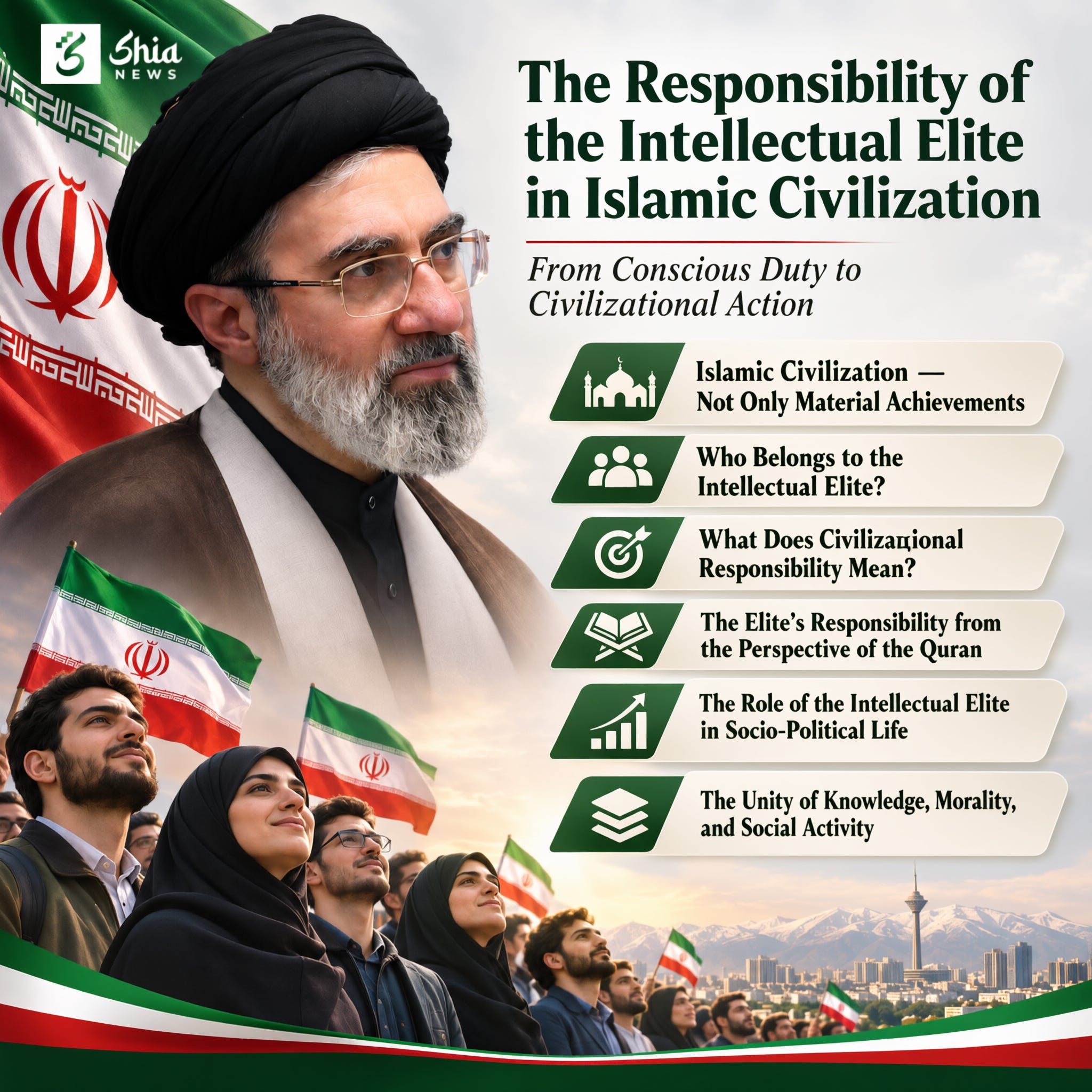
In a newly published analysis, Dr. Mehdi Jabraili Tabrizi — cleric, professor, and researcher of Islamic civilisation — examines the address delivered by the Leader of the Islamic Revolution, Ayatollah Sayyed Ali Khamenei (may Allah preserve him), to students on October 28, 2026, in which he outlined the decisive role of the intellectual elite in building Islamic civilisation.
Addressing the students, the Leader of the Islamic Revolution said:
“Strive to arm yourselves as much as possible with knowledge, faith, spiritual self-improvement, closeness to God, and a deep understanding of the teachings of the Quran and the Ahl al-Bayt (peace be upon them). Work with double the effort, show initiative, and strengthen the power and might of our beloved Iran, so that, through the prayers of our gracious Master of the Age (may Allah hasten his reappearance), all those united by a common goal can move faster and more successfully towards progress and the construction of an Islamic-Iranian civilisation.”
To understand and analyse the path of development the Leader traces for the intellectual elite, Dr. Jabraili Tabrizi identifies several key axes.
1. Islamic civilisation is not only material achievements
Islamic civilisation is not confined to magnificent structures, scientific discoveries, political institutions, or economic frameworks. It is a holistic system of beliefs, values, knowledge, social institutions, and ways of life aimed at upholding human dignity, social justice, reason, spirituality, and the well-being of both the individual and society.
In the formation and development of such a civilisation, the intellectual elite plays an indispensable role. Its representatives do not merely produce new knowledge and ideas; they shape public opinion, contribute to the transformation of social institutions, and set the direction of societal development.
2. Who belongs to the intellectual elite?
In the broadest sense, the intellectual elite comprises individuals and groups who — by virtue of their knowledge, professional skill, analytical ability, creative thinking, experience, or social influence — are capable of exerting a greater impact on society than most other people.
3. What does civilisational responsibility mean?
Civilisational responsibility is the conscious commitment of a person, commensurate with their capabilities, to participate in creating, preserving, and improving a social order in which science, morality, justice, spirituality, independence, and respect for human dignity develop in harmony.
4. The responsibility of the elite from the perspective of the Quran
Although the Holy Quran does not employ the concept of the “elite” in its modern sociological sense, it lays down principles that clearly define the responsibility of those endowed with knowledge, power, and social influence. In the Quranic worldview, knowledge is a trust (amanah) that carries obligation: Allah raises those who possess knowledge in degrees, and binds them to truthfulness, justice, and service to people — enjoining what is right, forbidding what is wrong, and never concealing knowledge out of fear or worldly compromise.
5. The role of the intellectual elite in socio-political life
From the standpoint of political sociology, representatives of the elite are not merely bearers of knowledge. They participate in the formation of social meanings and values, in the distribution of social recognition, in the creation of public opinion, and in establishing the relationship between society and government.
Three main functions can be identified in analysing this role:
Forming political consciousness and setting its direction. Representatives of the elite are able to transform scattered social problems into issues people can understand, explaining their causes, actors, and possible solutions.
Producing social meanings, values, and public opinion. Through these, society interprets its reality, grants recognition, and sets its priorities.
Mediating between society and government. The elite help establish healthy, trust-based relations between the people and the authorities.
6. The unity of knowledge, morality, and social activity
The responsibility of the intellectual elite in Islamic civilisation must be understood through the interconnection of science, morality, justice, and social action.
Thanks to their knowledge, experience, and influence, representatives of the elite are able to identify social problems and solve them. Their responsibility extends far beyond personal achievement, and the Islamic Sharia defines its moral foundations: truth, justice, and service to society.
From duty to action
The Leader’s address is thus both a summons and a roadmap: knowledge crowned with faith, effort doubled into initiative, and personal excellence directed toward collective strength. Under the prayers of the Master of the Age (may Allah hasten his reappearance), the intellectual elite carries the trust of moving society — swiftly and surely — toward progress and the construction of an Islamic-Iranian civilisation.
Based on an analysis by Dr. Mehdi Jabraili Tabrizi, cleric and professor of Islamic civilisation studies, originally published by Shia News.