

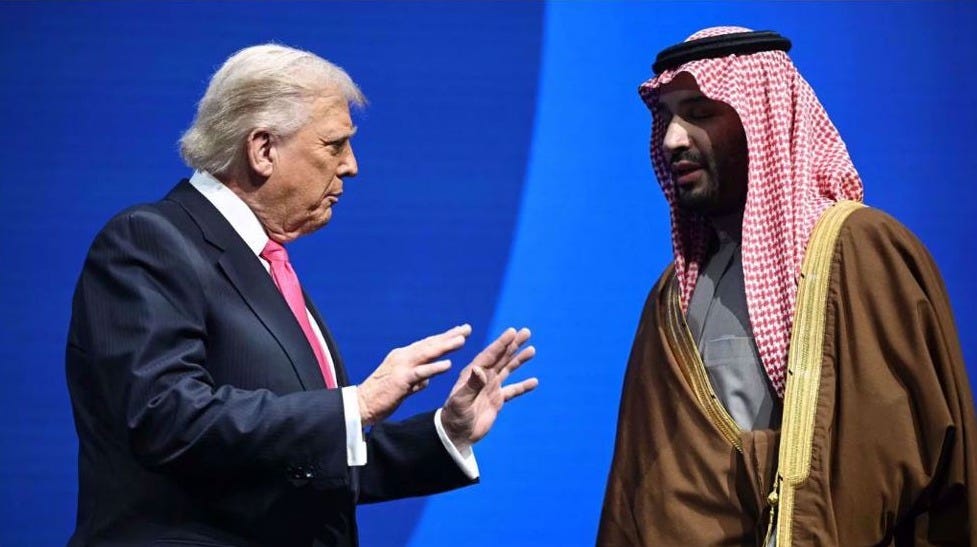
US President Donald Trump has reversed course on the proposed long-term civilian nuclear agreement with Saudi Arabia, restoring recognition of Israel as a condition for the deal after initially advancing the negotiations without tying them to the so-called Abraham Accords.
The shift emerged on Wednesday, days after reports that his administration had approved a 30-year civilian nuclear cooperation agreement with Riyadh and cleared the way for it to be submitted to Congress. The new position reinstates a condition that had reportedly been dropped during negotiations, fundamentally altering the terms on which Saudi Arabia would gain access to American nuclear technology.
Trump confirmed the reversal on Truth Social, writing that the civil nuclear deal — “There will be no enrichment of material!” — pertained only to non-military use of the kind Iran, the UAE and others already have, and would be approved, but was “totally subject to Saudi Arabia joining the very respected and successful Abraham Accords.”
An enrichment promise at odds with the reporting
Trump’s insistence that no enrichment will take place sits uneasily with the terms reported earlier this week, under which a joint US-Saudi study would assess whether domestic enrichment was warranted, with American firms building the facility under a “black box” arrangement if it went ahead.
That question matters because Saudi Arabia has stopped short of committing to the IAEA’s Additional Protocol, which grants the agency broader inspection powers, and has refused the “gold standard” pledge never to enrich or reprocess. US lawmakers from both parties have already voiced concern about the agreement’s safeguards.
The double standard
The episode has renewed scrutiny of Washington’s approach to nuclear matters in West Asia. Israel, its closest regional ally, maintains an undeclared arsenal estimated at around 90 warheads; it is not a party to the Nuclear Non-Proliferation Treaty, has never formally acknowledged its weapons capability, and does not place its facilities under IAEA safeguards.
Iran, by contrast, remains an NPT signatory, has maintained for years that its programme is exclusively peaceful, and has cooperated with the IAEA. US intelligence assessments have repeatedly concluded that Tehran is not pursuing an active nuclear weapons programme — yet Washington continues to cite Iran’s nuclear activities as justification for its pressure and military action against the country.
The result is an arrangement in which access to nuclear technology is offered to one Gulf state as payment for recognising Israel, withheld from another by force, and never demanded of the region’s only nuclear-armed power.
Reference: PressTv